

By Ken Camp
A funeral home contacts a pastor. The family of a deceased person has no church affiliation, and neither did their relative, but they want a minister to conduct their loved one’s memorial service.
The minister agrees, but in meeting with the family, they impose a restriction: “No religious stuff. Don’t talk about Jesus or heaven.”
Increasingly, some families who claim no religious affiliation — or who want to honor the wishes of deceased loved ones who professed no faith — choose secular celebrants to conduct nonreligious memorial events.
“A growing number are disengaged from religious communities, and they are not choosing traditional religious funerals. Instead, they are holding other events for friends and family — perhaps a meal — but it may not have any religious overtones,” said Bill Leonard, the James and Marilyn Dunn Professor of Baptist Studies and professor of church history at Wake Forest University School of Divinity.
Others want a Christian minister and a Christian funeral — but without reference to Christianity.
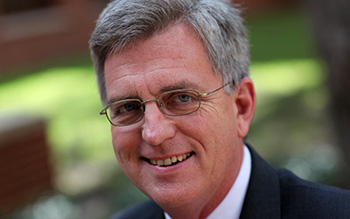 That puts ministers in an impossible situation, said Robert Creech, professor of Christian ministries and director of pastoral ministries at Baylor University’s Truett Theological Seminary.
“I will marry and bury anyone, as long as I can do it in my role as a Christian minister. All I ask is that I be allowed to serve in the role as a Christian minister and to represent Christ there,” said Creech, who served 22 years as pastor of University Baptist Church in Houston.
Remain true to calling
Ministers always should show sensitivity and compassion to grieving families, but they must remain true to their calling and “be the presence of Christ,” said James Heflin, professor of preaching and pastoral ministry at Hardin-Simmons University’s Logsdon Seminary. If a family wants a secular service without any religious reference, they probably should not ask a Christian minister to officiate, he said.
“I will be a minister. I cannot be less than that,” said Heflin, who served as pastor of churches in Texas, Arkansas, Louisiana and Mississippi. “I am not just a token Christian symbol. I must be a real spokesman of Scripture and representative of Christ. I cannot do otherwise and be faithful to who I am.”
If the role of a Christian minister is to represent Christ and lead a Christian funeral, what does that mean?
For Baptist ministers and others in the Free Church tradition, who operate without the benefit of the Book of Common Prayer or other prescribed worship guide, the specific form varies. But certain characteristics make a funeral distinctively Christian.
“Talking about Jesus” makes a funeral Christian — “having a Christian minister address life and death issues from the perspective of Scripture, church and Christ,” Leonard said.
“Sometimes it’s in response to the professed Christian faith of the one who has died ‘in the Lord,’ as the Scripture says. Increasingly, funerals are in response to a family with Christian roots, even though the deceased may have not engaged in Christian practices.”
Biblical perspective
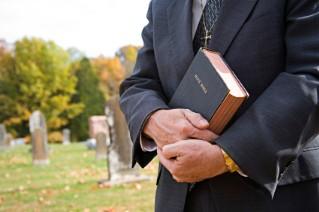 A biblical perspective that focuses on Jesus’ conquest of death, emphasizes the power of resurrection and stresses the promises of God characterize a distinctively Christian funeral, Heflin said.
“A Christian funeral generates hope,” he said.
In some contexts, it also generates fear and guilt, although some ministers question whether preachers who use funerals as platforms for heavy-handed evangelism really are fulfilling their Christian duty.
“In the Texas revivalist tradition, it was to comfort the bereaved and to caution those who never had professed faith in Christ. Some preachers included an invitation to the Christian faith at every funeral. It was not uncommon to speculate on the eternal state of the deceased,” Leonard said, recalling his own experiences growing up in Wise County in rural North Texas.
Such speculation has no place in a Christian funeral, Heflin said.
“Don’t accuse or ascribe someone to hell. The funeral is not the place to put people into shock,” he said.
Balancing remembrances with promises
While a funeral appropriately includes remembrance of a deceased person, the focus of the funeral message should be the promises of God presented in the Bible, Heflin insisted.
“The final word comes from Scripture. Let the Scripture speak for itself, presented in a gentle and compassionate spirit,” he said.
The minister’s role at a funeral is to present God’s message to those whose hearts are broken, Creech said.
“The preached word should bring a message of Christian hope and resurrection. The funeral message is addressed to the family. It’s not a eulogy. It is an opportunity to present the gospel of resurrection and hope to the family and let them know where God is in the midst of their grief and in their lives in the future,” he said.
“When the deceased was a faithful Christian, those are the easiest messages because the message of hope can be illustrated from the person’s life.”
Keep it simple
Funerals appropriately include remembrances of the deceased, but they are best delivered by one family spokesperson — not presented in response to an open invitation for anyone to speak, Creech said.
“It’s a good practice if one family member can be the spokesman for the family in the service. It’s best if that person has written out what he or she wants to say, not shoot from the hip. Then if the person is overcome with emotion, the pastor can continue reading,” he said.
“One unhealthy and unhelpful practice is having open mics, where people are invited to say whatever they want. That invites all kinds of chaos. Some become overly emotional. Some tell inappropriate stories.”
Baptists and other evangelicals are fooling themselves if they insist their funerals are free from ritual, Leonard observed.
“As Baptists, we have acted as if we are not liturgical, but funeral rituals developed. They were often unspoken but expected grief rituals that had to be observed,” he said.
Cultural context matters
Cultural context makes a huge difference, he noted.
“In African-American churches … there is a very clear protocol to follow in the funerals. The ministers, the choir, the deacons and deaconesses all have prescribed roles and special seating,” Leonard said.
Often, African-American funerals are scheduled a full week after a person dies, he noted.
“That came about as a way to honor the deceased and the family, giving distant family plenty of time to get there and to give the church plenty of time to prepare. It’s also a matter of respect for the deceased, to allow a period of mourning according to the proper protocol. The particular process of grieving in the culture is involved in that — the level of intense grieving.”
But even among African-American churches, funeral practices are changing, Leonard noted.
“Churches are in transition about everything — institutions, rituals and identity,” he said.
“It is important for local congregations to be intentional about developing grief rituals to make sure they are as intentionally Christian as possible, recognizing there is a wide spectrum.”
See related story:
Ashes to ashes: In debate over burial or cremation, some things get lost