

Opinions vary about whether the confirmation of President Donald Trump’s Supreme Court nominee Brett Kavanaugh would be good news or bad news for religious liberty, but one of a handful of church-state cases he has weighed during his 12 years on the U.S. Court of Appeals for the District of Columbia Circuit is a footnote in Baptist history.
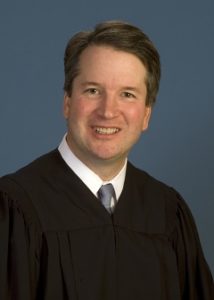
Judge Brett Kavanaugh
In 2008 Kavanaugh sat on a three-judge panel that refused to stop the government from taking DNA from a prisoner who claimed the process would violate his religious beliefs. Now largely forgotten, the inmate at one time played a leading role in the late 20th century theological-political schism remembered – depending on the faction asked – either as the conservative resurgence or fundamentalist takeover of the Southern Baptist Convention.
Before going to prison, Russell Kaemmerling briefly edited the Southern Baptist Journal, a conservative-oriented publication founded in 1973 by a former Home Mission Board staffer, Bill Powell, dedicated to removing so-called liberals from the denominational payroll.
From 1980 until 1985 Kaemmerling edited the Southern Baptist Advocate, an independent magazine used to advance the fundamentalist agenda and criticize leadership of SBC agencies and professors in the denomination’s six seminaries.
After his public work as an investigative reporter, Kaemmerling worked behind the scenes to support the get-out-the vote machine directed by his then brother-in-law Paige Patterson and Houston Judge Paul Pressler, until his election in 2000 as a trustee to the SBC International Mission Board.
Two weeks before his election, Kaemmerling was indicted on 19 counts of criminal conduct including conspiracy to commit fraud, interstate transportation of money taken by fraud and wire fraud. He resigned from the IMB when the news went public and was replaced the following year.
Despite maintaining his innocence, Kaemmerling was convicted in 2001 and sentenced to 120 months at the Federal Correctional Institution in Seagoville, Texas. In 2006 he and four fellow prisoners filed a lawsuit challenging a law passed by Congress that directs the Federal Bureau of Prisons to collect tissue samples from felons for a national database of electronic DNA profiles used by law enforcement and the courts.
Acting without a lawyer, the prisoners claimed “Sincerely held religious beliefs do not allow their consent in providing the government a DNA sample.”
“[The] plaintiffs are evangelical Christians who profess a belief in Jehovah God as sovereign in the universe; accept both the Old and New Testaments of the Christian Bible, in its original autographs, as the inerrant and infallible Word of God; and affirm the fact that God is the creator and sustainer of all creation, including mankind,” the lawsuit said.
They went on to “attest to and affirm the fact that mankind is the crown of God’s creative act; the only aspect of the creation stated to be made in the image of God,” and also to accept the assertion of modern science that DNA “is the building block of life.”
“This incontrovertible fact of science,” the lawsuit said, “makes it rationally, ethically and spiritually antithetical and uncompromisingly repugnant to the strongly held foundational beliefs of each plaintiff to be required to defile God’s temple, as represented by one’s mortal body, filled with the Holy Spirit by involuntarily, or in any matter, submitting to DNA sampling, collection and storage with no clear limitations of use, merely to satisfy the broadly overreaching efforts of secular authorities, politicians and their representatives.”
“This has the potential of non-consensual participation in cloning experiments and stem-cell research, as just two examples each of the plaintiffs find morally repugnant and ethically reprehensible and violative of their core, fundamental and strongly held Christian beliefs,” the lawsuit continued.

Russell Kaemmerling edited two of the important communication vehicles of the Conservative Resurgence within the Southern Baptist Convention (SBC). He edited the Southern Baptist Journal, a publication of the Baptist Faith and Message Fellowship, in 1980 and then edited the Southern Baptist Advocate from 1980–1985. (Archives and Special Collections at Southeastern Baptist Theological Seminary)
The lawsuit appealed further to “undeniable prophetic considerations of Bible-believing Christians.”
“The Bible, speaking prophetically of the events of the end of time, foretells the rise of a world ruler commonly referred to as anti-Christ,” the inmates protested, adding that they “unequivocally believe that forcing them to provide DNA sampling is tantamount to laying the foundation for the rise of the anti-Christ.”
“Though when the anti-Christ does finally make the scene of human history, plaintiffs may all have departed this life, the genetic mapping they are being forced to deposit and yield all control over to an undefined and uncontrollable authority likely would have a detrimental effect on their easily identified descendants,” they said.
“We must obey God rather than man,” the prisoners said, quoting a Bible verse from the New Testament Book of Acts.
Kavanaugh joined an opinion written by another judge upholding a lower court finding that Kaemmerling failed to state a legal claim.
The panel said sincerely held religious convictions do not relieve an individual of the obligation to comply with a “valid and neutral law of general applicability.”
Presuming his religious convictions were sincere, the panel said, Kaemmerling could not state a substantial burden on his religious exercise, because there was no “exercise” to burden.
“The extraction and storage of DNA information are entirely activities of the FBI, in which Kaemmerling plays no role,” the court said. The government’s action “does not call for Kaemmerling to modify his religious behavior in any way — it involves no action or forbearance on his part, nor does it otherwise interfere with any religious act in which he engages.”
“Although the government’s activities with his fluid or tissue sample after the [Bureau of Prisons] takes it may offend Kaemmerling’s religious beliefs, they cannot be said to hamper his religious exercise because they do not ‘pressure [him] to modify his behavior and to violate his beliefs,’” the judges held.
Even if Kaemmerling had alleged a substantial burden on his religious exercise, the court said his complaint would still fail because the DNA database serves a compelling government interest “in accurately and expeditiously solving past and future crimes in order to protect the public and ensure conviction of the guilty and exoneration of the innocent.”
From there, the judges said, “we have no trouble concluding” that applying the law to Kaemmerling was the “least restrictive means” of furthering that interest, satisfying the letter of the Religious Freedom Reformation Act of 1993.
With all that behind him, Kaemmerling, 69, today runs an internet/marketing firm in Bryan, Texas. According to his Facebook page, he got married in 2014.