
Baptist News Global
Sections
  • News
  • Analysis
  • Opinion
  • Curated
  • Podcasts
    • Stuck in the Middle With You ↗
    • Madang with Grace Ji-Sun Kim ↗
    • Highest Power: Church + State ↗
    • Non-Disclosure: The Silenced Stories of Kanakuk Kamps Survivors ↗
    • Change-making Conversations ↗
  • Storytelling
    • Faith & Justice >
      • Charleston: Metanoia with Bill Stanfield
      • Charlotte: QC Family Tree with Greg and Helms Jarrell
      • Little Rock: Judge Wendell Griffen
      • North Carolina: Conetoe
    • Welcoming the Stranger >
      • Lost Boys of Sudan: St. John’s Baptist Charlotte
      • Awakening to Immigrant Justice: Myers Park Baptist Church
      • Hospitality on the corner: Gaston Christian Center
    • Signature Ministries >
      • Jake Hall: Gospel Gothic, Music and Radio
    • Singing Our Faith >
      • Hymns for a Lifetime: Ken Wilson and Knollwood Baptist Church
      • Norfolk Street Choir
    • Resilient Rural America >
      • Alabama: Perry County
      • Texas: Hidalgo County
      • Arkansas Delta
      • Southeast Kentucky
  • More
    • Contact
    • About
    • Donate
    • Associated Baptist Press Foundation
    • Planned Giving
    • Advertising
    • Ministry Jobs
    • Subscribe
    • Submissions and Permissions
Donate Subscribe
Search Search this site

Church factors into American aversion to moving, pastors say

NewsJeff Brumley  |  October 2, 2014

By Jeff Brumley

Evidence that American society is becoming less mobile is backed up by some Baptist pastors who see devotion to church and neighborhood trumping the lure of better jobs — across town or the nation — among many parishioners.

“I think we are definitely in an age of community, where there’s less of a Lone Ranger radical individualism in the spirit of the times than there once was,” said George Mason, the senior pastor at Wilshire Baptist Church in Dallas.

That sounds almost unbelievable in a culture known for its mobility. Even researchers who have tracked U.S. Census data and other surveys have expressed surprise — but it’s true.

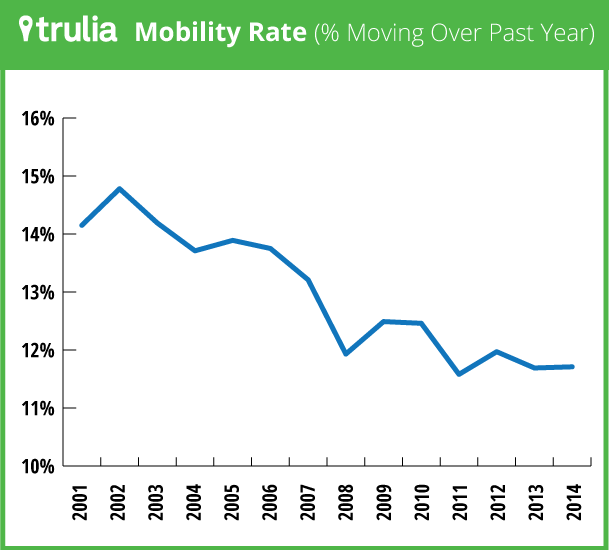
“Americans move less than they used to,” Jed Kolko, chief economist with the real estate data tracking firm Trulia Trends, wrote on Sept. 27.

How much less?  Down to about one in 10.
mobilitygraphic

Kolko said the percentage of Americans moving annually from 20 percent during the 1950s and 1960s to about 14 percent during the housing bubble of the 2000s.

Mobility had dropped to 11.7 percent last year, Keklo wrote.

“Clearly, Americans are not yet back on the move,” he said.

Interestingly, the analysis suggests that’s not just because job opportunities are fewer or houses are difficult to sell. In a 2011 essay, Julie Irwin Zimmerman, a contributing editor to Cincinnati magazine, wrote, “I’ve begun to understand why so many natives stay put. They’re not stuck. They’re content.”

‘Making a life’

That’s also been clear to some pastors — even to those with congregations well off enough to move if and when they desire.

What the ministers have noticed conforms to a CITYLAB report that attachment to neighborhoods and community are major factors convincing some to stay put.

Pastors Mason and Kyle Reese take it one step further in reporting that loyalty to a church or other religious organization is also factoring into many people’s decision against moving — whether across town or the country.

Kyle Reese

“I very much see that happening in the younger adults who are part of our congregation,” said Reese, the pastor at Hendricks Avenue Baptist Church in Jacksonville, Fla.

Relying on Pew and other studies of Americans’ moving habits, the CITYLAB article said “stayers” are often motivated by the proximity of family. But not all of them cited that as a reason.

“Stayers were much more likely than movers to feel a sense of belonging in their community and to view their neighborhood as a good place to raise children,” the article reported.

In fact, one study “found that the happiness derived from seeing friends is worth an additional six figures of income,” CITYLAB reported.

Reese said some HAB members have indicated to him the local community and the church have kept them Jacksonville.

“It’s not just making a career, but making a life,” Reese said.

‘Spiritually driven’

At Wilshire Baptist in Dallas, Mason said he’s been keeping an eye on the moving habits of different age groups in his congregation.

Some of the more senior members tend to move away to be around children and other family, he said. And those in the immediate post-college groups tend to leave for jobs.

“But I think in that vast middle ground, there’s more stability,” Mason said.

GeorgeMasonMug

He added that some in that category do leave, often for better schools and more economical homes because Wilshire is located within the downtown beltway. Many of those who have left often realize too late it’s difficult to find a church that’s the right fit for them.

But Mason said he’s noticed less of that happening as more are staying put.

“More people are choosing to live in smaller houses, to make the decision that the church community is more important to them than the upward mobility of moving to the suburbs,” he said.

The decisions seem increasingly “quality-of-life driven — and spiritually driven, as well,” Mason said.

Share this:

  • Share on X (Opens in new window) X
  • Share on Threads (Opens in new window) Threads
  • Share on Facebook (Opens in new window) Facebook
  • Print (Opens in new window) Print
  • Email a link to a friend (Opens in new window) Email
  • Share on Bluesky (Opens in new window) Bluesky
  • More
  • Share on LinkedIn (Opens in new window) LinkedIn
  • Share on Reddit (Opens in new window) Reddit
  • Share on Tumblr (Opens in new window) Tumblr
  • Share on Pinterest (Opens in new window) Pinterest
  • Share on Telegram (Opens in new window) Telegram
  • Share on WhatsApp (Opens in new window) WhatsApp
Tags:Social Issues
More by
Jeff Brumley
  • Get BNG headlines in your inbox

  • Check out our podcasts


    Stuck in the Middle
    With You


    Madang
    With Grace Ji-Sun Kim


    Highest Power
    Church+State


    Non-Disclosure:
    The Silenced Stories
    of Kanakuk Kamps Survivors


    Change-making
    Conversations


  • Politics • Faith • Resistance: by Greg Garrett

    BNG interview series on the state of faith, politics and resistance in our nation.

    See also Greg’s series on Politics, Faith and Mission


  • Featured

    • Understanding Al Mohler’s case against women

      Analysis

    • BNG podcasts feature each SBC presidential candidate

      Opinion

    • What the church got wrong about queer people

      Opinion

    • Trump admin denies hunger strike at immigrant detention center

      News


    Curated

    • Why Mary, as the Immaculate Conception, became the patron saint of the US in the 1840s

      Why Mary, as the Immaculate Conception, became the patron saint of the US in the 1840s

    • ICE protesters who interrupted Minnesota church service won’t face state charges, prosecutor says

      ICE protesters who interrupted Minnesota church service won’t face state charges, prosecutor says

    • Raising Dementia Awareness, One Black Church at a Time

      Raising Dementia Awareness, One Black Church at a Time

    • Trump Pledges $100M To Cuba, But Only If Faith‑Based Groups Distribute It

      Trump Pledges $100M To Cuba, But Only If Faith‑Based Groups Distribute It

    Conversations that Matter.

    © 2026 Baptist News Global. All rights reserved.

    Want to share a story? We hope you will! Read our republishing, terms of use and privacy policies here.

    • Facebook
    • Twitter
    • Instagram
    • LinkedIn
    • RSS
    • 129