

The pain and suffering Jennifer Wilder witnessed at the U.S.-Mexico border earlier this year shook her to the core.
Jennifer Wilder
Wilder, the pastor of Broadview Baptist Church in Sunderland, Maryland, spent parts of January and February as a volunteer providing pastoral care to, and advocating for, asylum seekers desperate to enter the United States.
It wasn’t an easy job, even with Spanish-speaking skills.
“Each morning, I walked across the border to a plaza in Tijuana, where asylum-seekers arrive with only the clothes in their packs, terrified and without full knowledge of what comes next,” Wilder wrote in an article published by the Alliance of Baptists, with which her congregation is affiliated.
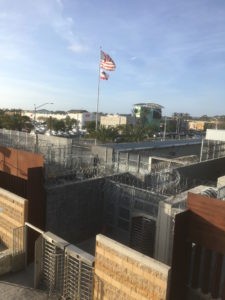
Detention area at the U.S.-Mexican border. (Photo/Jennifer Wilder)
The stories she heard were, at best, unsettling. People were fleeing all manner of violence and terror in their home countries, only to arrive at the border with a nation that has turned a cold-shoulder to displaced persons, including asylum seekers.
The frustration she continues to feel is exacerbated by the general lack of knowledge about what asylum is.
“Seeking asylum when facing persecution and torture is a human right backed by international and national law,” including the 1951 Refugee Convention “ratified by the United States in 1968,” Wilder said in her article.
Since returning from the border, Wilder told Baptist News Global, her ministry to asylum seekers has continued in part by getting the word out about the injustices they face.
In an interview with BNG, she elaborated on the desperate conditions people encounter at the border, and on the realities that drove them there in the first place. Her comments are presented here, edited for clarity.
You begin your article with a legal definition of asylum seekers. Do you find a lot of people are unaware of that?
Yes. I started off with that because of the criminalization of asylum seekers. It’s so easy for myself and others to just buy that perspective. When I first got down to the border and received my training, that’s what stuck out to me: this is a human rights issue.
What is the process for asylum seekers?
People who have been experiencing persecution and terror in their countries of origin travel to the country where they want to seek asylum. At the U.S.-Mexico border, they get in line and they take a number. That process is now months long. On the day their number is called, they are loaded onto iron-clad buses and taken to detention centers in the U.S. and while in detention they ask for a credible-fear interview in which they explain the fear, the terror, the persecution they experienced and why they fled to safety. If they pass that interview, then there is a process by which they are released into the U.S., given they have a financial sponsor in the U.S. who can support them for a year during which they prepare their case for asylum. Then they go in front of an immigration court and appeal for asylum. Should they not get past any of those points, they are sent back to the country from which they fled.
What organizations did you work with at the border?
I joined the Sanctuary Caravan which is connected to the New Sanctuary Coalition based in New York City. Their method is to partner with local organizations doing local work. We worked with Al Otro Lado, a community organization based in Tijuana, and Iglesia Fronteriza, a church which conducts a bi-national worship service in Friendship Park on the U.S.-Mexico border.
How does that work?
The piece that guides these organizations is that locals lead. It’s important that I am taking my guidance from folks who do this year-round. They tell us if you’re coming to save us, go home. But if it’s because your future is bound up in ours, then stay.
How did you come by your Spanish-speaking ability?
In my 20s I spent about three years volunteering and doing this accompanying work in El Salvador and other Central American countries.
What were some of the common sentiments expressed by the people you encountered during your recent work?
In my pastoral accompaniment – that was the term we used – we called the people we were working with friends. That’s to counter the criminalization of asylum seekers. I was being present as they were arriving after a number of years or a number of months on the asylum seekers’ journey. Many were coming from Central America, the Caribbean. Some were from Africa. Some were from different parts of Mexico. The needs they expressed were about the conditions from which they fled, the conditions in which they had to wait there at the border, and their fears about what was to come.
What conditions had they left behind?
They spoke of violence, predominately orchestrated at the hands of governments, gangs and drug cartels. Sometimes, for the women, it was violence at the hands of those who were after their husbands. Perhaps their husbands had been involved in gangs. Part of it was also not being able to report the violence and not having anything that could be done about it. There was even fear around reporting it. I encountered one mother who had been a victim of sex trafficking as a young person and had multiple children she was traveling with. A person in the government had offered to marry her to take care of her and then turned violent toward her. When she tried to get help for that she had a target on her back and on her children’s backs.
What did they express on being stuck at the border?
Shock. Months and years of fleeing for your life and then to get here, with people still looking for you to eliminate you, and here you have to live in Tijuana for months on end. How do you do that? And since there’s so much negative focus on the region, the camps where asylum seekers had been living for months were being shut down when I was there. There’s no place to get your basic necessities.
What is their main fear about the future?
It’s about the great mystery – I’ll use the word enigma – that is the process of asylum. They ask about the process of asking for asylum and beyond. Asylum is a human right backed by the U.S. and international law, but there is no accountability to have that system do its job. As I spoke to families, many would have questions like “will they let me over?” or “how cold will it be?” or “can I keep my documents?” or “will they take my children from me?” or “will I die in detention?” Etc. Etc. There are no rose-colored answers here.
How did you hold it together when witnessing such suffering?
It’s incredibly hard not only for myself, but also for the hundreds of people who do this work daily. Personally, every time I speak about this, I can feel it welling it up. It still deeply affects me emotionally. I have to do things that are restorative to myself. The other thing is that on this trip I really didn’t want to go alone. So, two other sisters in the struggle also made the journey. One is a deacon in formation in the Episcopal church, and the other is a devout Jewish woman. We went together and we continue to meet monthly. We encourage each other. The other piece is to keep telling the stories, even though it’s hard, to keep this alive. The storytelling is a responsibility, and that helps as well.