

By Ken Camp
In a nation where mass incarceration policies have devastated poor and minority communities, people of faith and hope can bring about change, an advocate for criminal justice reform told a Baylor University crowd.
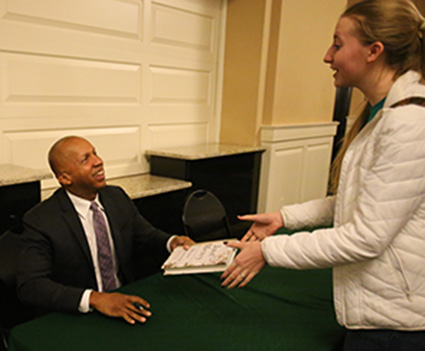
“Injustice prevails where hopelessness persists,” said Bryan Stevenson, founding executive director of the Equal Justice Initiative and author of Just Mercy. He spoke as part of a lecture series sponsored by Baylor’s Academy for Leadership Development.
Potential change agents need to understand the “power of proximity,” Stevenson said. When people see poverty and injustice for themselves, it changes them and they want to change society, he said.
“My career has been defined by my choice to be proximate,” said Stevenson, a Harvard Law School graduate who provides legal representation to death-row inmates and defendants treated unjustly due to their race, socio-economic status or age.
“The United States is a very different place today than it was 40 years ago,” he said, noting the incarcerated population has increased from 300,000 to 2.3 million in that time, and a disproportionate number are poor and racial minorities.
About 10,000 children are housed in adult jails and prisons, where they are at least five times more likely to be sexually assaulted than if they were in juvenile facilities, he noted. More than a dozen states have no minimum age for trying children as adults.
“We have allowed this big gap to exist” that enables privileged Americans to ignore vulnerable children who engage in destructive behavior because they have grown up in an atmosphere of abuse, neglect, violence and crushing poverty, he said.
Insulated from the reality of the daily lives of those children, the privileged find it easy to judge them as adults rather than recognize “all children are children,” he added.
Change the narrative
Meaningful transformation in the United States will require a willingness to “change the narrative,” Stevenson said.
“We’ve got to understand the narrative that sustains the status quo,” he said, adding, “it is a narrative rooted in the politics of fear and anger.”
Unlike other nations with a history of slavery, the United States uniquely created a narrative of racial differentiation and white supremacy to provide moral justification for it, he said.
Because Americans failed to address that underlying narrative, emancipation did not immediately result in justice for African-Americans.
“I don’t think slavery ended. I believe it just evolved,” he said, pointing to decades of what he described as terrorism against African-Americans.
Legacy of terror
Citing the Equal Justice Initiative’s recently released report, “Lynching in America: Confronting the Legacy of Racial Terror,” Stevenson pointed to 20 lynching incidents in the Waco area — where Baylor is located — between the end of Reconstruction and 1950.
Surrounding McLennan County had the second-highest number of African-American lynchings among Texas counties, and it ranked No. 18 nationally, according to the report.
The Equal Justice Initiative wants to “change the visual landscape” by erecting markers acknowledging where lynchings occurred and the slave trade flourished — particularly in states that continue to honor the Confederacy, Stevenson said.
Maintain hope
Potential agents of change must exercise the faith necessary to maintain hope, he insisted.
“You’ve got to find a way to hold onto your hope. … Hope, for me, is believing in things you haven’t seen. … Stay hopeful about what you can do,” he said.
Hope-filled people need to exercise the courage and discipline to seek justice rather than seek comfort, he concluded.
“In order to change the world, you sometimes have to choose to do uncomfortable things. You have to choose to be in places that are uncomfortable,” he said.
Surrounded by brokenness
Working in the criminal justice system means being “surrounded by brokenness,” and that can be disheartening, he acknowledged. But Stevenson found courage and hope to continue when he examined himself and came to the conclusion: “I do what I do because I am broken, too.”
Proximity to hurting people, willingness to confront and change narratives of fear and anger, and tenacious hopefulness in seemingly hopeless and uncomfortable situations can leave a person broken, he said.
“But in that pain, you will understand something important,” he said. “You won’t see that big gulf between you and the broken. You will see yourself in their eyes.”
Change the metric
Stevenson challenged his audience to “change the metric” for measuring success. He recalled an encounter with an elderly man confined to a wheelchair.
“Do you know what you are doing? I’ll tell you what you’re doing. You’re beating the drum for justice,” the man told him.
Drawing Stevenson close, he proceeded to point to scars he collected during civil rights marches in Selma and Birmingham and registering black voters in the South.
“When people look at me, they think I’m just some old man in a wheelchair covered in cuts and bruises and scars. I’m going to tell you something,” he said. “These aren’t my cuts. These aren’t my bruises. These aren’t my scars. These are my medals of honor.”