

 Christians, sadly, are known more for sectarian divides than for unity in the Body of Christ. That is why there are so many ecclesial families, independent churches and fractured relationships scattered across the globe. Issues that should not threaten unity today are given preeminence, and the strain of differences opens seemingly insurmountable crevasses.
Actually, this dismembering of the body started early in Christian history. Could Jews and Gentiles eat together? Could women take their rightful place alongside men in congregational and missional life? Could early missionaries find a shared vision for the spreading of the Gospel? Could class differences be overcome in the people of God the Spirit was forging? Could Christian witness survive without accommodating to Roman imperial rule?
“I grieve how we have countermanded Jesus’ prayer ‘that they might be one.’”
One might argue that the varied expressions of Christian faith actually allow for greater outreach, but I grieve how we have countermanded Jesus’ prayer “that they might be one.”
Some of this splintering arises from geographical distance, language barriers and ethnic identity. Some of the divides are because humans tend to claim more certainty than is possible when dealing with holy matters. When certitude prevails, minority perspectives are usually squelched. Some of the fissures are because we were part of larger historical movements that set the direction for our form of faith. It is hard to understand Western Christianity apart from rationalist impulses set in motion by the Enlightenment. It is hard to understand Eastern Christianity apart from the religious pluralism of its context.
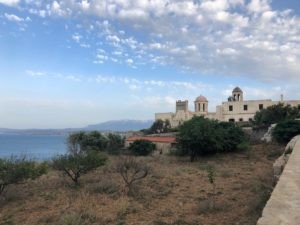
Mother of God Monastery
At the recent Global Forum for Theological Educators at the Orthodox Academy of Crete in Kolymbari, Crete, the largest island of Greece, I encountered an amazing coherence among the representatives of six ecclesial traditions. Gathered were sisters and brothers from Orthodox, Roman Catholic, Mainline Protestant, Evangelical, Pentecostal and Independent Churches (primarily African). We were there to explore the vision and viability of theological learning and formation in our varied contexts.
We worshipped together, studied the Bible, heard stimulating papers, discussed them with tablemates, shared meals and enjoyed the beauty of this ancient setting. It is hard to believe that Paul left Titus behind in Crete without reluctance (Titus 1:5). I did not easily leave, either. Bathed in golden light, this harbor for the church welcomed pilgrims with extravagant hospitality and genuine interest in the narratives of our Christian experience.
In one worship service, I was paired with a priest of the Greek Orthodox tradition, replete with requisite beard. It was fascinating to witness how our language and experience converged. He spoke of the exact day of his conversion; I spoke of the Benedictine vows of stability and conversatio morum that have shaped my life. As the season of Eastertide continues, we proclaimed “Christ is Risen” at each time of worship. Somehow saying it in Greek gave it even more solidity. Christos Anesth, indeed.
The academy is located next door to the Mother of God Monastery, complete with icon museum. The Orthodox tradition venerates icons as a way of seeing the heavenly mysteries and the celebration of beauty as a means of encountering God. Perhaps getting beyond confessional statements and convening with a shared longing for God through these beautiful portals can heal some divides. Sadly, iconoclasts contributed to the shattering of unity through their allegations of idolatry, in large measure misunderstanding the role of these images as a way of proclaiming the narratives of redemption and identifying key human instruments in God’s story of grace.
“It is a grace to receive from the global community, especially as the Christian footprint is re‑centering toward the global South and East.”
What the varied theological educators shared is simply this: commitment to vocation of forming/equipping leaders for the church and trinitarian faith. We also enjoyed singing together. In one of our debriefing sessions, I made the suggestion that we should sing more, and the whole company agreed. At the service of morning prayer, I even got to dust off the conducting skills I learned at Oklahoma Baptist University shortly after the earth cooled. How good and pleasant it is when brothers and sisters dwell in unity – and sing together, which I believe fosters that unity.
In our theological schools, we struggle with common challenges: human migration, financial sustainability, fostering vocations, missional fidelity in changing contexts, educational methodology and varied forms of diaspora. It is good to learn how others respond to these realities and trust God’s providence in sustaining the important pursuit of theological learning for the sake of the church and the world.
During our time together, participants recognized that we are each “learning on the way.” None has arrived, and a sense of being unfinished as individual leaders is helpful as we think about our particular roles in our institutions. We gain strength, also, as we listen to the faithful witness of our colleagues, often serving in treacherous places.
I give thanks for this time of learning. It is a grace to receive from the global community, especially as the Christian footprint is re-centering toward the global South and East. These days (and long before now), those of us in the West and North should be in the posture of receiving.