

By Aaron Weaver
Leaders from the Cooperative Baptist Fellowship, Baptist Joint Committee for Religious Liberty and Southern Baptist Convention joined Tuesday to discuss the importance of religious liberty around the world.
During the event at New Orleans Baptist Theological Seminary, CBF Executive Coordinator Suzii Paynter described her jarring encounter in 1978 with famed atheist Madalyn Murray O’Hair while a public school teacher in Texas.
O’Hair’s adopted granddaughter was in Paynter’s class, and the elder O’Hair showed up on the first day of class and announced that she intended to make problems for the school, vowing to expose the ways in which she believed the rights of her granddaughter were being violated.
Paynter said that her encounter with O’Hair, best known for her lawsuit that led to the Supreme Court’s landmark 1963 ruling outlawing state-sponsored Bible reading in public schools, caused her to take religious liberty more seriously — despite her personal dislike of O’Hair.
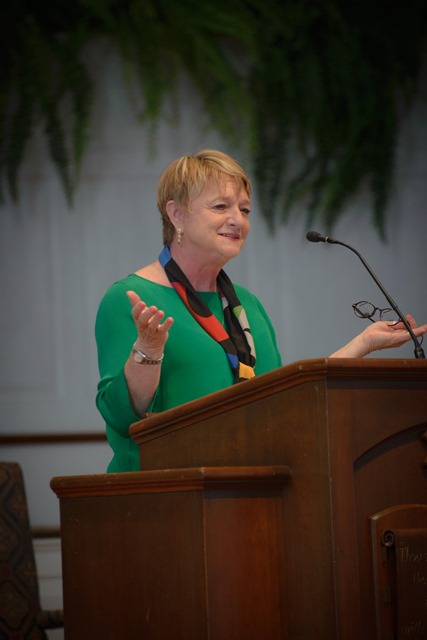
Religious liberty had little usefulness to her prior to the encounter, Paynter said.
“Religious liberty was about the equivalent to an English china teacup in my life — respected as fine and valuable, but rarely thought of or used.”
That teacup came off the shelf for daily use in 1978, she said.
“I had to come face to face with the words ‘freedom of conscience’ and know that that was not just for me,” Paynter said. “It is very hard to defend the most hated woman in America, but religious liberty is not sanitized and nice. …Thankfully, religious liberty is not as fragile as a teacup.”
Paynter said she would like it if her beliefs were embraced everywhere, but she would never request the government to make it so.
“I will not ask for state support — direct or indirect,” she said. “Don’t shame me or try to remove my right to religious expression. My faith expression does not coerce you.”
Turning her presentation to the importance of global religious freedom, Paynter noted that many churches and faith-based organizations have abdicated their support for freedom abroad over the years.
“If there is an area we have relegated to lawyers and experts, it is international religious liberty,” Paynter said, emphasizing CBF’s expanding partnership with the Baptist World Alliance to speak on behalf of global religious freedom in partnership with the worldwide fellowship of Baptists in 121 countries composed of 42 million members.
Focusing on global religious freedom will be a focus of the Fellowship for the foreseeable future, she said.
“It is a great privilege to serve a Lord and savior whose freedom calls for our direct worship and the sacrifice of our lives to his calling to love one another that our joy may be full and, in this case, to be sure of our liberty and freedom in Christ by working toward that goal for all.”
Assessing the religious liberty landscape
BJC executive director Brent Walker offered an assessment of the state of religious freedom in the United States.
Walker applauded the Supreme Court’s 2012 Hosanna-Tabor ruling, which recognized that churches and other religious groups are free to choose their leaders without government interference.
“I’m very optimistic about church autonomy,” he said. “Churches that do not want to solemnize same-sex marriages are not going to have to under this doctrine.”
Walker, also noted that many critics of the Affordable Care Act’s contraceptive mandate fail to mention that churches have been exempt from the provision from its beginning out of a respect for the principle of church autonomy.
Walker stated that recent Supreme Court decisions relating to the First Amendment’s Free Exercise Clause “suggest that we are doing very well.” But in terms of the First Amendment’s Establishment Clause, “we’re doing terribly and losing ground.”
He cited the Supreme Court’s 5-4 Town of Greece decision that affirmed the small New York state town’s practice of beginning its municipal meetings with a sectarian prayer. Walker distinguished the town’s policy with that of prayers that open up sessions of the U.S. Congress.
“The chaplains’ prayer [before the Congress] is for the body of the legislators,” Walker explained. “That’s completely different than in the [Town of] Greece — and at most local city council meetings — where the public is there not to just watch up in the galleries but to participate, to testify before the council…to get a zoning variance or business license.”
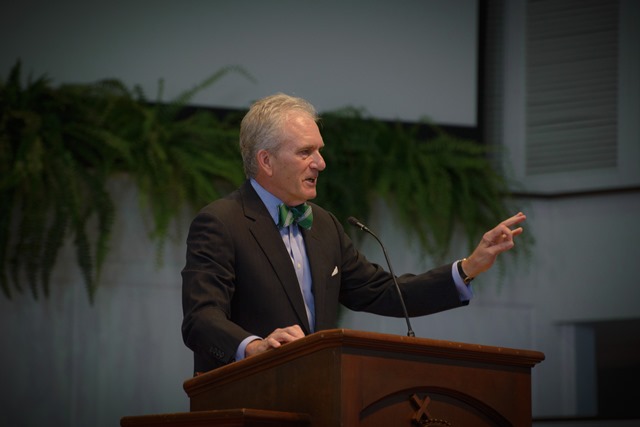
He said “we took the position that — in that context — it was impermissibly coercive to require those folks to undergo or to experience and participate in a state-sponsored religious exercise as a ticket to exercise and perform their civic responsibilities.”
Referencing recent controversial comments from Republican presidential candidate Ben Carson suggesting that a Muslim could not be president because of his or her faith, Walker said he was glad to see the candidate widely criticized by his conservative peers.
“I was heartened to see that several conservative commentators came out and roundly criticized Dr. Carson and his failure to [acknowledge] the importance of the ‘no religious test’ for public office,” Walker said.
While noting that citizens are free to impose their own religious test on candidates, Walker said that he thinks this is a bad idea.
“I think we ought to live by the spirit of ‘no religious test’ as well as the letter of the law and allow that to inform our thinking about our voting patterns and how we engage the government as citizens,” Walker said. “Religion, of course, can be taken into account and our public leaders don’t have to check their religion at the door.”
A people of the jailhouse
Russell Moore, president of the SBC’s Ethics and Religious Liberty Commission, shared a story about his love for the late country singer Johnny Cash and his famous song “Folsom Prison Blues.”
 For Baptists to be faithful to their commitment to religious liberty, they must remember their own prison roots and blues in the jailhouses of England, Virginia and Massachusetts during past centuries, he said.
“For us to be the people who maintain a witness to religious liberty, we have to remember what it means to be people of the jailhouse,” Moore said.
Speaking from Acts 16 and the story of the imprisoned Paul and Silas, Moore said that this New Testament scripture proposes us to give up our rights.
“Paul and Silas stay [in prison]…and they stay because of the gospel and the advance of the mission,” he explained.
“We see in this [text] the personal nature of the gospel. …This is why Baptists have fundamentally been committed to religious liberty. It is not because of some political responsibility we have. It is because how we believe the gospel works,” Moore said.
“One cannot somehow coerce people into believing, one certainly cannot use the power of the state to turn people into Christians because state power or economic power or community pressure can never make people Christians,” Moore added. “It can only make people pretend Christians. The gospel works with the spirit convicting the heart and the heart crying out for deliverance and the heart crying out for mercy.
Moore emphasized that what many conservative Christians in the United States believe to be persecution is not always persecution.
“Everything that offends us is not persecution,” Moore said. “We have not been promised life without offense. Often what we can easily do as Christians is to turn into an interest group that lashes out at any group that offends us or disagrees with us.”
When companies and groups poke fun at Christians that’s not persecution, Moore said.
Again, citing the Acts 16 story of the imprisoned Paul and Silas, Moore stressed that the “gospel propels us at the same time to stand up for our rights.”
“When we simply say, ‘I am not willing to stand up for religious liberty,’ we are actually acting in ways that are profoundly selfish and profoundly anti-gospel. What that means is that we are going to be the people who, like the Apostle Paul and Silas, are contending for every legal protection for those areas the government ought not have supervisory oversight over.”
He pointed to examples of conservative Christians who have opposed efforts to build mosques and Muslim cemeteries in their communities, and said the Christians who do so have “lost confidence in the gospel.”
“What happens when the power of the sword is used to shut down mosques for our Muslim neighbors, all that happens is that our mission field goes underground, and they realize that the Christians around me, hate me and want to see me invisible.”
Other presenters at the Sept. 29 event included William Brackney of Acadia Divinity College in Canada, Mike Edens of New Orleans Baptist Theological Seminary, Kenneth McDowell of Union Baptist & Theological Seminary in New Orleans and Gregory Komendant of Kiev Theological Seminary in the Ukraine.
The event, titled “Baptist Voices on Religious Liberty: Left, Right and Center,” was hosted by New Orleans Baptist Theological Seminary and sponsored by the Institute for Faith and the Public Square and the Baptist Center for Theology and Ministry, as well as endorsed by the Baptist History & Heritage Society, a CBF partner.