

By Ken Camp
In spite of some discouraging trends, the problem of hunger in the United States — particularly among children — can be solved, the leader of the national “No Kid Hungry” movement told participants at the Together at the Table Hunger and Poverty Summit at Baylor University.
“Lives really are at stake — the lives of kids, families and communities,” said Billy Shore, founder and chief executive officer of Share Our Strength.
For the third consecutive year, the number of Americans living below the poverty level hovered around 45 million, Shore said. Children comprise about half of all Supplemental Nutrition Assistance Program recipients, he added.
“For the first time, a majority of public school students — 51 percent — live below the poverty line,” said Shore, who serves on the National Commission on Hunger along with Jeremy Everett, founding director of the Texas Hunger Initiative, the summit’s organizer.
Poverty leaves a lasting developmental impact on children, Shore said. MRI studies reveal children in families with an annual income of $25,000 or less have 6 percent less brain surface than children from families whose annual income is $150,000 or greater.
So, he said, more affluent families not only have bigger homes and cars, but also “their kids have bigger brains,” he said.
‘A solvable problem’
“The good news is that the issue of hunger in America is a solvable problem,” Shore insisted. Unlike some parts of the globe — where famine, war and drought produce hunger — in the United States, the solution rests in connecting children in poverty to available programs and services.
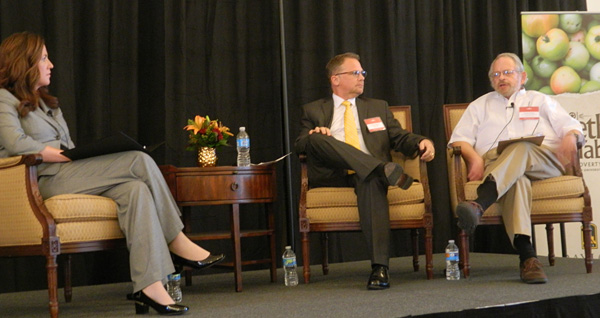
Anti-hunger activists need to focus on “knocking down the barriers” between eligible children and programs that could benefit them, he said.
“Some children and families are not only vulnerable, but also so economically and politically marginalized that they are voiceless,” Shore said. People of faith need to join with other citizens of good will in providing a voice for poor children and their families.
Shore encouraged other hunger-fighting groups to learn from Share Our Strength’s experience in recent years.
He encouraged them to set big goals, seek to increase their organizational capacity to serve, be accountable to supporters by measuring and communicating progress, strive to be the best and focus on connecting hunger issues to matters already part of the national conversation — issues such as health care, education and economic growth.
“We have the opportunity to lift our voices and not let politics, bureaucracy or indifference stand between a hungry child and a healthy meal,” Shore said.
Poverty, food insecurity related
Poverty and food insecurity are closely related but not synonymous, economist Craig Gundersen and public health specialist Joe Sharkey said.
Not all poor people are food insecure, and not all food-insecure households are below the federal poverty level, they noted, during a panel discussion on the economics of hunger and poverty during the hunger and poverty summit.
“Most families in the colonias [along the United States/Mexico border] live at 50 percent or even at 25 percent of the federal poverty level, but they have figured out strategies to cope,” said Sharkey, a professor in the department of health promotion and community health services at Texas A&M University.
But the coping strategies poor people use to maintain some level of food security vary from creating innovative entrepreneurial micro-businesses to giving up other necessities to buy food, he noted.
Gundersen, a professor in the department of agricultural and consumer economics at the University of Illinois, took issue with the notion that income inequality always relates directly to hunger.
Talking about inequality is a ‘distraction’
“Inequality and poverty are dramatically different things,” he said. “Talking about inequality is a distraction. If the goal is to help poor people and reduce food insecurity, talk about poverty. Inequality is not germane to the topic.”
Gundersen also disputed the assertion that raising the minimum wage will help the poor. Raising the minimum wage would benefit a relatively small percentage of poor people, likely would raise the price of food and arguably could have a negative impact on jobs, he asserted.
Instead, he recommended expanding earned income tax credits to benefit people at or near the poverty level. He also lauded SNAP as “the best safety net we have in the United States.”
Sharkey emphasized the importance of developing not just public/private partnerships to address hunger, but public/private/community-based partnerships.
“The priority population has to be part of the solution,” he said.
Pointing to his research in the unincorporated colonias along the Rio Grande, he emphasized solutions must be tailored to the context of the community.