

A common law doctrine long used to determine when disputes within a religious entity require intervention by civil courts took center stage in oral arguments Feb. 6 in the 5th Circuit U.S. Court of Appeals in New Orleans.

Will McRaney
Will McRaney, former executive director of Baptist Convention of Maryland/Delaware, sued the North American Mission Board of the Southern Baptist Convention in 2017 alleging job interference and defamation related to his 2015 termination.
A federal judge said last April said McRaney’s lawsuit could not move forward without deciding whether NAMB had a “valid religious reason” for wanting McRaney removed, something secular courts cannot do under the ecclesiastical abstention doctrine.
The ecclesiastical abstention doctrine is a long-held constitutional principle that prohibits courts from resolving disputes that are inherently religious in nature. In those cases, courts must either abstain or abide by the decisions of church leaders.
Since not every dispute within a church is fundamentally religious, however, courts are not precluded from resolving church disputes involving civil matters such as embezzlement or fraud. The distinction is further clouded in Southern Baptist polity, where lines of authority blur in interactions between autonomous churches, associations and state and national conventions with no ecclesiastical tribunal to correct wrongs committed within the system.
“This case is about whether or not a religious entity can commit acts which if committed by a non-religious entity would result in a tortious lawsuit, and then that religious entity hide behind the ecclesiastical abstention doctrine and say ‘no you can’t touch us because we are a church,’” McRaney’s attorney, William Harvey Barton II, argued on appeal.
NAMB attorney Donna Jacobs said in her argument that is not NAMB’s position, but disputes in the lawsuit “are essentially ecclesiastical” in nature and thereby outside the jurisdiction of secular courts.
Jacobs told a three-judge panel that the Baptist Convention of Maryland/Delaware, McRaney’s direct employer, and the North American Mission board, an agency of the Southern Baptist Convention, are separate and self-governing but “choose to voluntarily cooperate for a particular reason, and that is for mission strategy and specifically to grow the Southern Baptist church through church planting, the creation of new churches.”
“These are, while autonomous within the meaning of the Southern Baptist Convention, entities that are working together for an inherently religious purpose,” she said. “They exist to grow the Southern Baptist faith and to create new Southern Baptist churches.”
Barton said the problem is not so much with McRaney’s termination. “It’s after he was terminated, then the North American Mission Board by their power and influence continued to interfere with his business and his ability to make a living within the confines of the Southern Baptist Convention,” the attorney said.
McRaney, who taught at New Orleans Baptist Theological Seminary before serving as executive director in Maryland/Delaware, was getting along well until NAMB President Kevin Ezell wanted to change their strategic partnership agreement to give NAMB 100 percent control over church planting in the two-state convention.
McRaney refused, saying it would dilute the state body’s autonomy and independence. According to the lawsuit, Ezell responded by threatening to withdraw $1 million a year in funding unless BCM/D leaders fired McRaney.
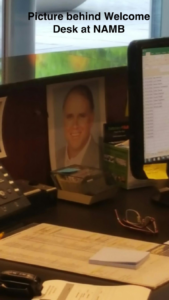 After his departure from Maryland, McRaney says, NAMB pressured Southern Baptist leaders in other states not to invite him to speaking engagements and posted a photo of him at the reception desk at NAMB headquarters suggesting that if he were to show up it would cause a problem.
“This at its very source is a dispute about power and money,” Barton said. “There’s no church doctrine, there’s no church policy. He’s not denying church doctrine. He’s not denying the birth of Christ or the virgin birth or the resurrection, none of that. It’s about who’s going to be in control.”
Jacobs, meanwhile, insisted that “the inherent nature of this dispute is religious.”
“Dr. McRaney had a different view of mission strategy from the direction which the North American Mission Board was going,” she said. “What we have here is a clear dispute about the direction of mission strategy and how that was going to be shaped and these entities’ right to choose who was going to be the public face of those beliefs and who was going to shape that mission strategy moving forward.”
Barton said there was nothing inherently religious about NAMB’s treatment of McRaney.
“When the church acts like the church, then I agree the Constitution is set up to protect the churches from intrusion by civil courts by the government,” he said. “I agree with that a hundred percent, but when the church stops acting like the church, and acts like the world and acts like any other corporate entity that is out there threatening, intimidating, coercing and bribing other individual entities … to interfere with somebody’s ability to make a living in this world, the civil courts need to step in and say that’s not right.”
“All we are asking for here is the right to go in and start looking into the facts of this case,” Barton said. “If it comes back that he was fired because of religious doctrinal differences, we lose.”
“But that’s not what this case is about,” Barton continued. “It’s about power and control by one entity over another. And now it’s by a major entity – you want to add a biblical scenario to it – Goliath versus David, a small individual who is fighting back, who pushed back.”
Previous story:
Southern Baptist polity on trial in lawsuit appeal