

By Brian Kaylor
As diplomats from more than 190 nations spent nearly two weeks in Paris hammering out details of an international agreement to reduce climate change, faith leaders also traveled to the talks in hopes of offering a moral witness.
The COP21 United Nations climate talks concluded Saturday with the signing of an agreement to reduce carbon emissions and address impacts of climate change.
 Samuel Chiu, East Asia project coordinator for A Rocha International (a Christian conservation organization) and multicultural program director for A Rocha Canada, called the final agreement “a good start” but added that more work remains. He believes faith communities remain vital in the process continuing to move forward.
“This is not finished. Now the faith communities will need to continue the works as advocates and motivators of the same moral ground in the implementation in each of the nations, keeping the national governments in check with prophetic voice when the real actions back home are contrary to the agreement.
“And the faith groups have an obligation to engage their constituencies back home, encouraging and initiating climate actions at the local levels.”
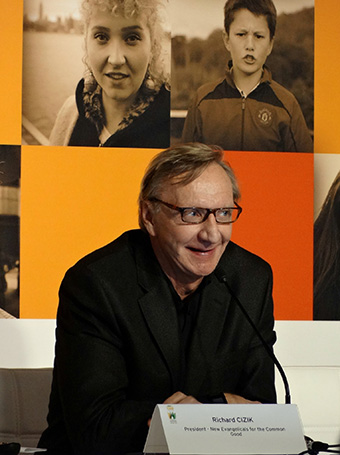
Richard Cizik, president of the New Evangelical Partnership, similarly believes the political community alone will not solve the issue.
“I’m here because I don’t believe governments will do what they should do and must do unless we in the faith community make it impossible for them not to,” he said. “That’s really the bottom line. I wouldn’t come here if I didn’t think that.”
Cizik and Chiu joined hundreds of Christians from multiple denominations and countries in Paris. A couple of clergy participated in the talks as members of their delegations — like Bishop Efraim Tendero, secretary-general of the World Evangelical Alliance, who served on the team from the Philippines. However, numerous other faith advocates like Chiu attended to press national delegations and report home to congregants.
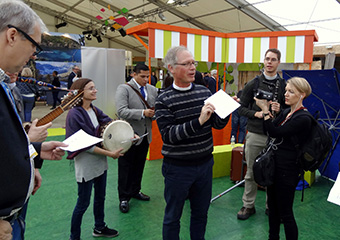 “There is a large ‘army’ of officially registered observers from the major international bodies of churches and Christian organizations who had the direct access to their respective national representatives, having the chances to discuss with them, showing concerns, giving encouragements, and equally important, praying for those negotiators and the process as a whole,” Chiu said. “And the faith community presence is not merely being there, but also constantly relaying news and messages, on top of the normal channels of news agencies, to their church communities at home, which is also essential too.”
Liya Rechtman, manager of the Coalition on the Environment and Jewish Life, said “the faith community played a critical role in the negotiations, one distinct from the role of traditional environmental groups.” She noted how Jewish and other faith traditions provide moral teachings relevant to “the issue of climate change from the perspective of justice, protecting not just our earth and natural resources, but also poor and vulnerable communities most impacted by climate change.”
She particularly sees the importance of interfaith cooperation in the work for climate justice.
“None of the faith community work would have come to fruition without interfaith collaboration. While the Jewish community cares deeply about climate justice, we must join with our Christian, Muslim and other interfaith counterparts to do effective advocacy and ensure that our position is heard. I think the interfaith community’s cooperation serves as a positive paradigm for international cooperation. I traveled to Paris with my Muslim counterpart from Green Muslims to exemplify the power of interfaith collaboration.”
The final agreement reached on Saturday marks the first time almost every nation agreed to reduce carbon emissions and work to stop climate change. It commits countries to cap warming at 2 degrees Celsius (the Earth has already experienced a 1 degree increase), and sets a goal of finding a way of stopping warming at 1.5 degrees. The agreement also expressed a goal of eliminating greenhouse emissions and established funding mechanisms to assist developing countries in energy transition and adapting to climate change.
Chiu noted positive and negative aspects of the final agreement. He praised it as “the first ever agreement applicable to all nations, unlike the Kyoto Protocol which only applied to ‘developed nations.’”
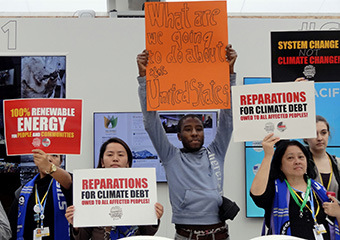 He also noted it includes some legally binding sections and sets the goal that “greenhouse gas emissions of all sources should be reduced to zero in the second half of this century.” He praised the various “financial arrangements and implications for assisting the poor nations” as they seek to reduce their carbon emissions and deal with a changing climate.
Chiu, however, expressed his wish that the 1.5 degree level had been set as “a solid objective” and not merely “an aim down the road.” He pointed out the evaluation process will not start until 2023, instead of in 2018 as some countries pushed. Additionally, he noted the final draft removed some language dealing with “the concerns of the aboriginal people groups” that earlier drafts included.
Rechtman called the agreement “a much needed step in the right direction” but added it “is only the beginning of combatting climate change.” She remains pleased that a couple of key moral items survived as various drafts of the agreement changed.
She said “faith advocacy has focused on ‘loss and damage’ mechanisms and adaptation finance, both issues that were included in the final agreement.” The “loss and damage” section deals with how to help communities whose homeland will be irreversibly damaged by climate change, such as low-lying Pacific Island nations. The adaption finance section deals with providing financial assistance to vulnerable nations as they deal with a changing climate.
“The final agreement is ambitious in theory and could result in under 2 degrees Celsius increase in global temperature,” she said. “However, U.S. negotiators could have done more on ‘loss and damage’ than what we wound up with. They made the minimum calls necessary to lead on those issues. The faith community is gearing to engage in advocacy over the next few years to ensure that the U.S. stays true to their emission reduction and financial obligations.”