

In the United Kingdom, the coronavirus lockdown “has made every follower of Jesus a leader, every house a house church, and every street a parish,” according to a consultant who works with thousands of churches across denominational lines.

Matt Bird
Matt Bird lives in London and is founder and CEO of Cinnamon Network International. This all-denominations ministry works in eight countries, beginning with 3,000 congregations in the UK and 1,000 churches in Australia, then spreading out to South Africa, Denmark, the Netherlands and beyond. Bird is an entrepreneur and former pastor who has a passion for helping churches learn how to engage their communities in Christian ministry and mission.
To illustrate his new motto brought on by the pandemic, he explained that his own family is engaging in daily Scripture reading and prayer as though they were a parish church. “My family have never prayed together and read the Bible together so much as we are now. We’re having to lead our families as mini-churches.”
That sense of mission extends right out the front door of their home, too, he said. “My wife and I wrote a letter to everyone in our street and said the next few weeks and months are quite uncertain. Wouldn’t it be great if we could look out for each other? Would you like to be part of a community support group?”
More than 60 of 100 houses in the neighborhood replied. Bird formed a WhatsApp group for easy communication. “Was it church organized? I’m not sure. But was it organized for Christian ministry? Yes.”
He’s collecting stories like this from all over Europe. And now he’s been invited to consult with the British government’s task force on reopening places of worship. That has brought him in contact with government officials and church leaders across Great Britain.
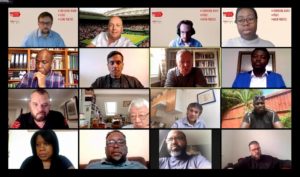
Screenshot of a recent online gathering of church leaders across Great Britain to discuss ministry amid the global pandemic.
One of his observations is that whatever the government says churches can now do by way of gathering, most congregations are waiting an additional four to six weeks before doing those things.
“There’s a natural cautiousness, but also a desire to protect vulnerable people,” he explained.
Most churches across Great Britain closed their doors back in March after the Church of England set that pattern. But churches large and small have not stopped being the church, he added.
“The research says that over a third of churches in the UK have provided some kind of digital prerecorded experience on a Sunday,” he reported “But 45% have done something live. We’ve had lots of innovation. One vicar set up a microphone on his car and drove through the neighborhood. Another church in a rural community with low Internet connectivity couldn’t do Internet church so they did telephone church, like a conference call. There’s a church in Denmark that hired a car park and did drive-in church. They put up a stage. You can only wind down the left-hand window of the car so as to ensure social distancing.”
And then there’s the UK pastor who took a second job as a pizza delivery guy. “His church ordered a lot more pizzas so they could have a visit from the pastor,” Bird said. “And he donated all his tips to the local food shelter.”
“We’re having to lead our families as mini churches.”
The silver lining to the dark cloud of the pandemic is that church innovation and participation both are thriving, he said. “A majority of churches in the UK have gone online. COVID-19 has been the biggest change program ever inflicted on the church in our lifetime. It has propelled the majority of the church to go digital. We’re also seeing churches becoming a lot less Sunday-centric and lot less platform-centric and a lot less leader-centric.”
And in a counter-intuitive way, churches’ small-group ministries are booming, Bird said. Whether done in outdoor settings with social distancing or via digital platforms, more people than ever are signing up for small groups through churches.
He cited the experience of one church in the north of England. “Before lockdown they had 50% of the church participating in small groups. During lockdown, 95% of this congregation are meeting in small groups weekly.”
“We need to be asking: What is God saying? What is God doing?”
From his 30,000-foot vantage point, this illustrates one of the big trends of the moment he hopes will endure beyond the pandemic: A movement from big gatherings to small groups.
“We need to be asking: What is God saying? What is God doing? What prophetically is going on? I think this has the potential to turn the church into a major missionary movement, a movement where there are fewer large gatherings and more small gatherings. And that will mean we need to train more leaders.”
Across the UK, churches are moving beyond the question of how to make Sunday services happen to considering how to make community service happen, Bird continued. “It has caused many churches to be more involved in their communities. It’s the best of times and the worst of times. We regret the loss of life, yes. And at the same time, the church is engaging more people online and in acts of service. That is certainly the tone and the feel of the church.
“Whilst the church is not able to meet physically, we have a lot more time to love our neighbors.”
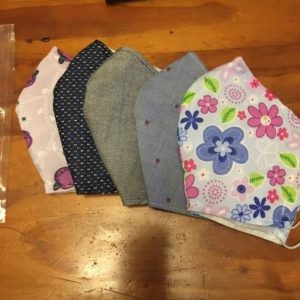
Cinnamon Network International shares a pattern for face masks with churches across the UK, and church members are making the masks to give away to care providers.
In South Africa, a Cinnamon Network church started making face masks for care workers. “One church made over 5,000 face masks,” he said. “We simply share the pattern for these, and other churches are making face masks. And businesses as they reopen are buying them.”
He reported a “massive uptick in food provision” by churches. “We’ve seen this across Europe as well, that churches running food banks are inundated.” And more churches are offering food ministries.
“The other thing is churches are simply listening to people in their communities,” Bird added. “Lots of churches have been reaching out to their communities offering a listening ear. They’re saying, ‘We’re here if you need someone to talk to.’ And lots of that is being done on the telephone.
“We’re seeing the use of radical new ideas like writing notes on paper and using the telephone.”
Meanwhile, worship attendance across the UK is perhaps the greatest it has been in years, he said. “There’s some research here that 25% of the population have listened to a religious service online during lockdown. Given that 6% of people would normally attend church on a Sunday, churches are reporting that they have more people listening online now than they could fit into their buildings.”
On the issue of when and how to reopen church buildings in the UK, Bird’s concern is that the needs of all churches are taken into consideration, not just the needs of the larger churches.
“Cinnamon Network International was commissioned by one of the members of the government task force to ensure that the voices and views of independent churches are heard by the government. It is imperative that the loud voices and voices with privilege don’t drown out the smaller voices,” he said, explaining that more of the “establishment churches” are middle class, and more of the independent churches represent the working classes and the poor. “These groups have a higher incidence of preventable chronic diseases, and a lot more people in these churches are more vulnerable to the virus.”
“It would be pretty monochrome if we said, ‘Don’t come if you’re old, don’t come if you’re young, don’t come if you’ve got an underlying health condition.”
When churches reopen their doors, they need to be able to accommodate a diverse group of congregants, Bird said. “It would be pretty monochrome if we said, ‘Don’t come if you’re old, don’t come if you’re young, don’t come if you’ve got an underlying health condition.”
As is true in the States, the most difficult question about gathering in person for worship is what to do about singing, he noted. “The jury is out, and that is a very tender issue for churches of all traditions. Singing is such a central part of what we do.”
However, even this could change the nature of Christian worship for good, he believes. “In the name of worshiping God, have we made an idol of singing? I hope our work is worship. I hope our prayers are worship. Potentially this could be good for the church because it’s causing us to question some of our sacred cows.”
His own prediction is that churches in the UK will be fortunate to resume in-person gatherings by Christmas. “But I don’t think it’s going to happen for the majority until after Christmas.
“I think in the future, there’s great possibility,” he concluded. “But I also fear that some church leaders are waiting for things to go back to normal, and they might be waiting a long time.”