

By Jeff Brumley
They say an army travels on its stomach. According to the proponents of “creation care,” the same can be said of the church.
As they observe World Food Day today, those activists are reporting a dawning awareness among mainstream Baptists and other Christians that agriculture, the environment and theology are — or should be — connected.
Progress is even being seen in the Bible Belt as global climate and domestic food scarcity are becoming ministry topics, thanks in part to the passion of Millennials for such issues.

“We activists are more realistic,” said Richard Cizik, president of the New Evangelical Partnership for the Common Good and a long-time advocate for creation care. “We know that among young evangelicals, and among new evangelicals, there is a clear commitment to address … the interconnectedness between food, poverty and climate.”
Cizik had a chance to make that case today at the Wake Forest University School of Divinity, where he was the World Food Day guest speaker. His visit was sponsored by the school’s Food, Faith and Religious Leadership Initiative and by Wake’s Center for Energy, Environment and Sustainability. It was also with support from the Good Steward Campaign.
All of that says a lot about how far concern for the environment has come in Baptist and other Christian circles in the South, said Fred Bahnson, director of the initiative and the author of the new book Soil and Sacrament: A Spiritual Memoir of Food and Faith.

“The fact that a divinity school has a food and faith initiative is evidence that the church is starting to shift toward more healthy eating,” Bahnson said.
While the faith-and-food movement isn’t attracting the most strident conservatives, it has outgrown perceptions that it’s limited to those engaged in radical ministry. “Some of our biggest connections are with the African-American community,” he said. “They know this is not a hippie movement.”
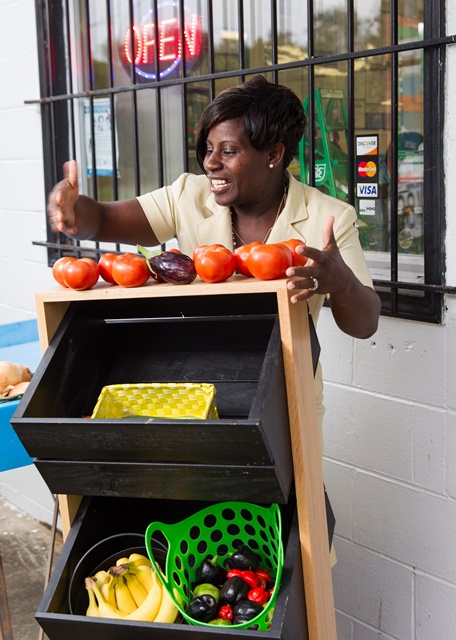
Instead, they see their own communities have become what the U.S. Dept. of Agriculture terms “food deserts” where there is a lack of access to healthy food. Some are responding with community gardens, while others are planning food trucks to sell locally grown food in impoverished, inner-city neighborhoods.
These things are happening in rural and urban settings and in churches of varying sizes, races and denominations, Bahnson said. Issues of food usually get people thinking about agricultural methods and ultimately about climate change, he added. But diet is the starting point. “Food is a wonderful leveler,” he added. “Everybody eats, so everybody has a stake in the conversation.”
‘Being incarnational’
The Cooperative Baptist Fellowship jumped into the conversation this month with a blog series titled “At the Table: Baptists Fight Hunger.” The writings featured long-standing and newer hunger and feeding initiatives by CBF churches and partners around the nation. The goal was to inspire others to take action to care for the 49 million Americans — including 16 million children — who are considered “food insecure” by the federal government.
The Fellowship is seeing a growing receptivity to the message that food is a matter of faith, said CBF Networks Manager Devita Parnell. “I think folks are feeling more connected and they want to know where their food is coming from and who’s growing it and what they’re eating,” she said.

But it’s more than that for Fellowship Baptists, she said. “If you’re thinking where your food is coming from and you’re eating more locally and investing in community … you’re living into this calling of being incarnational,” Parnell said.
That lifestyle also brings challenges. If Christians are more prayerful about what they’re eating, they must do the same when feeding others, she said. That could mean reinventing food drives and re-imagining what is served during after-school programs and other church ministries.
“Food pantries have been around a long time,” she said. “We have to think harder and more theologically about what we do and why we do it.”
At her own church — First Baptist in Decatur, Ga. — that process is underway due in large part to the passion of younger members. “I don’t think it’s just with the young folks, but I think the young folks are leading us into this and forcing us to care about it,” Parnell said.
It’s likely to be younger Christians to go the furthest with such spirituality, said Jessica Church, 22, field director of the Good Steward Campaign. “I know a lot of people in my age range … who are learning about agricultural systems in the United States and changing the way they eat,” said Church, an Episcopalian.
It’s also why she wanted to work with the campaign, which is an ecumenical Christian organization that seeks to engage college students on a broad array of faith-and-creation topics, including values-based investing, global climate change and food scarcity.
Institutions are noticing that young Christians have an interest in these issues. More universities and divinity schools are introducing programs and certificates that intentionally blend poverty, food and ministry, she said. Churches need to do the same, she added.
“Christians have to think about the way people around the world have to feed themselves and to be in solidarity with those people,” she said.
That kind of passion is making it easier for creation care advocates in Washington, D.C., and elsewhere, Cizik said. “The young people are not afraid to speak out,” Cizik said.