

By Jeff Brumley
Imagine spending three or four years in a place, building new ministries or reviving existing ones, only to be replaced by someone else and sent somewhere else to do it all over again.
It’s a feeling that Air Force Maj. Chuck Seligman and other American military chaplains identify with all too well — and all too painfully.
“You look back at all the work you’ve done and it’s gone, or its changed,” Seligman told Baptist News Global last week in Dallas, where he attended the Cooperative Baptist Fellowship’s General Assembly. “You have to be OK with that and be at peace with that but letting go of that — it’s very hard.”
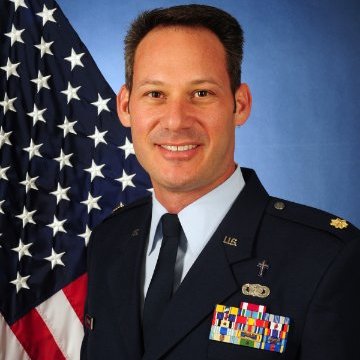
Seligman just let go of a position he considered a dream job at the U.S. military’s combined medical facilities in San Antonio, Texas. Just this week he arrived in Germany for a three-year assignment at Ramstein Air Base.
Moving around a lot — even when highly successful at a given duty station — is typical for all military personnel and even for chaplains, said Gerald Hutchinson, manager of CBF’s chaplaincy and pastoral care services program.
It’s also common for chaplains, as they rise in rank, to see less time doing the things they are considered best at, like pastoral care, Hutchinson said. In fact, some of them chafe at administrative responsibilities and collateral duties, tasks considered altogether outside the scope of chaplaincy, he said.
“I saw it as a way to develop additional relationships with people” and it’s through relationships that chaplains provide spiritual care, said Hutchinson, who is a retired Navy chaplain.
“As you progress in rank, you are no longer a direct care provider and your duty is supervisory,” he said. “But you’re still ensuring ministry is provided to our airmen, sailors, soldiers and marines.”
Seligman, who initially enlisted as a member in the Air National Guard security forces, shared his experience providing ministry and pastoral care in the military environment as an Air Force chaplain.
When and why did you decide to transition from security forces to chaplaincy?
In 1995 … I was sitting on the security desk when the chaplain came on base …. And he didn’t bring his keys with him to the headquarters building, so he called the security desk. I responded and … I got to talking to him. He found out I was starting at Southwestern [Baptist Theological Seminary] and we started talking about my direction in life and I that felt called to ministry.…
So that encounter helped focus your call into ministry?
The two loves of my life are serving in the military and serving God in whatever form of ministry he was calling me into. They had an opening for a chaplain’s assistant…. So I switched career fields.
How did you transition to becoming an officer and a chaplain?
In the process of all this there was a conference of chaplains here in Dallas. That’s where I learned about the chaplain candidate program and I eventually switched over to becoming a chaplain candidate. It was obvious that this was God’s direction in my life. It felt like … the more doors I would step through, the more doors that would open in front of me.
How did you get connected with CBF?
I was [with the Southern Baptist Convention] then… and the SBC helped to really form and shape me as a minister in doctrine and polity. But as the SBC kept moving more and more to the right, I stayed more in the middle of the road…. I finally said I just need to change. That was in 2005.
Your post in San Antonio: what kind of facility was it, and what was your title there?
I was the deputy wing chaplain of the 59th Medical Wing, which is the Air Force part of the San Antonio Military Medical Center, which merged all Air Force and Army medicine together…. Anyone who’s medical in the military comes out of San Antonio. Those medical centers are universities. They are teaching hospitals.
So, how hard was it leaving your post in San Antonio?
It was emotional. At the end of my last day there … I was thinking this will be the last steps I take in this building, I hadn’t really thought about it until then.
Why was it such an important assignment to you?
Last August or September we got a new commander for the wing, a two-star general…. He had me going around throughout the wing finding out … what happened to our ethics committee function? The wing used to have a world-renowned, world class ethics committee.… But since then the ethics function had been downsized. So he had me do this big survey and I put together this paper for him.
What happened with that report?
He said, “Chaplain, I want you to develop an ethics function. And I don’t know what that looks like. I want you to research what it needs to look like and what it needs to be. And I want you to implement it and find a director.” … Every month I gave him updates … and he gave me complete authority to act. It was amazing.
Is it scary having that kind of leeway?
It’s very scary. He said, “You act on my behalf.” I kept him up to date because I wanted to make sure we were going in the direction he wanted us to go in.
Where is that project now that you’ve left the wing?
In the last three months of my time at the 59th Medical Wing we actually opened up the office of ethics and professionalism, which is a new, staffed office with a director.
Did you get any opportunities for pastoral care while at the wing?
Oh, yes. I got to help people going through some traumatic things. My last year at the 59th I was helping people with PTSD, with sexual assault trauma, trauma from their childhood, physical abuse and sexual abuse. We worked with the mental health department to provide holistic care …. I would provide the spiritual care.
Did leaving that hospital setting make it hard to leave, too?
Yes. I was part of people’s live in such a deep and unique way. I watched people take their last breath in that building …. Chaplains are in ministry to be in the place where people need us most and be the presence of God. It’s a ministry of presence. What it means to be human is constantly exposed right in front of you.
What will you be doing in Germany?
I’m going to … the 86th Air Wing in Ramstein, Germany, to be one of the branch chiefs …. I am going to be taking over the Resources and Requirements branch. It involves handling contracts, managing the chapel tithes and offerings fund and all of our appropriated funds. Also the grants.
That sounds mostly administrative. Will that still feel like chaplaincy for you?
As I move up in rank more and more of my duties will be administrative. But, for me, that’s getting into where my gifts are. My primary spiritual gift is administration. In fact, the duties I do administratively I do to take care of my fellow chaplains, my peers, the people that I supervise. As a major I take care of captains — taking care of them, mentoring them, pouring myself into their lives, helping them to become better chaplains to grow in their own careers. That is a ministry.
And eventually you will have to give that up, too. Is all that moving around a positive or negative?
It’s both. I love moving around because it gives you such a wide variety to do so many things …. and you never get bored. But you can’t stay there. You are told that you will move and you will go do something else. So you really can’t allow yourself to cling to that stuff and you go in knowing that.