

For anyone who hasn’t gotten the message yet: American congregations are changing rapidly, and the old ways aren’t working. The kind of rapid adaptation seen in response to the coronavirus pandemic illustrates the kind of new thinking that will be needed to sustain congregational life.
Every congregational consultant in America could give this speech by heart, but now there is a massive pile of data to back up such claims.
In what is billed as the largest national survey of congregations ever conducted in the U.S., the 2020 Faith Communities Today survey includes results from more than 15,000 responding congregations. The study was a collaborative effort by 21 denominations and religious groups that developed a 180-question survey. Questions typically were answered by a primary leader in a congregation.
The survey was customized for individual faith groups and was translated into Cantonese, French, Korean, Portuguese and Spanish. Responses came from 80 religious denominations and traditions.
 “Traditional ways of worshipping, ministering to spiritual needs and organizing the business of congregations are no longer working adequately for many faith communities,” the survey’s summary states. “Many factors external to the religious community contribute to this reality, so the situation cannot entirely be attributed to a lack of congregational imagination and adaptation. However, the research is clear that this moment demands real change if a large percentage of faith communities are to survive the next 20 years with spiritual vibrancy and ministry effectiveness.”
The survey also is notable because it spans two decades and includes a snapshot of U.S. congregations before and after the coronavirus pandemic.
“Much that is written about the possible effects of the pandemic on society suggest an intensification of pre-existing trends,” the summary explains. “If that will be the case for the congregational reality, then this moment clearly demands institutional change. Religious leaders must be willing to champion innovative visions and novel ways forward just as they did over the past 18 months.
“These adaptive leaders will have to sustain this energy and passion to communicate the necessity for change, strategize a path forward, rally congregational will, and then mediate conflictual moments that will inevitably arise.”
An executive summary lists these key findings:
- Prior to the pandemic, many congregations were small and getting smaller, while the largest ones keep getting more attendees.
- Despite continued declines in attendance overall, about a third of congregations are growing and are spiritually vital.
- The size of larger congregations offers some distinct advantages, but each size grouping has certain strengths.
- Congregations have continued to diversify, particularly in terms of racial composition.
- A dramatically increased utilization of technology can be seen over the past two decades, even pre-pandemic.
- The fiscal health of congregations has remained mostly steady.
- There is a clear and demonstrated path toward vitality with characteristics that are consistent across the two decades of survey efforts.
Before the pandemic, America’s faith communities were “growing older, smaller, and, by many measures, less vital,” the report says. “At the same time, there are hopeful signs of resilience and considerable vitality within a solid percentage of faith communities.”
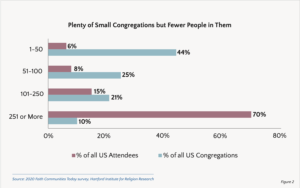 One of the notable disparities previously reported in other surveys but laid bare by the new data is this: Among the 350,000 to 375,000 U.S. congregations of all faith traditions, only 10% have more than 250 people in attendance. Yet 70% of Americans who attend religious services attend a congregation of more than 250 people. The vast majority of American congregations are small, but the vast majority of Americans attend congregations that are not small.
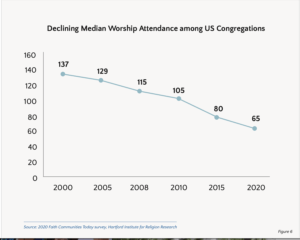
The number of small congregations in America is growing as once-larger congregations shrink, the study found. “In the past 20 years of this survey effort, the median attendance size has decreased by over 50%, from 137 to 65 attendees in weekly worship services. This means that at least 175,000 faith communities (half of 350,000) in the country have 65 or fewer people in attendance on any given weekend.”
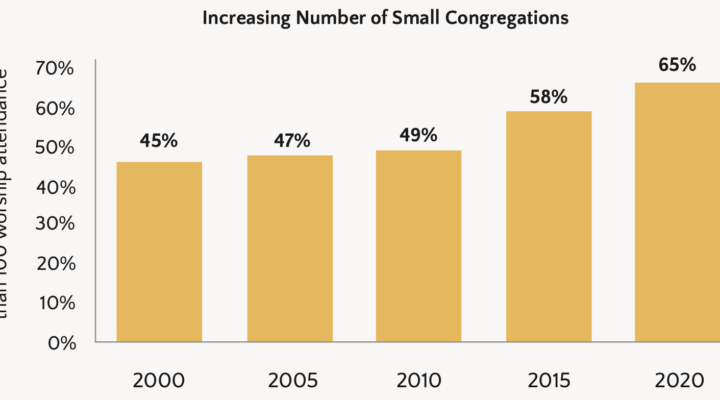
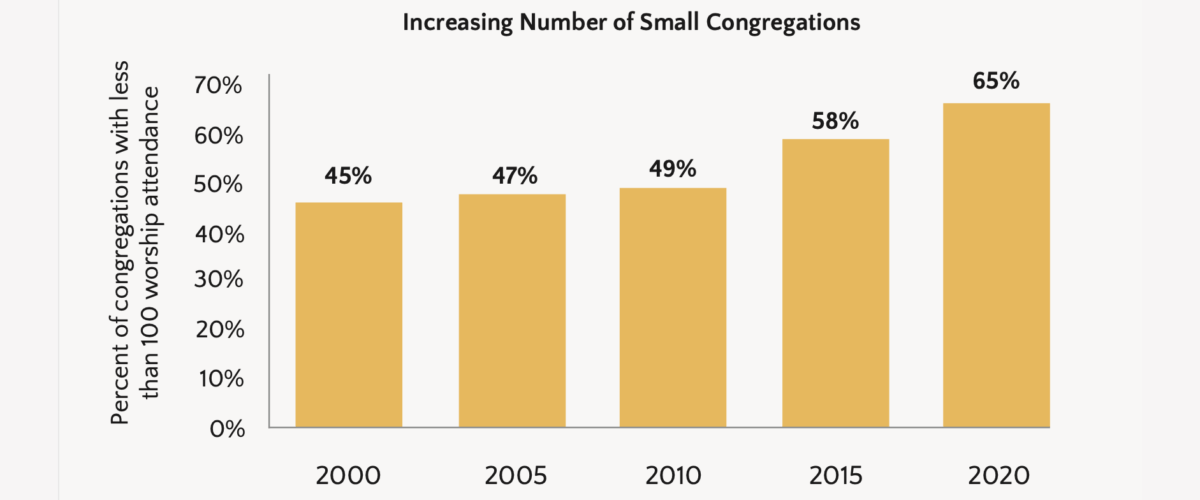
Further, the percentage of faith communities under 100 in attendance “changed only incrementally in the first decade of this century, but there has been a rapid change in the past 10 years,” the report adds. “It remains to be seen what the post-pandemic situation will bring, but early indications suggest this trend will likely accelerate over the next decade.”
Between 2015 and 2020, half of all congregations declined in attendance by at least 7%. “This is the first time in 20 years of surveys that the median five-year rate of change in attendance was negative,” the report says. “In addition, only 34% of faith communities grew by 5% or more between 2015 and 2020 — which means an average of 1% growth per year.”
The survey paints this portrait of the “average” U.S. congregation in 2020:
- 65 people in weekly attendance.
- 200-person seating capacity in worship space.
- 88% offer programs for children.
- 70% offer music programs.
- 17% host other congregations in their facilities.
- 30% offer a social justice ministry.
- 77% describe their worship as “thought-provoking.”
- 77% describe their worship as “informal.”
- $120,000 is the average annual income.
- 58% of that money now comes from online giving.
- 57 years old is the average age of the pastor or leader.
- 10% of congregational leaders are women.
- 53% of pastors or leaders are the only clergy serving their congregations.
This is the first in a series of articles about the Faith Communities Today survey results.
Related articles:
America 2021: Got church and steeple but where are the people? | Opinion by Bill Leonard
They’re not coming back | Opinion by Rob Dyer