

Editor’s note: This story will be updated as new information becomes available.
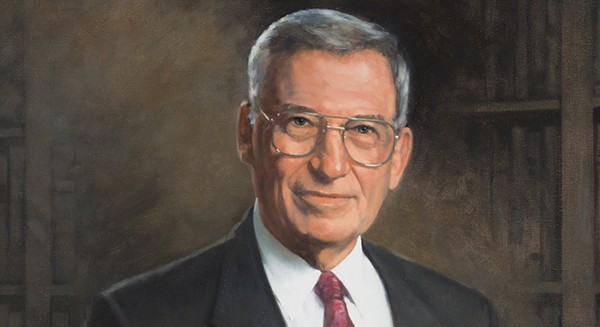
Randall Lolley, one of the pivotal figures in the late-20th-century schism in the Southern Baptist Convention and an early leader in the Cooperative Baptist Fellowship, died March 21 in Raleigh, N.C. He was 90 years old.
For 14 years (1974-1988), he served as president of Southeastern Baptist Theological Seminary in Wake Forest, N.C., one of the six SBC seminaries. That seminary, and Lolley as its leader, came under intense attack by leaders of the so-called “conservative resurgence” that began in the SBC in 1979. The school was deemed as the most “liberal” of all the SBC seminaries and thus a target for immediate reform.
He became the first SBC institution or agency head to resign in protest of the coming conservative juggernaut that in time replaced four of the other five seminary presidents, as well as the heads of most every other SBC agency. Some were fired, some were retired, and some left of their own volition, having seen the handwriting on the wall.
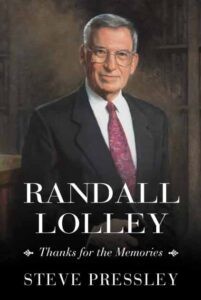 Lolley took a principled stand, according to his biographer, Steve Pressley of Jamestown, N.C., who wrote Randall Lolley, Thanks for the Memories, published in 2021 by Smyth & Helwys.
While serving as pastor of First Baptist Church of Winston-Salem, N.C. (1962-1974), he was named the third president of Southeastern Seminary and embarked upon a period of growth and academic rigor for the young school — young compared to most of its sister SBC seminaries.
“Impressive student body, faculty and program growth marked Lolley’s 14 years at the seminary,” according to Pressley. “But emerging division within the Southern Baptist denomination produced conflicting visions regarding the purpose and character of its theological schools. By early 1987, the trustee balance at Southeastern tilted in favor of doctrinal conservatives. Lolley, who had led the school from a moderate/conservative posture, resigned his presidency, citing what he regarded as an ‘alien vision’ that threatened the academic integrity of his institution.”
Immediately after gaining a majority on the trustee board — which happened through a series of SBC presidential elections that influenced the nature of trustee appointments — SBC conservatives adopted policies that ensured only biblical inerrantists would be hired to the faculty in the future.
In announcing his resignation to the student body, Lolley said: “I cannot fan into a flame a vision which I believe to be contradictory to the dream which formed Southeastern in 1951 and which has nourished me as a student and alumnus of the school.”
In a news conference after submitting his resignation to trustees, Lolley said: “The vision I see for Southeastern Seminary is not seen by many of the men (trustees) with me. They do not see my vision. Perhaps I do not see theirs. Our differences, as I have told them, range from matters of governance, through theology and ecclesiology, to management and leadership styles. We really cannot stand ambiguity and hostility any longer. We must have clarification and healing.”
Lolley then outlined “four lingering questions which I must ask Southern Baptist people”:
- “Southern Baptists, do you recognize the differences between free-conscience, conservative trustees, and trustees with pre-packaged agendas who must report out the results of their agendas?” He cited as an example newly elected trustees who “have never set foot on this campus before becoming trustees. Yet, upon arrival, they seem to know precisely what needs to be done and who needs to be disciplined. They have a pre-packaged agenda upon election.”
- “Southern Baptists, do you recognize the differences between ‘biblical inerrancy’ as a legitimate personal conviction or a theological construction and this concept as a code word for power politics?”
- “Southern Baptists, do you recognize the differences between our 1963 confessional statement and our 1987 functional creed?” The ultimate issue, he said, “is freedom — free consciences, free churches and free classrooms.”
- “Southern Baptists, how long will you go on calling young girls and women to faith in Jesus Christ; telling them to dedicate all their gifts to his lordship, recommending them from your churches to your seminaries, and then upon their graduation refusing to consider them as your pastors and teachers?” He added: “Do you realize that you are requiring us in your seminaries to be duplicitous with your daughters? And that you may be muscling in on the calling of God?”
Along with Lolley, the seminary’s dean of the faculty, Morris Ashcraft, also resigned, as did four other administrators. Lolley was succeeded at Southeastern by Lewis Drummond, who became a transitional president for four years, followed by the 11-year presidency of Paige Patterson, who had been co-architect of the conservative movement that drove Lolley from office.
In 1988, Lolley was given the Alexander Meiklejohn Award for Academic Freedom by the American Association of University Professors, in recognition for his attempt to defend academic freedom and the faculty at Southeastern.
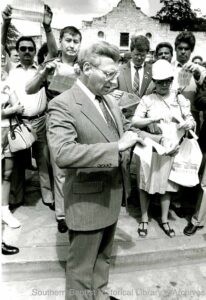
In June 1988, Randall Lolley leads a group of about 200 Southern Baptists in ripping up paper copies of a resolution adopted by SBC messengers that week on the priesthood of the believer, a resolution Lolley called “heretical.”
In the summer of 1988, as the SBC annual meeting was going on in San Antonio, Texas, Lolley led about 200 Southern Baptists in a protest in front of the Alamo. The group opposed a resolution on the doctrine of the priesthood of the believer adopted by convention messengers that week.
Lolley said the cherished Baptist principle “has now been destroyed by the majority opinion of the people registered as messengers at this convention.” He called the resolution “the most non-Baptistic, most heretical, from the Baptist free church point of view, statement ever made.”
He called the resolution “heresy” and wrote the word across a printed copy of the resolution. Others in the crowd did the same and joined him in ripping the papers as a sign of protest.
Lolley was 56 years old at the time of his resignation from the seminary. He returned to the pastorate, serving First Baptist Church of Raleigh (1989-1990) and then First Baptist Church of Greensboro, N.C. (1990-1996). Later, in retirement, he served as interim pastor of a dozen Baptist churches, from Washington, D.C., to Jacksonville, Fla.
He was an early and prominent supporter of the Cooperative Baptist Fellowship, a group of non-fundamentalists that in 1991 broke away from the SBC because of the schism. In 1999, he was elected to a one-year term as CBF moderator, the highest elected office.
Lolley was born June 2, 1931, in Troy, Ala., and spent his formative years in the small town of Samson, near the Florida state line. He graduated as valedictorian of Samson High School and then entered Howard College in Birmingham (now Samford University) in 1949. There he earned a bachelor of arts degree in 1952, with majors in psychology and history.
Two years later he enrolled at Southeastern Seminary, which had only been in operation three years. There he earned the bachelor of divinity degree (now known as the master of divinity) and the master of theology degree. He later earned a doctor of theology degree from Southwestern Baptist Theological Seminary, an SBC school in Fort Worth, Texas.
He married Clara Lou Jacobs in 1952, and they bore two daughters, Charlotte Murphy and Pamela Frey.