

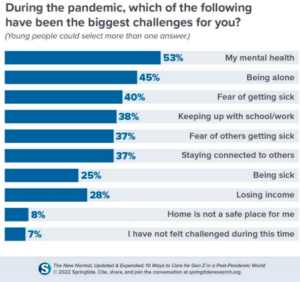
Mental health is the biggest challenge presently facing young people in the United States, but some say faith has helped them cope with their continuing emotional struggles, according to a survey designed to help churches minister to Generation Z in a post-pandemic environment.
The research by Springtide Research Institute found that Americans 13 to 25 years of age struggled with mental health issues during the COVID-19 pandemic.
The report summarizes: “Alarmingly, nearly half of young people (48%) told Springtide they are moderately or extremely depressed, while about a quarter of young people say they are ‘extremely’ stressed (25%), extremely anxious (26%), or extremely lonely (21%). Sadly, most young people (61%) agree, ‘The adults in my life don’t truly know how much I am struggling with my mental health.’”
 But among those who identify as persons of faith, most (67%) said religion and spirituality positively influenced their mental health during the pandemic and beyond, Springtide reported.
“Young people who tell us they are ‘very religious’ are more likely to tell us they are flourishing in their mental health. The inversion is true for those who say they are ‘not religious at all’ — they are more likely to say they are not flourishing in their mental health.”
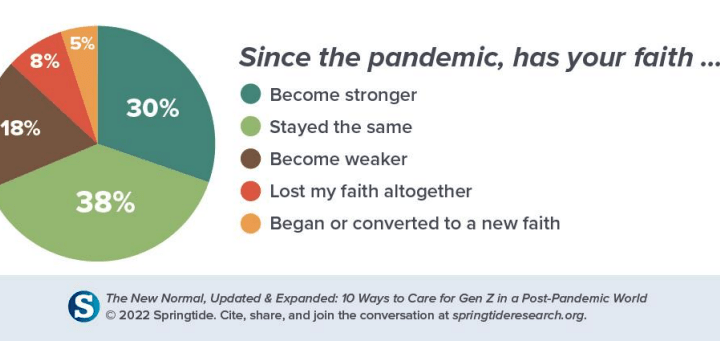
The survey also reported that the depth of faith has been on the upswing among young people during the past two years. “More young people told Springtide that their faith became stronger during the pandemic (30%) than weaker (18%) or lost completely (8%). This includes a growing number who agree, ‘I know a higher power exists and I have no doubts about it,’ from 22% in 2021 to 28% in 2022, and a higher percentage who say they feel ‘highly connected’ to a higher power, from 13% in 2021 to 18% in 2022.”
“This rise in religiosity, however, hasn’t translated into a desire to attend church or other worship for most surveyed.”
This rise in religiosity, however, hasn’t translated into a desire to attend church or other worship for most surveyed, Springtide found. “The percentage of those attending religious services daily, weekly, monthly or less than monthly each dropped 1% to 5% from 2021 to 2022, while the percentage who say they never attend religious services rose somewhat dramatically from 30% in 2021 to 44% in 2022.”
The picture isn’t any brighter for online religious gatherings. “The most popular pandemic practice that young people want to keep is cooking more (39%), while virtual religious gatherings are what young people least want to keep (6%). Only 10% of young people say they found joy in virtual religious gatherings during the pandemic.”
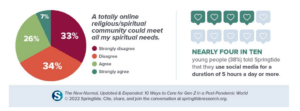 In sum, 31% of respondents agreed or strongly agreed that a “totally online religious/spiritual community could meet all my spiritual needs,” while 67% either disagreed or strongly disagreed with the statement.
Also declining is the esteem with which Gen Z members hold clergy, given that only 10% said a faith leader contacted them personally during 2020, according to the survey.
“Now, 26% of young people say their relationship with faith leaders has become weaker during the pandemic —though nearly the same percentage, 23% of young people, say these relationships have become stronger.”
In probing Gen Z respondents on their views of how different institutions handled the pandemic, Springtide found only 17% reported an increase in trust of government while 47% said they trust government less or not at all.
Schools didn’t fare much better, with 34% reporting they trust those institutions less compared to 28% who trust them more.
“By comparison, more young people say they now trust their place of worship more or completely because of their handling of the pandemic (37%) than trust them less or not at all (20%). Seven in 10 young people (71%) agree that their place of worship did a good job keeping them safe from the coronavirus, compared to 63% who agreed about their school and 43% who agreed about the government doing a good job keeping them safe.”
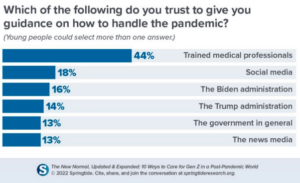 When asked which institutions they trusted to give reliable guidance in handling the coronavirus outbreak, 13% said “the government in general,” 14% credited the Trump administration and 16% cited the Biden administration.
“Low marks were also given to social media (18%) and the news media (13%). Overwhelmingly, young people said they trusted trained medical professionals (44%) to give them guidance on how to handle the pandemic.”
While 34% of young people reported feeling hope for 2022, 33% said they feel uncertain and 42% said they feel isolated or trapped. As a result, many in the Gen Z cohort are in need of help and likely open to it.
“Trusted adults and leaders have an opportunity to rebuild trust and help stoke the small glimmer of hope young people admit having at this point,” Springtide’s report said. “Young people don’t necessarily feel they have been safely guided through this unprecedented time.”
Related articles:
42% of young people say no one outside their home has reached out to them during pandemic
Young adults say churches key in battle against climate change, poverty and corruption
Most young people are unsettled in the new year but few plan to turn to the church for help