

The Baptist youth group I grew up in was made up of three main categories of students — the Christian school students, the homeschool students, and the public school students. Every fall, as we gathered on Wednesday evenings just a few short hours after our various schools let out, we were keenly aware of the differences that set us apart from one another and the dangers the others posed.
Our Baptist church had a small Christian school, which made up the vast majority of the kids in our youth group. We were taught the traditional evangelical theology that the universe was 6,000 years old, that Adam and Eve’s eating of the forbidden fruit caused pain and death to enter into the world, that everyone deserved to burn in hell forever, that Jesus took the punishment on the Cross for those who would trust in him alone by faith alone, that everyone stands at the crossroads of heaven or hell, and that the rapture was going to happen at any moment to seal our fate for eternity.
Rick Pidcock
The homeschoolers believed the same fundamental theology, but also believed the Christian school kids weren’t quite as protected as they were due to some worldly kids who were allowed to attend our school. And this was one form of protection our various Christian contexts felt was necessary to educate us about.
Worldliness
“Worldliness” was defined as a lack of separation from the values and desires of “the world,” which was a vague term meaning “the unsaved,” or non-evangelicals. It was based on 1 John 2:15-17, which states: “Love not the world, neither the things that are in the world. If any man loves the world, the love of the Father is not in him. For all that is in the world, the lust of the flesh, and the lust of the eyes, and the pride of life, is not of the Father, but is of the world. And the world passeth away, and the lust thereof: but he that doeth the will of God abideth forever.”
“The holy trinity of threats to the Christian school kids and the homeschool kids in our youth group were considered to be sex, the Democrats and evolution.”
The holy trinity of threats to the Christian school kids and the homeschool kids in our youth group were considered to be sex, the Democrats and evolution.
“Whatever you do, don’t ever touch yourself,” was preached constantly. “What if the rapture happens when you’re in the middle of masturbating?” We couldn’t listen to rock music because it would remind us of sex. We couldn’t watch PG movies because they would remind us of sex. Our girls had to wear culottes over their wind suit pants in the cold or the shape of their legs might remind us about sex.
“Bill Clinton is going to declare himself president forever and hand the United States over to the United Nations to usher in the Tribulation,” was threatened constantly. Decades before QAnon conspiracy theories became the talking points of mainstream Republican politicians, they were forming in the womb of Christian schools.
“From goo to you by way of the zoo” was mocked constantly. Evolution was seen as a silly way for scientists to reject the authority of God in order to justify living however they wanted to, which of course we all knew meant having a lot of sex.
“Public schools were considered the breeding grounds of worldliness.”
So public schools were considered the breeding grounds of worldliness. It was there that liberals would have unmonitored access to teach our young kids about sex while handing out condoms and talking to them about the existence of gay people.
It was there that the federal government had taken away local control in order to indoctrinate our young kids in the values of big government and to rewrite our nation’s history from the glorious Christian roots it supposedly had to embrace multi-culturalism.
It was there that evolution would be taught as fact, while young earth creationism and the existence of God would be mocked. And where God’s existence is mocked, God’s authority is dismissed, which we all knew would lead to having a lot of sex.
So in our Baptist church youth group, the public school kids either were a danger to our souls and therefore were our mission field, or they were superhero missionaries resisting sex, the Democrats and evolution at every turn.
Choosing to homeschool as conservative evangelicals
Our oldest child began kindergarten two months after Donald Trump announced his candidacy for president. At the time, I was a volunteer worship leader who made a living as a janitor and floor cleaner. With very little money, there was simply no way we could have afforded to send him to a Christian school.
Our reasons for homeschooling were simple, although the voices around us in our conservative evangelical world were a complex echo of our fundamentalist past.
Having spent a year in a Sovereign Grace church at the beginning of the decade where everyone homeschooled, we felt somewhat out of place because they were happy that five years later we would want to homeschool, and yet we did not share their same theological and spiritual reasons for doing so.
Family and friends who were more fundamentalist than we were at the time were beside themselves that we would even consider sending our kids to public schools given all the danger they believed public schools posed for our children’s souls. And while we shared many of their theological and political convictions, we did not share their views about separation from the world for protection purposes.
I had one conversation with a fundamentalist family member who admitted it might be OK to send your child to public school at some point. But the debate was over whether it would be better to send them during elementary school when they wouldn’t face temptation about sex, the Democrats or evolution, or during high school when they might be vulnerable to temptation but could be a witness for the gospel.
Ultimately for us, the decision to homeschool our children was about flexibility with my work schedule and about providing a more efficient and flexible educational atmosphere. With our kids being homeschooled, I still could see them despite working on the weekends and we could go on a trip during the school year. And we also felt our kids wouldn’t waste so much time. “If a school has our kids for eight hours every day, they shouldn’t need another two hours of homework to educate them,” I often would say.
Homeschooling in community
For the first four years of homeschooling, our decision was playing out pretty well. While I focused on trying to string together enough cleaning jobs to pay our bills, Ruth Ellen stayed home with the kids and homeschooled the older two.
We also had the support of a co-op, which was a group of about 75 kids that met once a week at a local Southern Baptist church to learn together. The group was very conservative theologically and politically. And that was reflected in the curriculum.
“The more our theology and politics evolved, the more disconnected we felt.”
But during our four years in that group, we began deconstructing our theology, which eventually would include shifting our convictions about sex, the Democrats and evolution, among other things. The more our theology and politics evolved, the more disconnected we felt. After leaving our conservative evangelical church, it made no sense to continue in a conservative evangelical homeschool co-op.
From there, we moved to a co-op that was Christian, but that at least allowed modern science to be taught. And while it was a much better fit, it ended up closing during the pandemic. With so many families moving on to more conservative Christian co-ops that continued to meet during the pandemic, it simply could not stay open.
Our theology continued to open up during this time. So for 2021, we joined a secular, inclusive homeschool co-op that met at a more progressive Baptist church in town.
Personal changes and challenges
During November 2019, my work vehicle broke down and we had no financial way of paying for repairs or for buying a new vehicle. We were quite literally at the end of the road. Something needed to change. With Ruth Ellen having a degree in interior design and years of experience doing freelance design work, we decided to have her pursue a career in interior design and have me close my cleaning business to be at home with the kids.
One month later, she began her new full-time job. Three months after that, the COVID-19 pandemic began. And the following fall, she was diagnosed with stage three breast cancer.
I was suddenly responsible for taking care of the kids, cleaning the house and caring for a wife who was undergoing chemo, surgery and radiation. With four kids needing to be homeschooled and a fifth child a year away from kindergarten, there was simply no way I could do all of that on my own. It took everything within me just to survive the day, let alone stay up late at night to work on my writing.
“Two months ago, I had to admit I needed help.”
The house cleaning, my writing and our kids’ education all were falling behind. So two months ago, I had to admit I needed help.
Enrolling in public school
We decided last month to do the previously unthinkable: enroll two of our children in the local public school. We figured if it goes well, we could enroll the other three next year.
It felt vulnerable to open ourselves up to a world that had so long been demonized to us. However, the vulnerability now wasn’t felt due to spiritual fears of the next world, but due to opening up about our own desires, inadequacies and shortcomings in this one.
I had to admit that I wasn’t doing a good enough job teaching my kids, that they needed something and even someone beyond what I could provide for them.
But so far, the decision to enroll them in public school has been exactly what we needed. Our school has reading coaches who can meet with our children individually to help bring them up to speed. They have counselors who can help them process their concerns if need be. And their teachers have been taking a relational approach to learning that has brought a calm to our souls.
Being reminded of who I am
When we walked into our children’s classrooms for our first parent-teacher conference, we wanted to see if our kids were doing well. But when I saw what was on the walls, I didn’t need to know what their grades were. I knew they were being well cared for.
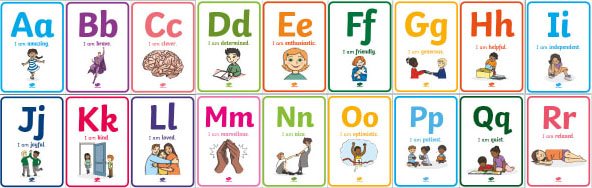
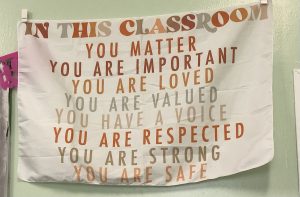 On one wall hung a banner that read, “In this classroom, you matter, you are loved, you are valued, you have a voice, you are respected, you are safe, you are strong, you are worth it.” On another wall was displayed the letters of the alphabet, with each letter having an identity affirming statement like, “I am Needed, I am Optimistic, I am Patient, I am Qualified, I am Resilient, I am Strong.”
As encouraging as that was to read, it reminded me as well of the messaging I received growing up in the educational environments I was raised in. When I was a kid, I was told I was a sinner, I deserved to get hit, I deserved to die, I deserved to go to hell, I killed God.
While I’m thankful for the expertise and care my children are receiving, there is also a sadness I’m reminded of when I think about the identity statements that were formed in me when I was their age.
“In my children’s classroom, I also am loved, valued, needed, resilient and strong.”
Yet, with the sadness it reminded me of, it also spoke deep words of comfort to my own identity. Those signs were there for me as well. In my children’s classroom, I also am loved, valued, needed, resilient and strong.
Resurfacing trauma
Ironically, the concerns we have now are not the presence of sex, the Democrats and evolution, but are about the influence of conservative evangelicals.
Because we live in such a conservative community in the South, how many of the teachers are conservative evangelicals who see themselves as missionaries of a sort to our kids?
When we came to the school’s open house prior to school starting, one of the first things we saw was a table set up for the Good News Club, featuring adults reaching out to our kids with puppets and candy to try to get them to sign up for their after-school program. It felt like a scene from the old Chitty Chitty Bang Bang movie when the “child catcher” was luring kids with candy.
When we first began homeschooling as conservative evangelicals, I was a daily listener to the conservative talk show host Dennis Prager. A video surfaced last week of Prager complaining about a sign at a school that read, “The world is better because you are in it.” Prager replied in disgust: “What a stupid message. Plus it’s not true. What has any fifth grader done to have made the world better because he or she is in it?”
The view of children my kids are hearing at public school today is the opposite of how many of us were raised. That’s precisely my point.
Abolish, control or work together
When I was a political conservative, I agreed with the idea that we should abolish the Department of Education. After all, I was convinced the Democrats were using it to push sex, their political agenda of critical theory, and evolution on children.
It seems now that many conservatives are realizing the opportunity that centralized educational power structures can have and are shifting more toward controlling it rather than abolishing it.
But what if education wasn’t an opportunity for a power grab to control others? What if it were a community of communities working together to educate our kids?
“When my wife has cancer and my child needs to learn how to read, I don’t really feel like competing with and controlling others.”
When my wife has cancer and my child needs to learn how to read, I don’t really feel like competing with and controlling others. And I’m not trying to be lazy or mooch off others. But I need to be vulnerable and ask for some help. And I don’t see why we can’t be there to work on these things together.
Ironically, I don’t see how that’s not conservative. While it might be labeled “progressive” in our two-team political system, isn’t caring for kids conserving our community?
Educating by faith
By no means have we completed our journey. Like all of life, this is an evolving story. Our desires for flexibility and efficiency in education have not disappeared.
We are not looking at the world through public-school-colored glasses, as if public schools are the bastion of perfection for all time. We are aware to some degree of its shortcomings and have many questions about what impact the growth of evangelical power, white male supremacy and Christian nationalism in the United States and in our community may have on our local public schools.
But isn’t this what walking by faith looks like — not to know all the dangers you face, and yet to step into the uncertainties toward one another while trusting that you are loved and are going to be OK together?
While many of our conservative Christian school and homeschool friends may see us as having abandoned the walk of faith by questioning or rejecting their theology and by embracing those we were taught to fear, isn’t the journey we’re taking into communal love and learning despite our fears the very definition of walking by faith?
And if the presence of God really is in and among us, then why would we categorize and control rather than commune and cooperate toward such a common cause as the conserving of humanity through the education of our children?
Rick Pidcock is a 2004 graduate of Bob Jones University, with a Bachelor of Arts degree in Bible. He’s a freelance writer based in South Carolina and a former Clemons Fellow with BNG. He recently completed a Master of Arts degree in worship from Northern Seminary. He is a stay-at-home father of five children and produces music under the artist name Provoke Wonder. Follow his blog at www.rickpidcock.com.
Related articles:
Racism and the evolution of Protestant support for private education | Analysis by Andrew Gardner
Why is there a boom in enrollment at private Christian schools? Here’s one critical theory: Race | Analysis by Rodney Kennedy
Anatomy of a lie: How one private school amplified a persistent COVID vaccine myth