

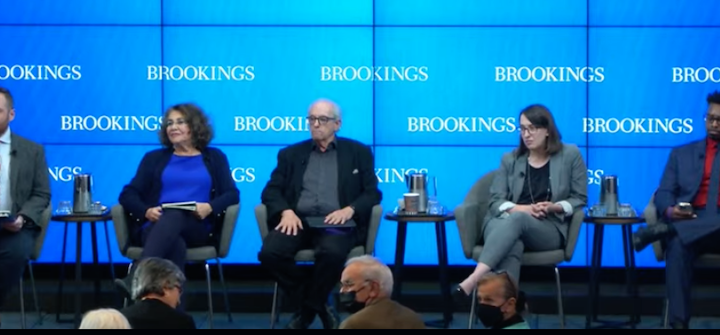

Americans who embrace democracy and shun conspiracy theories have reason to be cautiously optimistic about the U.S. political system after the 2022 midterm elections, said Norman Eisen, founder and executive chair of the States United Democracy Center.
Nov. 8 was a tough day for election deniers, including former President Donald Trump and the candidates he supported, because American voters showed their faith in, and support for, the world’s oldest continual system of democratic governance, Eisen said during a post-election webinar hosted by the Brookings Institution.
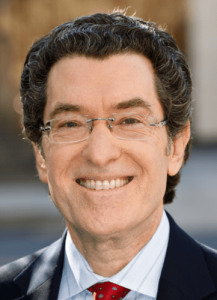
Norman Eisen
“Everybody was saying there was going to be a ‘red wave,’ and maybe there will be … but one of the things that the prognosticators missed is just how much the American people care about their democracy,” said Eisen, also a senior fellow in governance studies at Brookings who served on the House Judiciary Committee for the impeachment and trial of then-President Trump.
Eisen and other members of the Nov. 9 panel covered numerous election-related topics ranging from the current situations in specific congressional and statehouse races to voting on marijuana legalization and other ballot measures. But they also examined the influence that race, gender, abortion and culture-war tribalism had in shaping what many experts describe as a historic midterm political contest.
The results are astonishing because they defy the thumping typical for a president’s party in the first midterm after his election, said Norman Ornstein, senior fellow emeritus at the American Enterprise Institute.
While some races are not yet decided, the Associated Press projects that to date, Democrats lost seven seats in the U.S. House and gained one in the Senate. Democrats also gained two state governorships compared to the GOP’s loss of two. That’s a far cry from the norm, Ornstein said.
“We know Bill Clinton and his party got destroyed in 1994. It was a double whammy for Barack Obama in 2010 and 2014, and the idea that you could come through this with what might be minimal losses in the House” is historic, he said.
While election deniers didn’t do as well as they and their supporters expected, incumbent and newly elected Republicans in Congress will be almost impossible to govern with, Ornstein added.
“Don’t imagine for a nanosecond that Trumpism is dead, even if he fades into the darkness or ends up in an orange jumpsuit.”
“It was a bad time for Donald Trump, but don’t imagine for a nanosecond that Trumpism is dead, even if he fades into the darkness or ends up in an orange jumpsuit,” he said. “We know that the vast majority of Republicans in the House are election deniers, which is a good template for saying that they are extraordinarily radical.”

Norman Ornstein
That radicalism emanates from a huge cultural divide between Americans that can be described as “the cancer of tribalism,” Ornstein said.
The divide is illustrated in part by a 2006 Indiana senate race in which the Republican candidate publicly claimed women cannot become pregnant as a result of rape. “Republicans and Democrats condemned it. It was unacceptable. Now you can say anything, and it is acceptable.”
The effect was the same this year when news broke that Herschel Walker, a Georgia Republican locked in a runoff for the U.S. Senate, was accused of threatening an ex-girlfriend with a gun. “It’s obvious that we used to think that if somebody put a gun to the head of his (ex-girlfriend) and threatened to blow her brains out, that that might be disqualifying. No more,” Ornstein said.
“And it goes beyond that … because in an era of tribalism you give aid and comfort to the enemy if you do anything to undermine one of your own,” he said. “It reflects the coarseness that we have right now. That is going to make it so much more difficult to be able to unite as Americans or across party lines.”

Elaine Kamarck
Much of that difficulty will be visible at the state level, said Elaine Kamarck, founding director of the Center for Effective Public Management and a senior fellow at Brookings.
“I think the Supreme Court is going to be much more favorable for shifting power to the states, and whether that’s a good or a bad thing depends entirely on who’s running these states.”
The tribalism separating Americans likely will interfere in the process, she said. “The country really is divided between states. There are different worlds. One America is over here, and one America is over there. So, I think we need to watch the states.”
Panelist Rashawn Ray said he was focused on state-level issues during the midterms and didn’t like much of what he saw there.
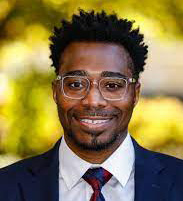
Rashawn Ray
“I don’t know if you all have been following this, but five states were voting to eliminate slavery from their constitutions. Think about this — this is 157 years after the Civil War ended and states are just now voting to end slavery,” said Ray, a senior fellow at Brookings.
Voters in Alabama, Oregon, Tennessee and Vermont cast ballots to remove slavery and any form of involuntary servitude from their state constitutions, while Louisiana, with a 61% majority, did not.
But even in the states that officially abolished the practice on Nov. 8 there were disturbingly large minorities who wanted to retain slavery, Ray noted. “In the state of Tennessee, where I was born, 21% of people, based on what we currently know, voted against the removal of slavery from the constitution. We’re talking about over 330,000 people. Let’s go to Oregon, (where) 46% voted to keep slavery on the constitution.”
The voting on these issues illustrates the mindset of significant numbers of Americans, he said. “Y’all, this is 2022. This is the democracy that we have. We have to be clear that it’s not only about who we’re voting for, but that a large percentage of people actually want things to go back to pre-1865.”
The panelists agreed that divisions are growing among Republicans, especially on whether Trump or Florida Gov. Ron DeSantis should run for president in 2024.
“If Trump’s candidates keep losing and things keep happening, Republicans are going to jump off that train and jump on the DeSantis train,” Ray said.
Tensions between the two have mounted since the midterm in which DeSantis and other Republicans scored major victories in Florida. Trump even sarcastically labeled the Floridian as “Ron DiSanctimonious.”
“Trump gave DeSantis a nickname, and whenever that happens you know that Trump feels threatened and so there’s definitely something happening there,” Ray said.
But the difference between the two only comes down to how they operate, other panelists said.
“Trump wanted to be Kim Jong-Il,” Ornstein said in reference to the former dictator of North Korean. “Ron DeSantis wants to be Viktor Orbán,” the anti-democratic prime minister of Hungary.
“The real difference between DeSantis and Trump is that Trump never wanted to learn how government worked. DeSantis did.”
Trump and DeSantis differ mostly in administrative style, said John Hudak, deputy director of the Center for Effective Public Management and a Brookings senior fellow. “The real difference between DeSantis and Trump is that Trump never wanted to learn how government worked. DeSantis did.”

John Hudak
Expect a much more focused approach if the Florida governor eventually wins the White House, Hudak added. “If you disagree with Trump’s views on policy, you could at least be enlightened by the fact that he could have done more as president had he bothered to learn how government worked. Ron DeSantis will be a much more effective president, with very similar policy views, than Donald Trump ever was. Regardless of the outcome, the actual execution would be much stronger and much more effective under President DeSantis.”
But the failure of many election-denying political candidates cannot be laid at Trump’s feet alone. Rather, the abortion issue, and the 2022 Supreme Court ruling ending Roe v. Wade, had a major effect on the outcomes of many races and issues, Hudak said.
“It’s important to note that the most critical votes that were cast in 2022 were cast by six people: (Justices) Samuel Alito, Clarence Thomas, Brett Kavanaugh, Amy Coney Barrett, Neil Gorsuch and finally John Roberts. Those were the critical votes to be cast that set die for what would happen on Tuesday.”
Kamarck said it comes down to basic math, namely that women make up more than half of the U.S. population. “This enormous vote happens and more than 50% — may I say 52%? — is outraged. It affects people deeply.”
At least four states passed abortion protections on Election Day, with two other such ballot initiatives too close to call.
“I think what this says is that this is an issue that is very fundamental. People get it. They know which side the two parties are on,” Karmack said. “We didn’t have the pro-inflation party and the anti-inflation party. We had the pro-choice party and the anti-abortion party, so it was easy for this to become a critical political issue. When you take away a right from someone, that is a very significant thing to do and you’re going to have consequences and they’re going to be political.”
While it’s important to remain vigilant for election-threatening litigation or even violence by election deniers who have lost races, Eisen said he sees reason for hope emerging from the midterms. “We didn’t see the kind of chaos on Election Day that we feared. We did not see political violence. Now, that comes with a caution — there are exceedingly close races that are being counted.”
But he predicted a possible easing of the kind of extreme rhetoric that was generated in large part by Trump and other election deniers heading into the midterms. “I do think there will be a self-correcting effect because it clearly is not what the American people are interested in.”
Related articles:
‘Send these bigots and homophobes and misogynists back under the rocks out from which they crawled’
Surviving this election season and repenting of idolatry | Opinion by Marv Knox
Trump’s toxicity: A first take on the midterm elections | Opinion by David Gushee
Moderates are an endangered species in the pews, but they aren’t completely extinct at the ballot box | Analysis by Laura Ellis