

Where the Appalachian region of North Carolina crashes against the central Piedmont’s rolling hills, I came of age. Where the exploitation of workers centered less on what took place in coal mines and instead played out inside the walls and on the lines of hosiery mills, my people lived.
In such a place, my family huddled near one another like balls on an uneven pool hall table. Collecting and sharing space while trying to position ourselves for a level of independence rarely felt or achieved.
My grandparents lived an earshot away from my childhood home, Aunt Sue lived beside us, and great-aunts Emmie and Minnie lived a short distance down the road. In our curio family, they were another level of exceptional.

Justin Cox
My life and theirs were connected by blood and separated by more than cow pastures and tobacco fields. A learned chasm of contentedness was present, made possible by lives existing before and during the Great Depression and second World War. They were two of nine children. Two of seven who would reach adulthood. Two of seven held captive to a piece of land while their siblings orbited places and farms of their own both miles and worlds away.
Why these women stayed put and lived together, becoming co-matriarchs to my family, mimicking the Baldwin Sisters on The Waltons, is a story for another day.
Both possessed expressions and charms from another time, beautifully distinguishable as Blenko glass to any who wandered into their spheres. They were attached, and yet each was one of a kind.
Emmie, the older sister, dipped snuff and told stories about “haints.” She wore short-sleeve dresses with long strains of pearls. Aunt Em was notoriously competitive at card games, offering no quarter during Skip-Bo tournaments on rainy afternoons. Letting loose a cackle while she crushed the spirits of adults and children alike. Her choice of transportation would put most small boats to shame. I can still see her sturdy frame sliding behind the wheels of cars with more metal than an Ozzfest concert. I never knew her to be scared of anything except a rabid “mad” dog. Having been chased up a tree by one as a child, the trauma and caution around canines never left her.
Aunt Minnie was just the opposite. Swearing off tobacco products before I was born, her vice was sweets, especially boxed varieties of pecan ice cream. She let me win every board game we ever sat down to play. Her stories were less spooky in nature, consisting of Jack Tales and other folklore with roots in the mischievous and playful. Aunt Minnie never drove a car, satisfied with a perpetual shotgun status. Her wardrobe consisted of blouses and pants with fluctuating shades of tan and taupe. She was absolutely terrified of snakes, a trait she successfully passed on to me, and where Aunt Em seemed indifferent toward food, Aunt Minnie enjoyed cooking.
While not as polished a cook as my maternal grandmother, who worked alone for efficiency, Aunt Minnie warmly welcomed my small hands into her kitchen. Her presence and touch filled in the cracks of my inexperience — making what we created together whole and complete in a way my own undertakings never could.
It was she who introduced me to all sorts of simple dishes. Peas and dumplings. Boiled potatoes, smashed, covered with slabs of butter, and topped with salt and pepper. Green beans from the family garden. Her larder was stocked with the uncomplicated. Her stove was stripped of pretentiousness. Her oil-cloth-covered farm table ever ready to host our own America’s Test Kitchen.
Afternoons with her might see a heavy reliance on Betty Crocker or involve watching a German chocolate cake develop from scratch. She saw it as her responsibility to keep the neighborhood kids stocked with oatmeal, sugar and chocolate chip cookies.
“For Aunt Minnie, preparing food wasn’t only about what we made but how we made it.”
For Aunt Minnie, preparing food wasn’t only about what we made but how we made it. And most importantly, who we made it for.
She and Aunt Em have since passed on. I’d like to imagine they’re still accompanying each other on the other side of eternity.
For years I kept Aunt Minnie’s gifts to me tucked away. Buried in the basement of my recollections. A few years ago, I started sifting through those memories. Or maybe it’s the other way around; they began sifting through me.
The clearing of those cobwebs started with a parishioner asking me how I made my biscuits. “How ’bout I show you,” I asked? A date and time were picked, and I went to her house.
 We made my biscuits and a cobbler-like dessert she pulled from a collection of worn recipe cards. While weaving around the kitchen, we shared techniques and stories. We had so much fun we decided to do it again. I brought out my jalapeno cornbread. She passed on to me a pie crust recipe I still use today. Between cups of cornmeal and shortening, we cut our lives into one another. Our words and laughter spilling over onto countertops like soft flour, unwilling to stay confined to its canister. Our appreciation for the other being the same — uncontainable.
The experience was infectious. I carried my desire to cook with folks to my new faith community. When I baked the bread for my first Communion service there, I was approached by a woman, pelting me with praise and dangling in front of me a bait I had no choice but to take.
“I heard you baked the bread,” she said
I Southerned up a quick, “Yes, ma’am.”
“You know I make pretty good bread myself,” she stated.
Grinning, I replied, “Prove it.”
I received an official invitation from her a week later.
June’s home was an interactive time capsule, with walls filled with a lifetime of collected cast iron and seasoned anecdotes. Her voice guided me over periods of her life, many involving her late husband. His presence was everywhere. His mastery of woodworking permeated and warmed our discussion.
“If Jesus had any tears left after the death of Lazarus, I believe, my hand to God, he would have wept again out of carpentry envy.”
If Jesus had any tears left after the death of Lazarus, I believe, my hand to God, he would have wept again out of carpentry envy. Small intricate carvings rested on larger pieces. The edgings and legs of dressers held thoughtful details my eyes had trouble catching. In the way falling snowflakes bombard a windshield, piling up and making it impossible to distinguish what lies ahead, June’s husband’s skill did the same, coming so quick I couldn’t properly process and appreciate it all.
As we moved from room to room, June’s hand would lightly brush a piece, drawing my attention to it, while she’d empty herself of how it came to be. I could have listened to talk about the functioning hearth in her living room all morning, but our bread was ready, and she insisted we enjoy it while it was still warm.
In a rare period of silence, June placed a thick and hearty piece of bread in front of me, and I struggled to suppress the impulse to tear into it while she secured her own. Unscrewing a small jar filled with a butter and olive oil mixture, she smeared a large dab on each of our slices. Finally, we indulged, our chewing a communal prayer, the only sound worthy of capturing the goodness we were simultaneously sharing.
My time with June was the first Communion cookery moment but not the last. In the past few weeks, I’ve wandered into other homes eating and preparing food with those intrigued enough to invite me and my family in.
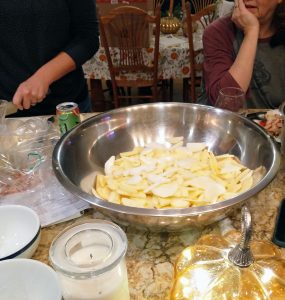 Gathered around a large kitchen island, I witnessed a dozen hands equipped with peelers shed the skin of several pounds of local apples. Our collected slices of fruit soon found a home in a community bowl, growing higher and higher like some redeeming Tower of Babel. Not even the grabby hands of curious children scurrying about could topple what we had raised.
And while our combined efforts went smoothly, the demonstration of my pie crust was not as successful. Blame the unfamiliar environment, blame the Crisco, or blame the heavenly elixir resting in my Dubbel. My dough stubbornly refused to cooperate. I sheepishly apologized while making it work the best I could with all eyes watching.
“My uneven crimping glared at me with a judgment typically reserved for those who knew they had no business at Promise Keepers event.”
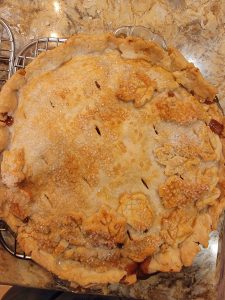
The pie would hold, but the imperfections stared back at me through the holes in the top of the crust. My uneven crimping glared at me with a judgment typically reserved for those who knew they had no business at a Promise Keepers event. With clocks ticking closer to our children’s bedtimes, I was forced to abandon my unbaked pie along with the gnawing of my shortcomings. However, the hosts assured me they would see it through.
And did they. Later that night, my phone buzzed from a text with an attached image. On the glow of my screen set my now fully baked pie, my mistakes covered by leaves cut out from our hostess’s extra dough from her own pie. Her message to me read: “Your pie is amazing! I love the texture, and it’s subtly sweet. I’m watching the Great British Baking Show right now and would give you the Paul Hollywood handshake.”
I read those words and thought they could have come from my Aunt Minnie. And just like that, I was back in her kitchen. Encountering the importance and goodness of supportive words and hands. Only this time, appearing like festive foliage on top of a rustic apple pie needing a little extra care. Those leaves, falling on, covering and encouraging me the way I imagine grace should. Spilling out on the paths of our lives and then amassed into piles. Ready to be jumped in whenever life gets a little too hard.
Aunt Minnie and her kitchen showed me how love and care can come together in the simplest ways.
Now my neighbor’s kitchens are doing the same. They’re a continuation of a space occupied by people who look to feed both my spirit and soul in ways food prepared with caring hands only can.
I’ll take the recipes shared with me and tuck them away. Pulling them out when I need them the most. Passing them on whenever I get the chance.
Justin Cox received his theological education from Campbell University and Wake Forest University School of Divinity. He is an ordained minister affiliated with the Cooperative Baptist Fellowship and enrolled in the doctor of ministry program at McAfee School of Theology. Besides reading, spending time in the kitchen and amateur gardening, Justin spends time with his spouse, Lauren, and their two daughters. He began his tenure as senior pastor of Second Baptist Church in Suffield, Ct. in August. Find his ramblings at blacksheepbaptist.com.
Related articles:
What The Bear should teach us about the church and genuine acceptance | Opinion by Justin Cox
Sleepless nights, parenting, biscuits and holy Communion | Opinion by Justin Cox
What The Great British Baking Show teaches us about life and politics | Opinion by Laura Ellis