

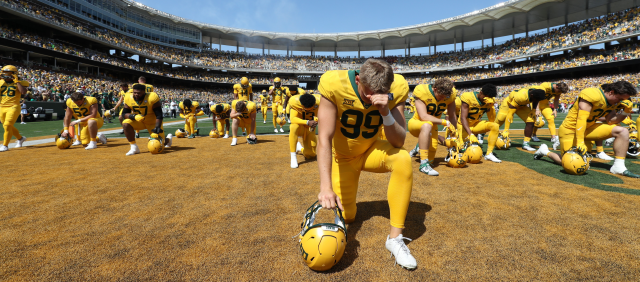
Student athletes at Baylor University demonstrate higher levels of religious belief, participation and identity than their non-athlete counterparts at least in part because the Baptist school is successfully balancing faith and athletics, according to a study published last month in the Journal of College and Character.
“Our findings suggest that Baylor is, at present, succeeding in the two endeavors of competing at the highest levels of sport and remaining faithful to its Christian mission,” said Daniel Allen, one of several researchers on the project.

Daniel Allen
The project was based on the Baylor Faith and Character Study, which surveyed nearly 900 graduating seniors to track the effect of a Baylor education on character and faith. The results were not what the university research team expected.
“Overall, we theorized that student athletes would report lower levels of religious belief, behaviors and identity than non-athletes. Somewhat surprisingly, these data did not support this line of theorizing because student athletes reported higher religiosity in all three areas,” the research article explains.
The Baylor research team consisted of Audrey Chisum, Kevin Dougherty, Perry Glanzer and Sara Schnitker. Allen, a doctoral student in sociology when the study was conducted, is now an assistant professor at Olivant Nazarene University in Illinois.
The study was launched in 2020 in part to supplement a dearth of scholarship into the religious and spiritual lives of college athletes.
The study was launched in 2020 in part to supplement a dearth of scholarship into the religious and spiritual lives of college athletes, much less at an NCAA Division I school whose athletes compete in a Power 5, or top-tier, athletic conference, the authors said.
“Athletics occupies an ambiguous place within the greater university mission, particularly at religious institutions. Intercollegiate sports programs may purport to reinforce the university’s aim to develop the whole person, but the nature of athletics can compromise student athlete religiosity and well-being,” the report says. “Little research has focused on the religiosity of student athletes and the potential implications for religious institutions.”
The study was limited to Baylor students because “religious context matters,” the Nov. 22 research article explains. “At non-religious institutions where the overall student body is less religious, student athletes might be expected to be more religious than non-athletes because religion can provide a sense of meaning and security that acts as a buffer against uncertainties and stressors like injuries or the strains of competition.
“Conversely, at religious institutions, higher levels of non-athlete student religiosity may be assumed. By their very nature, religious environments attract a more religious type of student. Thus, student athletes at such institutions would not necessarily exhibit higher religiosity than non-athletes.”
The scholars’ first hypothesis expected lower levels of religious belief among student athletes, “especially in a university setting where religiosity is elevated for students overall.”
Assessing religious maturity was the approach used to investigate that premise.
“The concept of faith maturity has been shown to be indicative of individuals who express religious beliefs such as God is guiding them, that their lives are filled with meaning and purpose, that they sense God’s presence in their relationships with others, or that their life is committed to God,” the researchers explain. “Those indicating stronger beliefs in these areas can be said to be more mature in their religious faith. Consequently, we framed our first hypothesis on religious beliefs through the lens of faith maturity.”
The theory that athletes would possess lower levels of religious belief wasn’t supported by the survey.
But the theory that athletes would possess lower levels of religious belief wasn’t supported by the survey: “Contrary to our first hypothesis, the student athlete mean of 5.29 for beliefs was higher than the non-athlete mean of 4.91.”
Based on observations from other studies, the researchers’ second hypothesis was that student athletes at a Christian university engage in religious practices less frequently than non-athletes.
“Religious practices include public and private expressions of faith, such as congregational attendance, prayer and reading sacred texts. In general, college students experience decreases in their religious practices as they accommodate the academic and social demands of college life,” the research team states. “Time demands on student athletes are even greater. There are practices to attend, team meetings, tutoring sessions and an assortment of other team-related activities. In fact, college athletes report spending as much as 30 hours per week in athletic-related activity. Faced with these time constraints, athletes often curtail their religious practices.”
But the research showed the opposite to be true at Baylor. “Instead, there was a significant, positive relationship between being a student athlete and exhibiting religious behaviors. Student athletes will on average have a 0.20 higher religious behavior score than non-athletes,” according to the study.
Again citing previous studies, researchers theorized that student athletes at Baylor would regard religious identity as less important than it is for non-athletes.
“Identity is a composition of numerous social roles that individuals inhabit. Often, there are conflicts between these identities that require the individual to prioritize one over the other. The student athlete identity presents such a conflict, and existing research shows that athletes often prioritize their athletic identity. Since winning is prized by not only the athletic department but by the greater campus community, student athletes may find their athletic identity more relevant than religious identity,” the report explains.
Again, the numbers didn’t bear out that prediction either: “The third model showed that student athletes, on average, indicate the salience of religious identity at a 0.17 higher level than non-athletes.”
The study offered several possibilities to explain why student athletes demonstrated greater levels of belief than non-athletes.
“Perhaps the most apparent explanation is the considerable influence that peers have on college students’ values and beliefs. … Being a student athlete is an immersive experience that offers ample opportunity for close relationships with teammates and other athletes. An additional explanation for this finding is that religious beliefs help student athletes cope with the anxiety produced by competitive pressures. Religious beliefs can also provide a sense of purpose and help student-athletes make sense of their successes and failures.”
Baylor’s status as a Christian institution and an NCAA Division I athletic school may also have influenced the survey results, researchers said.
“This finding may be a result of intentional efforts within the athletic department to address various identities beyond that of ‘the athlete,’ including religious identity. … Taken as a whole, a possible explanation for our findings is that the athletic department at the institution we studied effectively manages the competing institutional logics of athletics and their religious mission.”
Related articles:
Christian Athlete Circles provides alternative space in sports
At Baptist college in Virginia, a disagreement over athletes kneeling during National Anthem