

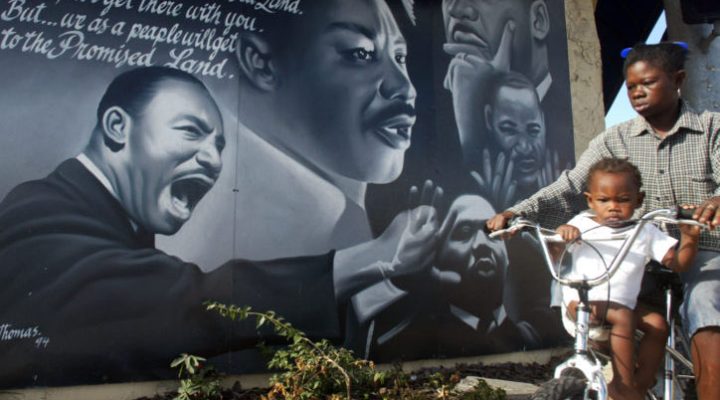
At the height of his fame in the 1950s and ’60s, Martin Luther King Jr. waged a two-front struggle, battling segregation and racial injustice and inequality in America and drawing attention to the challenges in Africa caused by colonialism.
His campaign for Africa was related to an awareness of his ancestral ties to the continent and knowledge of the place, having visited countries like Ghana and interacted with leaders there and elsewhere.
Using his oratorical gift to great effect, the Georgia-born preacher and civil rights activist spoke about the conditions in Africa and the struggle for emancipation by people of the continent just as Black Americans led by himself and others were championing equal rights across the United States.
In one of his speeches delivered in early April 1957, King compared the struggle of the African people to the biblical travails in Egypt.
“I would like to use as a basis for our thinking together a story that has long since been stenciled on the mental sheets of succeeding generations,” he said. “It is the story of the exodus, the story of the flight of the Hebrew people from the bondage of Egypt, through the wilderness and finally, to the Promised Land. It’s a beautiful story.
“I had the privilege the other night of seeing the story in movie terms in New York City, entitled The Ten Commandments, and I came to see it in all its beauty. The struggle of Moses, the struggle of his devoted followers as they sought to get out of Egypt. And they finally moved on to the wilderness and toward the Promised Land. This is something of the story of every people struggling for freedom. It is the first story of man’s explicit quest for freedom. And it demonstrates the stages that seem to inevitably follow the quest for freedom.”
He added that prior to March 1957, there existed a country known as the Gold Coast (now Ghana) which was a colony of the British Empire.
“This country was situated in that vast continent known as Africa, … that continent with some 200 million people, and it extends and covers a great deal of territory. There are many familiar names associated with Africa that you would probably remember, and there are some countries in Africa that many people never realize. For instance, Egypt … and Tunisia and Algeria and Morocco, and Libya.”
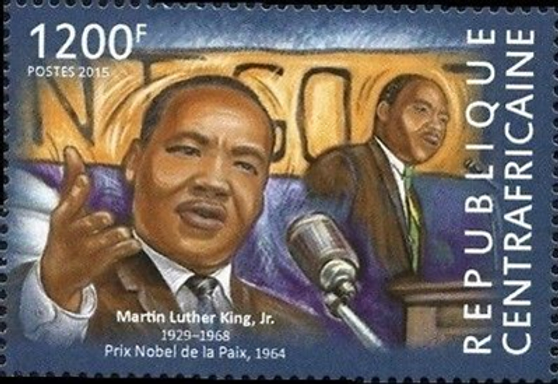 He then moved the tale to South Africa, talked about the capital city of Johannesburg that was often in the news, Rhodesia (present-day Zimbabwe), the Belgium Congo, then further to East Africa with places like Kenya and Tanganyika (now Tanzania) and others like Uganda and further down to West Africa and Nigeria, Liberia, Sierra Leone.
King then drove home his point: “For years and for centuries, Africa has been one of the most exploited continents in the history of the world. It’s been the Dark Continent. It’s been the continent that has suffered all of the pain and the affliction that could be mustered up by other nations. It is that continent which has experienced slavery, which has experienced all of the lowest standards we can think about, brought into being by the exploitation inflicted upon it by other nations.”
He continued: “And there was a big scramble for power in Africa. With the growth of the slave trade, there came into Africa, into the Gold Coast in particular, not only the Portuguese but also the Swedes and the Danes and the Dutch and the British. And all of these nations competed with each other to win the power of the Gold Coast so that they could exploit these people for commercial reasons and sell them into slavery. Finally, in 1850, Britain won out, and she gained possession of the total territorial expansion of the Gold Coast.”
Like in many parts of Africa, the struggle by Ghanaians to gain independence from Britain was a long and tortuous one. Independence finally was secured in 1957 with King and many other civil rights activists and delegates of nations from all over the world, traveling to Ghana to witness Kwame Nkrumah take up the mantle of leadership from British colonial lords.
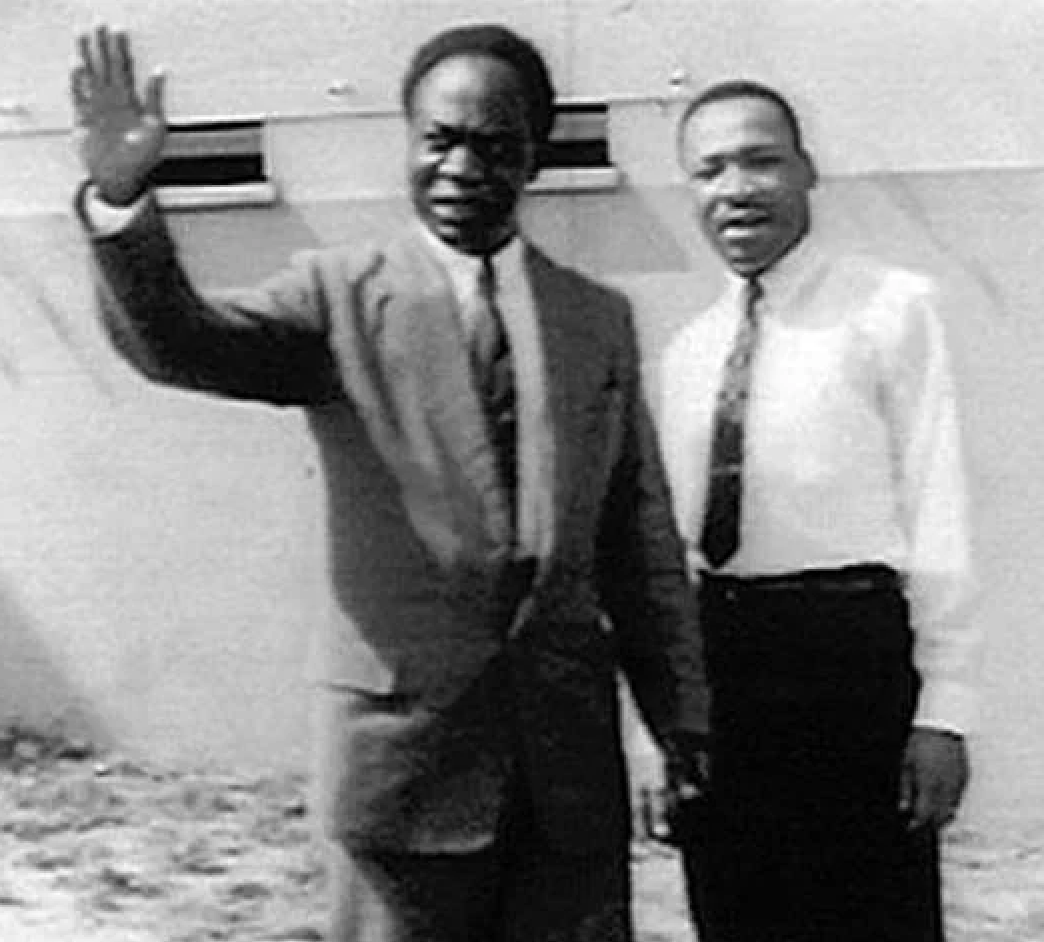
Ghanian Prime Miniser Kwame Nkrumah with Martin Luther King in Ghana in 1957.
It was a victory that would resonate across the African landscape.
King recalled his emotion on that day: “Before I knew it, I started weeping. I was crying for joy. And I knew about all of the struggles, and all of the pain, and all of the agony that these people had gone through for this moment.”
Apart from Ghana, King also spoke about the conditions in apartheid South Africa where discriminatory policies put in place by a minority white government placed whites ahead of the majority blacks. He denounced those who made it impossible for both sides to co-exist as one people.
Julius A. Amin, a professor of history at the University of Dayton, in an article published by The Conversation, notes that “King’s knowledge of Africa evolved slowly and was initially peppered with the usual beliefs of African backwardness.”
But his trip to Ghana turned out to be an eye-opener, Amin said “King … spoke endlessly about the endurance, determination and courage of the African people. The anti-colonial struggle in Ghana mirrored what was taking place all over Africa.”
Amin continued: “Later, King noted that Ghana’s independence will have worldwide implication and repercussions — not only for Asia and Africa, but also for America. This gave African Americans new insights about the anti-colonial struggle. Increasingly, King saw parallels between the anti-colonial movement in Africa and the civil rights struggle in the U.S.”
Following on the heels of Ghana’s success as an independent country were other African countries. Nigeria gained independence from Britain in 1960, Algeria from France in 1962, Kenya from Britain in 1963, Mozambique from Portugal in 1975.
While racial segregation remained entrenched in America, the tide of independence was changing quickly in Africa, Amin noted. “In 1960, 17 African nations gained independence. They took their anti-racism message to the United Nations, where they chastised the U.S. for its failure to stop anti-Black racism.”
Anthony Akaeze is a Nigerian-born freelance journalist who lives in Houston. He covers Africa for BNG.
Related articles:
A privileged white Southern dad reflects on racism and the legacy of MLK | Opinion by Brad Bull
Some hard questions for reflection on this MLK Day | Opinion by Sid Smith III