

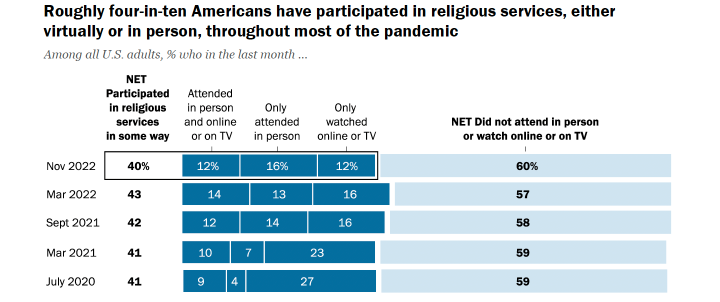
The relationship between Americans and worship attendance since the COVID-19 pandemic is complicated, Pew Research Center found in a new study.
The project compiled statistics from five surveys conducted from 2020 to 2022 and found a steady share of U.S. adults, about 40%, reported attending either online or in-person services. Yet when asked if they attend more or less often than before the pandemic, most said they attend less frequently.
“But it’s a complicated picture: As of November 2022, 20% say they are attending in person less often (while 7% say they are going in person more often). On the other hand, 15% say they are participating in services virtually more often (while 5% say they are watching services online or on TV less often),” the report states.
Among individuals who participated in four longitudinal studies from 2019 to 2022, Pew reported, monthly attendance declined from 33% to 30% in that time, while “the vast majority (87%) report no change in their rates of worship attendance over that period. But among those who do indicate a change, more report attending services less often (8%) than report attending more often (4%).”
Complex as their findings may be, the studies were necessitated by pressing concerns about the possible effects of the pandemic on American religious institutions.
“In-person attendance quickly rebounded and then appears to have plateaued.”
“Since the World Health Organization declared COVID-19 a global pandemic three years ago, observers of religious life in America have wondered whether — and how — the upheaval would impact religious worship,” the authors explain. “Would the temporary shuttering of churches and other houses of worship accelerate the longer-term decline in attendance, especially if many people who stopped attending religious services in person during the pandemic never go back? Or could the widespread introduction of virtual services extend congregations’ geographic reach, increase their appeal to young people and help them attract new audiences?”
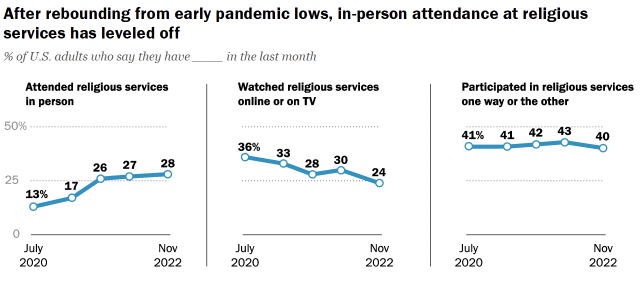
Overall, in-person engagement in religious services has dropped slightly since 2019, while the percentage of American adults participating in some form of religious services in a 30-day period has held steady since the beginning of the pandemic. Since July 2020, the share of adults participating in religious services “has barley budged” from about 40%, Pew reported.
“But as the pandemic has run its course and many religious congregations have reopened their doors to worshippers, the percentage of Americans participating virtually in worship services has been dropping. Meanwhile, in-person attendance quickly rebounded and then appears to have plateaued.”
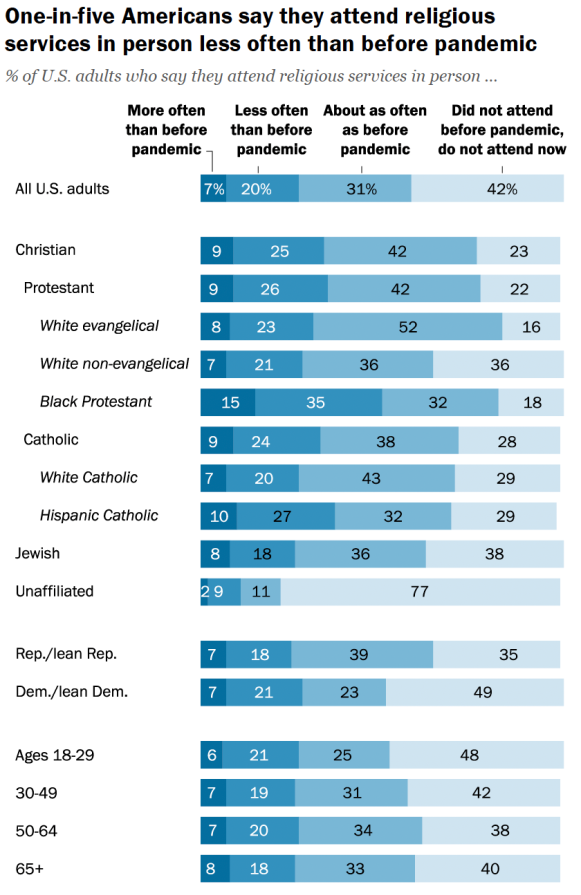 White evangelicals and Black Protestants have helped bolster the trends uncovered in the study, Pew researcher said. “The portion of white evangelicals who report that they physically went to church in the past month has not dropped below 30% at any point since July 2020. In the most recent survey, fully half of white evangelicals (52%) say they attended in person.”
Attendance among Black Protestants, meanwhile, shot up from 14% in July 2020 to 41% in 2022. While the report found 35% of this group was less likely to attend in-person gatherings, “an identical share say they now watch religious services online or on TV more often than they used to — a number that is also higher than in other U.S. religious groups.”
Coronavirus had a significant role in shaping the African American church attendance, researchers explained: “Black Americans also have suffered a disproportionately high share of COVID-19 hospitalizations and deaths relative to white Americans, and Black Protestants remain the U.S. religious group most likely to be viewing services virtually. In the most recent survey, about half of Black Protestants (54%) say they participated in services online or on TV in the last month, compared with 46% of white evangelical Protestants and smaller shares of Catholics (20%), white non-evangelical Protestants (19%) and Jews (16%).”
Party affiliation and generation also contributed to the data, with Republicans and Republican-leaning independents more likely than Democrats and Democratic-leaning independents to attend in-person religious services, Pew noted. Conservatives also were slightly more likely to attend virtual services throughout the pandemic.
“Older Americans tend to be more religious than young adults, and despite being at greater risk of hospitalization and death from COVID-19, Americans ages 65 and older have generally been somewhat more inclined than young adults (ages 18 to 29) to go to religious services in person,” the report added. “Older Americans also report participating in religious services virtually at higher rates than the youngest adults.”
As a result, approximately 50% of American adults 65 and older said they attended religious services in the past 30 days, including 18% who attended in-person gatherings only, or 15% who attended both in person and virtually, the study found. By comparison, only three in 10 adults age 30 and younger said they participated in any form of religious service during the preceding month, including 12% who attended in person only and 9% who participated in person and virtually.
“Throughout most of the pandemic, about six in 10 Americans have not taken part in religious services in any way.”
“Throughout most of the pandemic, about six in 10 Americans have not taken part in religious services in any way. In the new survey, this includes roughly seven in 10 adults under 30 (72%) and about nine in 10 religiously unaffiliated adults (those who describe their religious identity as atheist, agnostic or ‘nothing in particular’).”
Among the 6,000 respondents who participated in each of the four longitudinal studies, 87% described their attendance patterns as essentially unchanged since the pandemic, Pew reported. “Specifically, a quarter of Americans said they attended services at least monthly in both 2019 and 2022, while 62% said they attended less than monthly both before the pandemic began and more recently.”
Similar patterns were documented across numerous demographic categories: “In most groups, a slightly larger number of respondents reported attending less often in 2022 (compared with 2019) rather than more often, though the vast majority of respondents showed no change in their self-reported general level of religious service attendance over this period.”
Related articles:
Is the dramatic global rise in unhappiness correlated with the continued drop in church attendance? | Analysis by Mallory Challis
Less than half of Americans now claim a formal congregational membership
Younger and older Americans aren’t returning to church as much as the middle-aged