

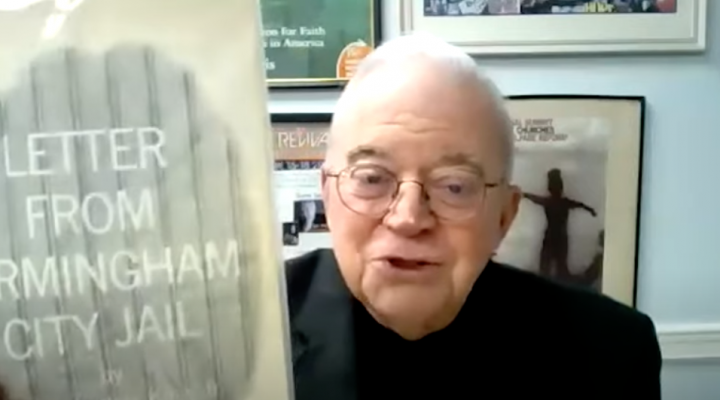

Martin Luther King Jr.’s historic “Letter from Birmingham Jail” is as relevant and hard-hitting today as it was when penned in 1963, a panel of religious leaders said at Georgetown University.
For one, King’s audience is the same now as then, said Otis Moss III, a social justice activist and senior pastor of Trinity United Church of Christ in Chicago.

Otis Moss III
“We would today say Dr. King knew how to throw some shade and get you straight at the same time,” said Moss, also a professor at Mercer University’s McAfee School of Theology.
King “was talking to the Christian nationalists of his day and setting them straight and saying you have no moral authority because the authority you think you have is wrapped up in a Constantinian view of Christianity, of empire, and I want to correct that,” Moss said during the virtual discussion hosted by the Center on Faith and Justice at Georgetown University to mark the 60th anniversary of the letter.
“So, it really was about Christian nationalism,” Center director and event moderator Jim Wallis responded. “I love that. That’s as relevant as it could possibly be. The best way to confront bad religion is with religion that’s true.”
“The best way to confront bad religion is with religion that’s true.”
King’s letter was a response to the request of local white pastors that he dial back the intensity and scope of Civil Rights protests in Birmingham, which they considered ill-timed and inappropriate. King was arrested in Birmingham in April 1963 for coordinating and participating in sit-ins and other protests against segregation in one of the South’s most segregated cities.
The white supremacists he addressed in the letter were not fundamentalist Christians, but those who typically claimed support for racial justice but took no action to support the movement.
“First, I must confess that over the past few years I have been gravely disappointed with the white moderate. I have almost reached the regrettable conclusion that the Negro’s great stumbling block in his stride toward freedom is not the White Citizen’s Counciler or the Ku Klux Klanner, but the white moderate, who is more devoted to ‘order’ than to justice, who prefers a negative peace which is the absence of tension to a positive peace which is the presence of justice,” King wrote.
Later he added: “Shallow understanding from people of good will is more frustrating than absolute misunderstanding from people of ill will. Lukewarm acceptance is much more bewildering than outright rejection.”
That response was “one for the ages” and still rings true, Wallis said. “Our conversation here tonight is especially important because we are at a moment when a conservative movement is attempting to whitewash American history, to literally remove books and lessons from our children’s schools. It is impossible to build a truly multiracial democracy if we do not wrestle honestly and directly with its legacy and current manifestations of white supremacy when some are trying to erase our history — especially our racial history.”

Bishop Vashti McKenzie
King’s letter also serves as a blueprint for those currently engaged in the struggle for racial and economic justice, said Bishop Vashti McKenzie, interim president and general secretary of the National Council of Churches.
The document lays out operating guidelines and steps for nonviolent campaigns for justice and reminds readers of the interconnection of all people, communities and states, said McKenzie, a retired bishop of the African Methodist Episcopal Church and the first woman to serve in that role.
“This is a roadmap. You can go back and look at history to see that every other organization that was looking for social change followed the roadmap that he set out in the ‘Letter from Birmingham Jail.’ King gives us a roadmap on how to begin that process of change.”
The document also lays out who must resist, and when.
“I have yet to engage in a direct action campaign that was ‘well timed’ in the view of those who have not suffered unduly from the disease of segregation.”
“We know through painful experience that freedom is never voluntarily given by the oppressor; it must be demanded by the oppressed,” King wrote. “Frankly, I have yet to engage in a direct action campaign that was ‘well timed’ in the view of those who have not suffered unduly from the disease of segregation.”
“That to me is a call to action,” McKenzie said. “It is a call to change. You cannot sit idly by.”
The letter’s power also derives from its parallel to Jesus’ words and actions in confronting the religious and political authorities of his time, she said. “And so here comes King using simple language that just opens the mind, you know: power does not submit itself voluntarily. You are really going to have to stand up and confront this process. You’re really going to have to speak up. You cannot just lay down and wait for change to happen.”
Wallis offered another parallel: “Wherever the early Christians entered a town, the power structure got disturbed. And here was King, now, disturbing the power structure of Birmingham in the same way.”
Advocates for social and racial justice must continue that tradition, McKenzie said. “We cannot sit on the sidelines and wait for someone to hand us what was granted to us by God. We are the ones that have to push the envelope to instigate the intense event that makes America take a look at itself.”
Moss said he was taught by his parents that King’s letter is nothing short of canonical for Christians engaged in social justice work: “Both my parents were involved in the (Civil Rights) movement. I came along and there was what I would call ‘extra canonical’ material that my father had added to the biblical cannon.”
In addition to the Bible, Moss was taught to consider as sacred works such as Jesus and the Disinherited by Howard Thurman, Frederick Douglass’ “What, to the Slave, is the Fourth of July” speech, Sojourner Truth’s “Ain’t I A Woman?” address, and the story of Harriet Tubman.
“My father said this is an epistle.”
“And then there was the ‘Letter from Birmingham Jail.’ My father said this is an epistle. He said you can read Paul’s epistles, but you have to also understand King’s epistle. And so from the pulpit and from the dinner table, my parents would have this conversation about this work and the brilliance of what Dr. King did to merge African American cultural history, perspective and theology together with Martin Buber and St. Augustine, put in a little bit of Socrates, lay out some moral philosophy, and then throw a wink of shade to those who were the moderate liberals at the time who thought he was moving too fast.”
Related articles:
How King’s ‘Letter from Birmingham Jail’ parallels the Tennessee Three | Analysis by Kristen Thomason
Letter to white American evangelicals | Opinion by Joel Bowman
Otis Moss III found beauty dancing in the darkness