

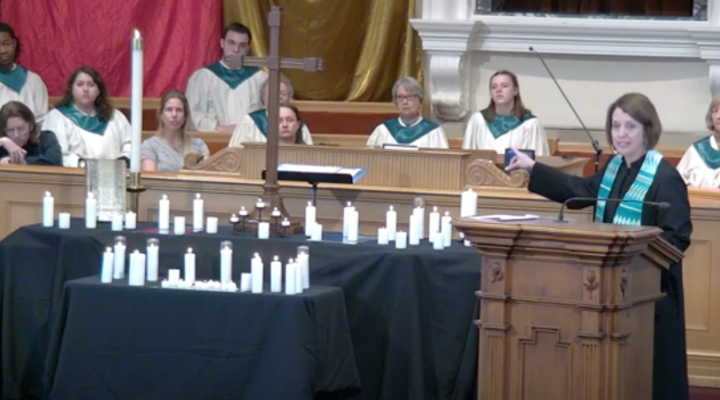
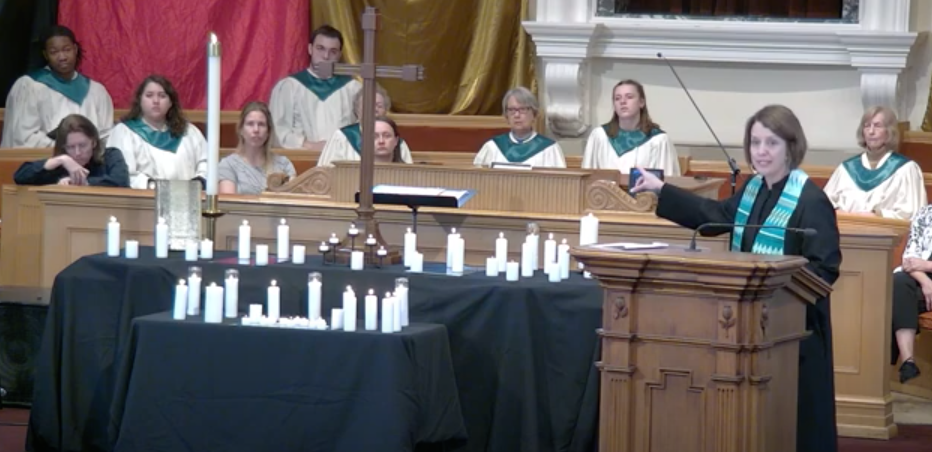
The congregation at First Baptist Church in Columbia, Mo., recently held a worship service devoted to confessing and lamenting the church’s historical connection to slavery.
The October service was part a year-long observance of the church’s bicentennial, which will be celebrated Nov. 22. But to recognize that milestone, the congregation needed to publicly and prayerfully account for the fact that at least 37 of its founders and early members were enslavers, said Senior Pastor Carol McEntyre.
“We do this on a Sunday morning in the context of worship because the grace of Jesus Christ always invites us to be honest about our own sin and honest about our church’s sin,” she told the congregation. “We do this because we believe in redemption. Redemption is the belief, the hope, that a community’s past does not have to define its future.”
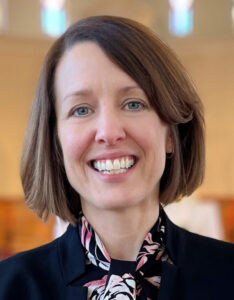
Carol McEntyre
The liturgy included McEntyre’s sermon devoted to the congregation’s act of contrition and a “litany of truth” in which the names of 53 slaves owned by First Baptist according to records from 1823 to 1844 were read aloud.
“A review of our handwritten journals, one of which is on the Communion table today, show no indication that we even debated the morality of race-based chattel slavery” during that era, McEntyre said. “The list we are going to read later today doesn’t represent all enslaved people” owned by First Baptist members. “We are confident that the number of people enslaved by our members was much, much larger than even our records indicate.”
The congregation’s racial self-examination places it squarely amidst a movement of churches, seminaries and other institutions examining their historical connections to slavery and other forms of racial injustice. Wake Forest University has launched its Slavery, Race and Memory Project, while Princeton Theological Seminary dedicated more than $27 million for scholarships and other initiatives after an audit documented how the school benefited from the slave economy of the 19th century.
The Episcopal Church and Southern Baptist Convention have apologized for their roles in slavery, and the Alliance of Baptists has transformed itself into a dedicated anti-racism organization. The St. Charles Center for Faith in Action in New Orleans, E Pluribus Unum and the Public Religion Research Institute have partnered to offer “In Deed and Truth: Interrogating Legacies of White Church in America,” a program to walk churches through an examination of their pasts as related to race.
For First Baptist, the journey to its Oct. 22 truth-telling service began with the 2017 formation of a racial justice team in response to the Unite the Right white supremacist rally in Charlottesville, Va. Several initiatives sprang from the team’s work, including an eye-opening examination of historical church membership and probate records, McEntyre said.
“Enslaved persons were accepted into membership and recorded in our records with the designation ‘belonging to’ or ‘servant of,’ followed by the name of their enslaver,” she explained. “So, we want to acknowledge, as a community of faith, the harm that was committed by members of our congregation.”
The records also reveal the earliest generations of the church read the Bible through a white supremacist lens and preached a gospel of bondage rather than freedom, she said. “The supremacy of whites is the idea that white people are more valuable, more intelligent, more industrious or morally superior, and thus entitled to hold positions of power over Black and brown people. Our founders spiritualized Jesus’ message of liberation and turned salvation into saving souls or just getting into heaven when you die. They had a distorted and limited view of the gospel of Jesus and hollowed out Jesus’ strong social agenda.”
Those who wonder why the church doesn’t leave the past alone fail to see how the legacy of slavery continues to show up through African American unemployment rates, health outcomes, home ownership and life expectancy, the pastor said.
“Black people, as a group in the United States, fare worse than white people do. And since Black people are just as intelligent, hardworking, creative, ambitious, entrepreneurial and capable as white people, the only logical explanation for this disparity of well-being is the lingering impact of 400 years of chattel race-based slavery followed by Jim Crow laws, the terrorism of lynching, redlining, the denial of the GI bill to Black veterans and the mass criminalization and incarceration of Black people to this day.”
“The people in our church who initially practiced slavery are not around, so it falls to us, the present generation, to acknowledge the sin and to work really hard to build a different future.”
Churches should know better than any other organization that confession and contrition also are for who have been harmed, McEntyre said. “Even though we didn’t personally commit the sin we are confessing, we are still responsible for restoring trust and making things right. The people in our church who initially practiced slavery are not around, so it falls to us, the present generation, to acknowledge the sin and to work really hard to build a different future.”
Another common push-back to racial truth-telling is that it is unfair to judge slaveholders by modern standards of morality.
It’s appropriate because anti-slavery values existed even during the slavery era and were held by slaves and free Blacks, McEntyre said. “I imagine there were many, many, many white people who believed enslavement was wrong, but they chose to stay quiet and participate anyway because they benefited from the status quo or maybe they were afraid.”
Confession and lament also provide push-back against rising claims that slavery was a benefit to Black people, McEntyre said. That message is epitomized in a new education curriculum approved in Florida this year asserting slaves benefited by learning useful skills.
“Slavery is frequently, especially these days, being whitewashed. The myth or trope of the happy slave who was content to be in bondage and happy to have the paternalistic care of their enslavers is being trotted out,” she said. “Slaves were not workers, volunteers or immigrants who wanted a better life. The truth is that slavery was a cruel and dehumanizing reality, and untold numbers of enslaved persons died trying to escape. They wanted to be free and the other enslaved persons we remember today were real people with real hopes and real dreams.”
Related articles:
Princeton Seminary’s gift of reparations? Let’s talk instead about cultural competency | Opinion by Wendell Griffen and Lauri Umansky
Naming and un-naming: Slavery, schools and the present moment | Opinion by Bill Leonard
Southern Seminary won’t rename buildings but creates scholarships for Black students
What to do if you unearth a history of slavery in your church, college or institution?