

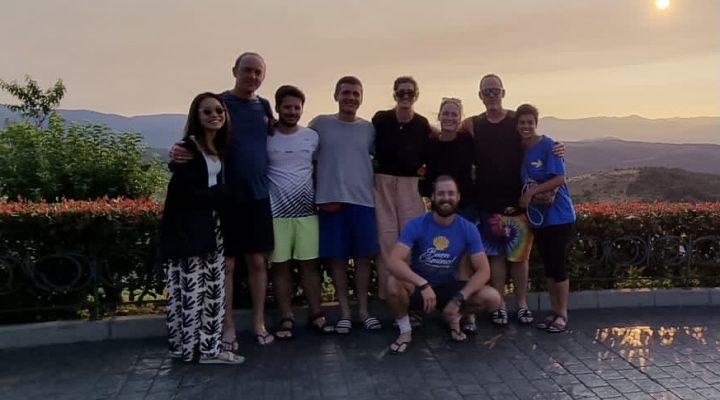
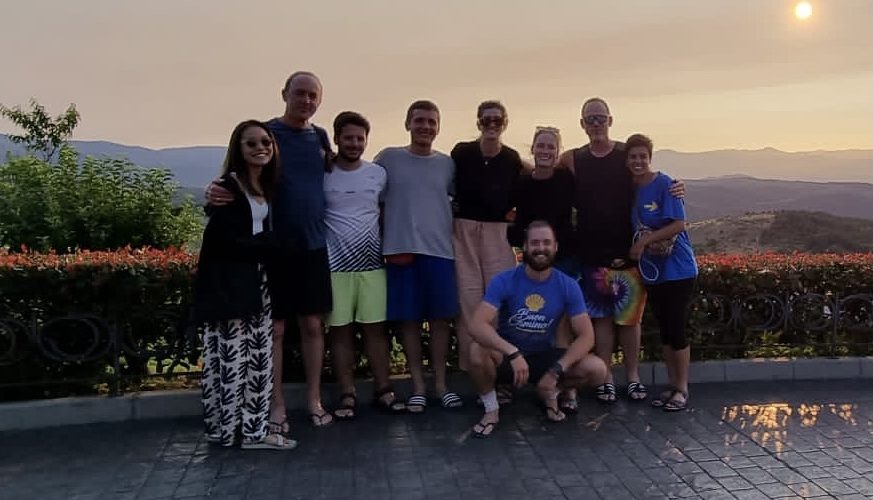
“Buen Camino.” This is the phrase every pilgrim uses on the Camino de Santiago — a 500-mile spiritual pilgrimage in Spain — when walking past another pilgrim.
Considering my walking pace was slower than everyone else’s, I often heard, “Buen Camino.” It started to sound more like, “Eat my dust.” Only an American would take a friendly phrase from a fellow pilgrim during a religious pilgrimage and turn it into competitive taunting.
America has put me in an awful mood. For example, I have found that in my 47 years of being alive, through counseling jobs, pastoring jobs, friendships, relationships, and in my political and religious observations, I feel pretty confident in saying people suck. We are petty, resentful, self-righteous, self-serving and mean. Not always, and not everyone, but enough. Enough to turn me into a recluse.
It took me about a week on the Camino to detox some of my reclusive, judgmental and cynical approaches to life. One evening, I came into a particular albergue, or hostel, and did my post-hike routine. I showered, hand-washed my clothes, hung them to dry and was about to lie down when a group of four women invited me to join their dinner.
As the night progressed, we discussed nothing and everything. Mostly, we just laughed and talked about our hurting feet. This excited my new Romanian friend very much. She claimed to have the cure for my five blisters — two on my left foot and three on my right. By night’s end, I had my feet elevated while she used a needle and thread to sow my blisters better.
Strangers showing love and community to strangers felt very strange to me.
After this night, my approach to my fellow pilgrims changed. I started to look for these social engagements. I began to walk with other people regularly. Beers were shared, and cheering commenced as people entered a town on the final leg of the day’s journey. A sense of closeness and acceptance started to happen.
I began to consider maybe people do not suck.
More importantly, I began to put down the anger, judgment and negative outlook on people, along with my ego. And I began to consider maybe people do not suck.
In America, every time we are around people, the headphones go in, the laptop opens and the phones come out. Anyone who tries to talk to you is annoying and lacks proper social awareness. Somehow, strangers do not notice the clear signal being communicated by everyone to leave them alone.
I have determined, based on America’s current divisiveness, this isolation might be a bad idea.
 In the last week of my Camino, I walked with a group of three women. In the evening, we still met up with a larger group for a community dinner. This group of women was a true test of my American go-go-go, win-at-all-costs personality. These three loved to stop and look at sights, go swimming in a river, or just sit and goof off at an outdoor coffee shop.
In my normal routine, I was out and walking by 6 a.m. and done by 2:30 p.m. I would spend 45 minutes on my shower and laundry routine and then relax. I was a machine, even though my Achilles heel may have been tearing.
This group took their time — a lot. We’d leave by 7:30 a.m. at best, and not get in until 5 to 6 p.m. It drove me nuts.
I was unable to leave the group because I was one of those lucky pilgrims who got to meet someone special on the Camino — a traveling nurse and a wonderful human being, who seemed to enjoy life and my company. That is an unusual combination in my experience.
But I decided having a walking schedule I hated was worth having the company of a gorgeous and intelligent woman who wanted my company all day.
I have been home for about a year now, and I must admit that I am already tired of people all over again. So ,what is the difference? I think much of it revolves around how we talk with each other and the topics that dominate the current culture in America.
Just an FYI about why the conversation is so much better on the Camino, here is the basic framework of things not discussed on the Camino — our careers, our families and anything relating to money (like no one passively mentioned their Tesla or a big house or anything that may reveal their class; too many Americans love, love alluding to how much money they either have or don’t have). No politics, no religion, no money and nothing alluding to social status.
In other words, no one drones on and on about their kids, partners or any other topic that is boring or potentially divisive to the listener.
On the Camino, the focus was simply on our true selves.
On the Camino, the focus was simply on our true selves. Our happiness, losses, suffering, insecurities and complete lack of conclusions about our own lives, our journey and our deepest parts of ourselves.
Now, that is talking.
The church service my group attended in the gorgeous cathedral in Santiago defined my last day on the Camino. I didn’t understand most of the service, but I did answer the call to have communion.
 This is a bit of a theological no-no if you are not Catholic, but I figured God could yell at me later. I went up and had the priest place the “body of Christ” or wafer on my tongue. For the first time in my entire Camino journey, I wept. A sense of God welcoming me back into his service came over me. I have failed in every way I could come up with in life and yet here is God saying, “Welcome back.”
I believe it is time to say, “Welcome back” to the people who have failed us.
Currently, the news focuses so much on what divides us, the church preaches about what divides us, the entertainment industry shows what divides us, and certainly, U.S. politics divides us.
It would seem the more we focus on what divides us as a society, the more divided we become. What divides us really divides us, but I believe it does not have to. The problem is that all this division is making Americans incredibly unhappy.
Back in America, we hate each other, judge each other, compete with each other and root for the failure of those who have wronged us or this country. The problem with that approach is all that hate and vengeful feelings eventually get connected to ourselves and to our families. We end up hating ourselves or passing on that self-hatred to our family.
Therefore, my original evaluation I have observed during my 47 years is true and the solution is a journey few seemed willing to participate in.
Wishing someone a “buen Camino” is to wish someone a happy journey. It is to hope that someone who is not yourself, that you know nothing about finds themselves on a happy path in their life.
These words are about recognizing we all are on the same journey. We all are carrying our backpacks, which contain what we have collected over the years. We all are in some pain, and we all want to find our place in this world. We all are unique in our approach. But in the end, most people want the same things in life. We want to love and to be loved, appreciated, truly heard, truly seen and to feel welcomed by some community.
Nathaniel Manderson was educated at a conservative seminary, trained as a minister, ordained through the American Baptist Churches USA and guided by liberal ideals. Throughout his career, he has been a pastor, career counselor, academic adviser, high school teacher and advocate for first-generation and low-income students, along with a paper deliverer, construction worker, package handler and whatever else he could do to take care of his family.
Related articles:
Living as pilgrims to know Jesus better
Pilgrimage making comeback — even with Baptists and unbelievers