

From the Smurfs to Superman, 2025 will be the year of the reboot in movie theaters across America. It’s common, during times of economic crisis and social upheaval, for Hollywood to trot out familiar favorites, playing on nostalgia for a boost at the box office.
A reboot also is a handy tactic for a president who needs to distract Americans from his inability to create the economy they want while simultaneously implementing the Project 2025 agenda they do not. Which is why at a recent news conference Donald Trump proposed a reboot of American imperialism — this time in Greenland.
All good reboots require a fresh take on beloved characters to revitalize the franchise while still luring in the fans. At the close of the 19th century, our scrappy upstart of a country had manifested its destiny all the way to the West Coast, and at the close of the 19th century was looking to expand its booming economy into international markets. As the old guard of Europe scrambled for land and raw materials in Africa, America set its sights on the Spanish territory of Cuba.
William McKinley

William McKinley (Wikipedia)
The Cuban people were rebelling against Spain in 1896 when Americans elected Republican William McKinley president. J.P. Mogan, J.D. Rockefeller and other Gilded Age Robber Barons funded McKinley’s $16.5 million ($5 billion today) campaign, ensuring they had a seat at the table when it came to international policy. As the revolution in Cuba began to threaten American investments and sugar plantations, McKinley’s former donors urged him to buy Cuba from Spain. When the Spanish refused to sell, McKinley deployed the battleship U.S.S. Maine to protect America’s economic interests.
For his American imperialism reboot, Trump wants to acquire Greenland from Denmark. Like McKinley, Trump is beholden to the business moguls who donated hundreds of millions to his presidential campaign. By this summer, the modern titans of industry who hope to profit in the imperialism reboot will have given half a billion dollars in total to Trump’s inauguration account, the MAGA Inc. Super PAC, a dark money group called Securing American Greatness, the Republican National Committee and Trump’s presidential library fund. In the cinematic universe of imperial America, crony capitalism is a recurring character.
“In the cinematic universe of imperial America, crony capitalism is a recurring character.”
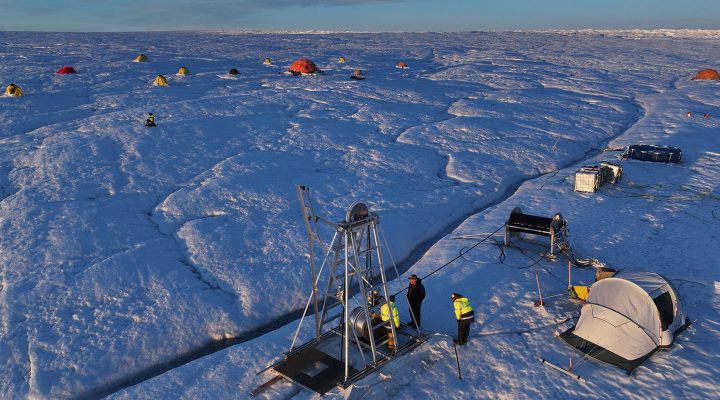
Greenland is at the center of a geopolitical “gold rush” as retreating ice caps allow easier access to valuable mining assets like lithium, which is used to manufacture electric car, laptop and cell phone batteries. Greenland also is rich in graphite, an important component of semiconductors, which have many and varied applications in computer technology, aerospace, automotive and nuclear engineering.
Tech oligarchs
Perhaps most important, outside of China, Greenland has the largest deposits of rare earth elements, known as REE for short, which are critical for electric car motors, wind turbines, aircraft engines, computer hard drives and the special computer chips that run artificial intelligence programs. The country’s cold climate, along with its renewable wind and abundant hydro energy, makes it ideal for enterprises that use large amounts of electricity such as cryptocurrency mining and the numerous data centers required to power artificial intelligence. Greenland also is home to 13% of the world’s untapped oil, 30% of the world’s undiscovered natural gas and the world’s second largest uranium deposit.
Compare the potential of Greenland’s raw materials to the needs of the corporations and the billionaires running them, and it’s obvious why these groups are backing Trump like never before. Toyota, Ford and General Motors, who stand to benefit from lithium and REE, each donated a million dollars to Trump’s inaugural fund. Megadonor Elon Musk, who says lithium is the “new oil,” is building North America’s largest lithium processing plant in Robstown, Texas, to furnish battery material for Tesla and SpaceX.

Priscilla Chan, Meta founder Mark Zuckerberg, Lauren Sanchez, Amazon founder Jeff Bezos, Google CEO Sundar Pichai and Tesla CEO Elon Musk attend the inauguration of U.S. President-elect Donald Trump in the Rotunda of the U.S. Capitol on January 20 in Washington, DC. (Photo by Chip Somodevilla/Getty Images)
Bill Gates and Open AI’s Sam Altman need uranium for the small nuclear reactors they hope will satisfy the growing electricity needs of AI. Gates also has joined Jeff Bezos to fund KoBold Metals, which uses artificial intelligence to search for valuable minerals. In August 2021, they partnered with the British company Bluejay Mining to begin scouring Greenland for the nickel, copper and cobalt necessary to manufacture their own electric cars. The Trump administration is said to be “very enthusiastic” about KoBold which, in 2024, had identified seven priority targets in West Greenland.
With China now banning the export of several REE to the U.S. and Trump threatening 60% tariffs on Chinese goods, Greenland’s treasure trove of REE also would be a boon for Meta, Google, Microsoft and Apple, which each donated a million dollars to Trump, along with the cryptocurrency company Ripple, which gave $5 million. Speaking anonymously, one Trump adviser told Axios: “The crypto guys are just blowing it out. It used to be $1 million was a big number. Now we’re looking at some folks giving like $10 (million) or $20 million.” Unlike campaign donations, presidential inaugurations have no limits on contributions or corporate involvement.
Aircraft manufacturer Boeing contributed to Trump’s inauguration fund, as did defense contractor Lockheed-Martin, which needs REE to manufacture the F-35 stealth fighter.
“Trump and his rich allies all stand to become even richer with a U.S. controlled Greenland to plunder.”
The bottom line is that Trump and his rich allies all stand to become even richer with a U.S. controlled Greenland to plunder. However, to reboot imperialism right, it is not enough for America’s president to have big business as a sidekick. He also needs a cooperative press.
William Randolph Hearst
In 1898, New York newspaper magnate William Randolph Hearst filled his New York Journal with sensational, if spurious, stories of Spanish atrocities designed to tug at readers’ heart strings. His illustrators personified Cuba as a helpless white woman in need of rescuing from a brutish, swarthy Spain. When the paper’s headlines falsely accused the Spanish of blowing up the U.S.S. Maine in the Havana harbor with a secret “infernal machine,” the humanitarian cause rapidly transformed into a military one. Still, McKinley remained reluctant to declare war until pressured by the business community and public opinion.
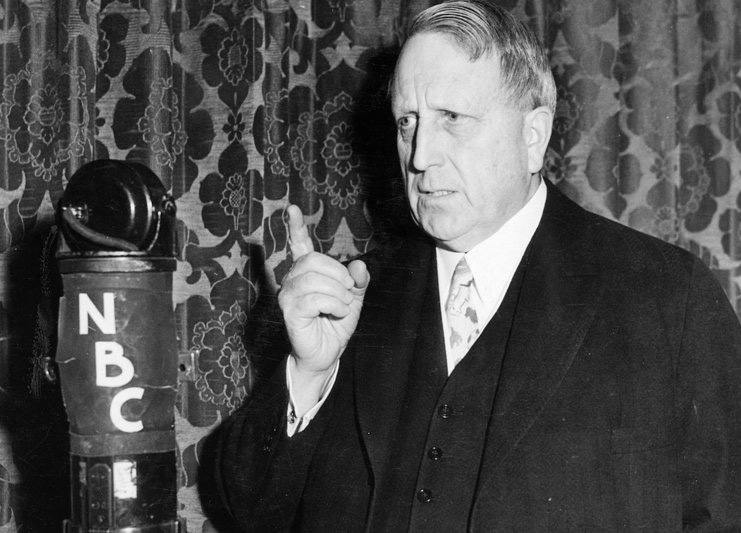
William Randolph Hearst (Photo: Margaret Herrick Library, Academy of Motion Picture Arts and Sciences)
Trump has a plethora of traditional and social media outlets at his disposal to support his imperialism reboot. In addition to his own Truth Social platform, where he said, “I am hearing that the people of Greenland are ‘MAGA,’” Fox News and Newsmax already are running segments endorsing Trump’s purchase of Greenland.
Facebook’s Mark Zuckerberg has promised he will “do nothing to obstruct the Trump agenda.” The algorithm of his now fact-check-free platform is amenable to Trump’s brand of conflict and chaos.
Trump also has support from Musk’s right-wing X. Musk himself posted, “The people of Greenland should decide their future and I think they want to be part of America!”
Jeff Bezos prevented the Washington Post, which he owns, from endorsing Kamala Harris and paid a $40 million licensing fee for Amazon Prime to air a vanity documentary produced by Melania Trump about her life as first lady.
In a content-generating publicity stunt designed to coincide with Trump’s press conference, Donald Trump Jr. and Turning Point USA’s Charlie Kirk traveled to Greenland. There they posed for photos under a controversial statue of 18th-century Danish missionary Hans Egede, who helped colonize Greenland and recommended enslaving its indigenous people. Trump Jr. and Kirk also met with homeless locals who donned MAGA hats in exchange for a free lunch.

Donald Trump Jr. (left) and Charlie Kirk in Greenland. (Photo: Instagram)
Kirk claims on his podcast the Greenlanders told him: “We feel like prisoners in our own land. We are being controlled by these Danish masters who treat us terribly.” A young boy (who is supposedly a fan), said to Kirk, “The Danes don’t let us mine our rubies, our gold, our lithium, or our gas. It’s time for a rebellion against the Danes!”
The location may be different but the message is the same. Trump must “liberate” the people of Greenland just as McKinley had to “rescue” the Cubans.
While the boy in Kirk’s story is oddly obsessed with lithium and natural gas, it appears others Kirk met in Greenland were completely ignorant of “oil.” As he told Newsmax in an interview, “They say, ‘Wait a second, we have this “liquid gold,” and this Trump guy is talking about “liquid gold” all the time in America. Why don’t we have that for our country?’”
The episode would be laughable if it were not so laden with condescension and racism.
Rudyard Kipling
Infantilizing indigenous peoples is standard practice for colonizers. British poet Rudyard Kipling celebrated America’s entrée into empire with the poem The White Man’s Burden. Having defeated Spain and won custody of Cuba, Puerto Rico, Guam and the Philippines, Kipling summoned Americans to Christianize and civilize the native people whom he called, “Half devil and half child.”
Portraying indigenous adults as child-like and/or in need of rescuing, as both Kirk and Kipling do, implies native people are incapable of self-government and stewardship of their land and its raw materials. They need a white savior to step in and take over. Trump implied something similar on Truth Social, saying about Greenland, “We will protect it and cherish it from a very vicious outside world.”
Some on the conservative right, including Kirk, already are calling for “ambitious Americans” to go and settle Greenland, which they view as a reopening of the American frontier. Left unsaid is what they plan to do about those already living there.
“Left unsaid is what they plan to do about those already living there.”
The Kalaallit (as the Inuit Greenlanders refer to themselves) have inhabited Greenland for 4,500 years and comprise 89% of the territory’s population. Familiar with the threat Trump’s first administration posed to the land and livelihood of Native Alaskans, the Kalaallit are (despite what Don Jr. and Charlie Kirk want you to believe) skeptical of Trump’s imperialism reboot.
“We know how they treat the Inuit in Alaska. Make that great before trying to invade us,” said Pipaluk Lynge, an MP from Greenland’s largest party and chair of the parliamentary foreign and security policy committee, in an interview with Politico. “We want our own independence and democracy.”
Greenland may vote on a referendum for independence as soon as April 2025. However, to be politically independent the country must become financially independent from Denmark as well. Currently, Greenland relies on Denmark for an annual subsidy of $600 million, which comprises 35% of the national income. Mining might be a pathway to national and financial independence; but harvesting and processing valuable rare earth elements comes at a high cost to the environment.
Rare earth
“Rare” is a misnomer. REE are common, but they exist in small concentrations jumbled together with other elements, including radioactive ones. To be useful, engineers must extract and purify the REE, an energy-intense process involving toxic chemicals that leaves behind wastewater ponds full of toxic acids, heavy metals and radioactive material. In China, mining REE has contaminated 10% of the arable land with heavy metals, and 80% of the groundwater is no longer potable.
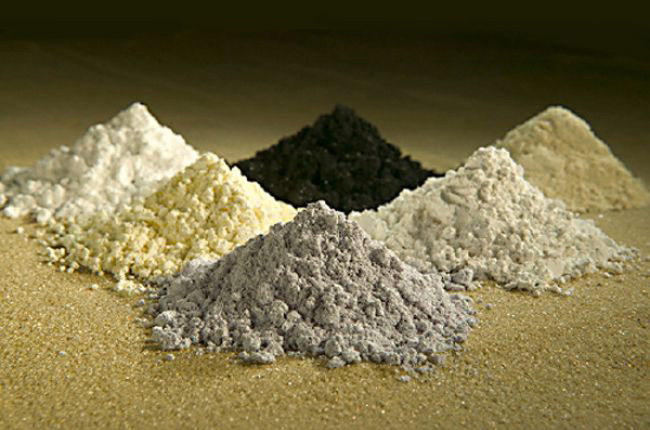
Examles of rare earth elements (Source: US Geologic Survey)
When Energy Transition Minerals (formerly Greenland Minerals) attempted to open an REE mine in Greenland that would release radioactive waste into a nearby lake, Kalaallit opponents formed the Inuit Ataqatigiit party and won the national election on a platform of “no uranium.” In 2021, they passed a law banning uranium mining, including any uranium bound to REE. Taking seriously its commitment to the Paris Agreement on Climate Change, the government of Greenland has also banned any future oil and gas exploration.
Reversing the country’s strict regulations for resource extraction and lifting the uranium embargo may be why Trump is looking to buy rather than lease Greenland. Not that Greenland or Denmark have any intention of selling; but, then, neither did Spain until forced to sell the Philippines to the United States.
It’s impossible to predict what policy Trump ultimately will pursue in his attempt to control Greenland and its resources. He may increase America’s military presence in Greenland, rebooting early 20th-century “gunboat diplomacy,” or he may threaten to decrease U.S. military involvement in NATO to gain their cooperation for his takeover of Greenland. Trump and his billionaire backers also could initiate a return to “dollar diplomacy” by imposing crippling tariffs on Denmark, which does billions in trade with the U.S., or dangling economic freedom in front of Greenland in exchange for unregulated access to the country’s natural resources.
Trump’s imperialist ambitions for Greenland are an encapsulation of the danger inherent in his administration. Trump has a price, and the billionaires filling Trump’s cabinet and his pockets are willing to pay it for a chance to line their own, regardless of how it impacts indigenous communities, the climate, our allies or average Americans.
Such unmitigated greed may work in the business world, but in global politics aggressive expansionism foments nationalism and transforms allies into adversaries. The same was true during America’s first foray into imperialism and the result was a world war. Let us hope Trump’s reboot of American imperialism has a happier ending.
Kristen Thomason is a freelance writer with a background in media studies and production. She has worked with national and international religious organizations and for public television. Currently based in Scotland, she has organized worship arts at churches in Metro D.C. and Toronto. In addition to writing for Baptist News Global, Kristen blogs on matters of faith and social justice at viaexmachina.com.