


Antisemitism has reached “deeply alarming” levels around the world by doubling in the past decade, according to a new report by the Anti-Defamation League.
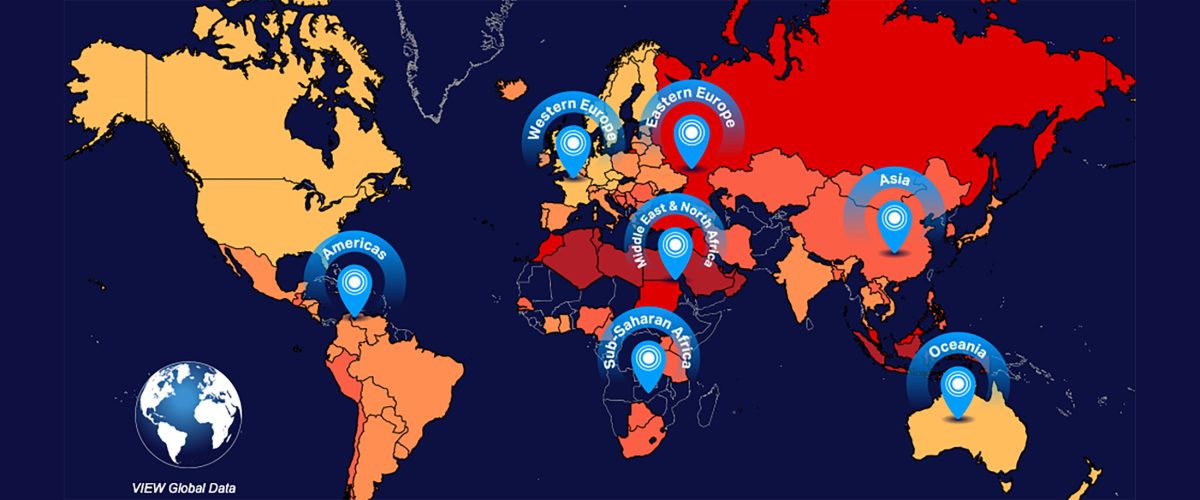
Close to half of all adults worldwide — or about 2.2 billion people — harbor “elevated levels of antisemitic attitudes,” ADL said in its latest Global 100 study. That 46% share is up dramatically from the 26% share documented in the organization’s 2014 antisemitism report.
“Antisemitism is nothing short of a global emergency, especially in a post-October 7 world,” ADL CEO Jonathan Greenblatt said in reference to the day in 2023 when Hamas militants attacked Israel.
“We are seeing these trends play out from the Middle East to Asia, from Europe to North and South America. It’s clear that we need new government interventions, more education, additional safeguards on social media, and new security protocols to prevent antisemitic hate crimes,” he added.
 The Global 100 index represents the share of 58,000 respondents from 103 nations who considered at least six of 11 stereotypes about Jews to be “definitely true” or “probably true.” The tropes included “Jews think they are better than other people,” “Jews are responsible for most of the world’s wars,” “Jews have too much power in the business world” and “Jews have too much control over the media.” Those surveyed also were asked if the Holocaust did or did not happen and if people “hate Jews because of the way Jews behave.”
According to ADL, 76% of adults in the Middle East and North Africa agreed with most of the 11 stereotypes, compared to 51% in Asia, 49% in Eastern Europe and 45% in Sub-Saharan Africa. The Americas followed with 24%, Western Europe with 17% and Oceana with 20%.
Nations and territories with the highest index scores included Kuwait and the West Bank, both at 97%, and Indonesia at 96%. The United States (9%), Sweden (5%) and Canada, the Netherlands and Norway (each at 8%) were among the nations with the lowest scores.
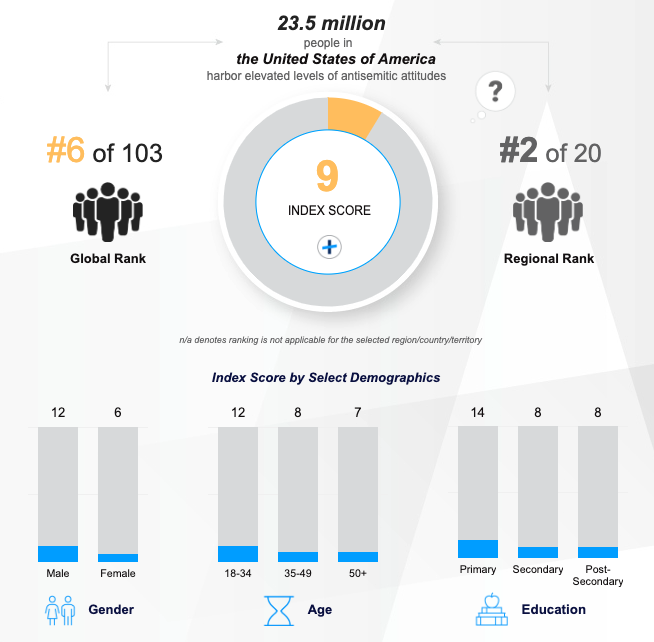
In the U.S., men were twice as likely to hold antisemitic views as women (12% vs. 6%). Generationally, adults 18 to 34 were more open to believing stereotypes about Jews than those 50 and older (12% vs. 7%). Likewise, Americans with primary schooling were much more likely to share such beliefs than those with secondary and post-secondary educations (14% vs. 8%).
Among Americans who harbor antisemitic stereotypes, the belief that Jews are loyal only to Israel had the most traction, at 27%. Seeing Jews as too influential in business followed at 17%, while 15% believe “Jews still talk too much about what happened to them in the Holocaust.”
But the U.S. also recorded a significant increase in antisemitic incidents, rising from 2,107 in 2019 to 8,873 last year, the report says. By comparison, Germany had 4,782 incidents against Jews in 2023, the United Kingdom 4,103 and France 1,676. No data on incidents was available from Middle Eastern, African and Asian countries as well as Central and South America.
The survey also warns that younger adults around the world are becoming increasingly open to antisemitic stereotypes, with 40% of respondents under age 35 agreeing “Jews are responsible for most of the world’s wars.”
In addition, 23% of younger adults view Hamas favorably. And only 16% of adults in the Middle East and North Africa, and 29% in Sub-Saharan Africa, believe in “the historical accuracy of the Holocaust,” the report states.
“Antisemitic tropes and beliefs are becoming alarmingly normalized across societies worldwide,” said Marina Rosenberg, ADL senior vice president for international affairs. “This dangerous trend is not just a threat to Jewish communities — it’s a warning to us all. Even in countries with the lowest levels of antisemitic attitudes globally, we’ve seen many antisemitic incidents perpetrated by an emboldened small, vocal and violent minority.