

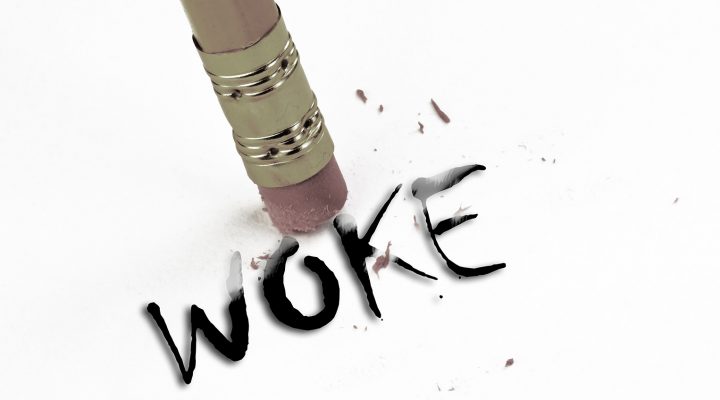

I remember well the day I heard the word “woke” for the very first time. It came from the mouth of a Black scholar addressing a conference on “Public Theology and Racial Justice” at Vanderbilt Divinity School in Nashville. It was a new word for me, at least in the context of racial justice, but I understood what she meant.
“Woke,” as she used the term, meant waking up to the long history of injustice committed against people of color in the United States. It meant waking up to the lament of oppressed people and hearing, not just with our ears but also with our hearts, what marginalized people wish us to know about ourselves, our churches, our synagogues, our schools and our country.
Richard T. Hughes
“Woke,” as she used the term, was the opposite of “dream,” as Ta-Nehisi Coates used that term when he described “the American Dream” embraced by people Coates called “the Dreamers.”
“I have seen that dream all my life,” Coates wrote. “It is Memorial Day cookouts, block associations, and driveways. The Dream is treehouses and the Cub Scouts. The Dream smells like peppermint but tastes like strawberry shortcake.” And the Dreamers — those who embraced that dream, live in “that other world … (which is) suburban and endless, organized around pot roasts, blueberry pies, fireworks, ice cream sundaes, immaculate bathrooms and small toy trucks that were loosed in wooded backyards with streams and glens.”
The American Dream, as Coates used that term, is a dream of a life so good, so insulated from suffering or tragedy, that one need not concern oneself with the plight of oppressed and marginalized people.
“For so long,” Coates continued, “I have wanted to escape into the Dream to fold my country over my head like a blanket. But this has never been an option because the Dream rests on our backs, the bedding made from our bodies.”
Awakening
“Woke” means to awaken from that dream long enough to understand — or at least to try to understand — what it is that Coates is talking about. One who cannot grasp the truth of Coates’ words is still fast asleep.
But “woke” means more than that. It also means an empathy so great that one stands in solidarity with those who suffer. It means feeling the burden of injustice and oppression so keenly that the burden becomes one’s own.
Yes, I understood well what the speaker meant when she used the word “woke.” I thought it was a powerful word, a beautiful word, and if not a Christian word, at least a word whose meaning was fully in sync with the counsel Jesus gave to “do unto others as you would have them do unto you,” fully in sync with the counsel given by the Apostle Paul to “bear one another’s burdens,” and fully in sync with Jesus’ vision of the upside-down kingdom of God. It was a word I knew I should embrace, for it had the ring of truth.
Derision
Only a month or two later, I heard that word again, this time in a radio ad for bedding. In that ad, “woke” was not a beautiful term, but a term of derision, even ridicule, heaped on the Black community from whence the word had come. That ad for bedding was one of many ads I would hear over the months to come — ads for a variety of products — that used the word “woke” to mock Black Americans, other oppressed and marginalized people, and the very idea of diversity.
“It was almost as if a gigantic choir, composed of white supremacists from all over the country, had responded on cue.”
I was shocked at how quickly “woke” had been adopted by conservative corporations, small businesses, legislatures, schools and even churches as a term of white resistance against Black demands for justice. And it seemed so coordinated. It was almost as if a gigantic choir, composed of white supremacists from all over the country, had responded on cue to some great conductor in the sky.
The term “woke” as a term of derision and ridicule quickly became a staple in the Republican vocabulary and central to their talking points. They used the term to target Black people, brown people, LGBTQ people and diversity initiatives of all kinds. American colleges and universities, they said, were woke and should be brought into line. The American military, they said, was weak because it was “woke.” And on and on they went, transforming the word “woke” into a synonym for evil and perversion.
Evangelicals join the chorus
And then, as if on cue, many evangelical Christians took up that same refrain. In that world, “woke” came to connote a way of life so committed to diversity, so tolerant of “the other,” and therefore so misguided that one could not be a Christian and “woke” at the very same time.
Long before anyone heard the word “woke” used in the context of racial justice, however, powerful Christian leaders sought to discredit the term “social justice.” In 2010, for example, the conservative pundit Glenn Beck attacked “social justice” as a “perversion of the gospel” and a “code word” for both communism and fascism. He advised Christians to “look for the words ‘social justice’ or ‘economic justice’ on your church website. If you find it, run as fast as you can. … If you have a priest that is pushing social justice, go find another parish.”
Over the next several years, the crusade against the terms “woke” and “social justice” became so intense that, in January 2024, the lead story in the Sunday edition of The New York Times appeared under the headline, “’America is Under Attack’: How Conservative Activists Took Aim at ‘Woke.’” The story told how a well-funded coalition of Republican activists “coalesced … around a sweeping ambition: to strike a killing blow against ‘the leftist social justice revolution’ by eliminating ‘social justice education’ from American schools.”
“The concept of ‘woke,’ they believed, implicitly suggested they might be racist, and that was an accusation they could not bear.”
In the end, many Christians heard the word “woke” as an accusation that challenged their sense of innocence. The concept of “woke,” they believed, implicitly suggested they might be racist, and that was an accusation they could not bear.
Teaching while woke
Over the years, I have sat around seminar tables with scores and scores of faculty members for whom the question, “What does it mean to teach from a Christian perspective?” has taken on great urgency. After all, they teach in Christian institutions of higher learning that often require them to address that question in applications for tenure and/or promotion.
After years and years of reflecting on that question, I have come to the conclusion that, fundamentally, teaching from a Christian perspective means teaching while woke. For if we teach while woke, ours will be classrooms where students feel free, even encouraged, to raise the most difficult sorts of questions, knowing those questions will be treated with seriousness and great respect.
If we teach while woke, we will encourage our students to be open to and supportive of those whose religion, race, politics and ethnicity may be different from our own.
If we teach while woke, our students will learn a Christian is one who stands with oppressed and marginalized people, not one who hungers for the “American Dream.”
If we teach while woke, we, their professors, will no longer hide behind our degrees, behind our lecterns and behind our various publications, but we will make ourselves vulnerable to our students, never afraid to respond to their questions with the simple answer, “I don’t know.” And we will learn from them, just as they learn from us.
“Teaching from a Christian perspective means teaching while woke.”
If we teach while woke, we will be sensitive to the fact that our students are more than consumers of information, that they are real human beings, many of whom bring to our classrooms stories of hardship, brokenness, parental divorce, exclusion on the basis of race or class, physical or emotional challenges that make it hard for them to learn, and so many other forms of hurt and deprivation.
And if we teach while woke, our classes, while communities of learning to be sure, also will become communities of trust where students know their stories of pain, or hurt, or hope can all be heard.
Most of all, if we teach while woke, we will try our best to see the world through the eyes of others — people whose religion, gender, ethnicity, social strata, race and worldview are different from our own — for learning to see the world through the eyes of others is the first requirement of Jesus’ command, “Do unto others as you would have them do unto you.”
In brief, if we teach while woke, we will emulate Jesus, who was open to every story, open to every pain, and open to every burden of those whose lives he touched. If we call ourselves Christian educators — educators who wear the name of Christ — how can we do less?
Belonging
Some months ago, several teachers convened around a small conference table to discuss the topic, “On Building a Culture of Belonging.” We gathered to explore the role that diversity — or the lack of diversity — played in our classrooms and on our campus. Each of them should have read in advance the essay you have just read, an essay first published by the journal Teleios under the title, “On Teaching While Woke.”
We quickly discovered, however, that no one had done the reading. Its use of the term “woke” had prompted the judgment, made somewhere in the institution’s halls of power, that the essay should not be distributed to participants in advance lest colleagues worry that someone, somewhere, had embraced a “woke agenda.”
Defending that decision, one of my colleagues argued that when the cultural establishment rejects a term like “woke,” we should simply abandon that term and find another. After all, he said, it’s the substance and content behind the term, not the term itself, that finally matters.
I responded that the cultural establishment had rejected not just “woke,” the term, but the entire landscape of meaning that the simple word had come to signify, from the claim that “Black lives matter” to the notion that diversity can be a positive force in American life. An alternate term, I told him, could be safe from wholesale cultural rejection only if it failed to carry with it the full embrace of diversity, of blackness, of marginality that the term “woke” had embodied.
And were we to embrace that safer alternate term, we inevitably would embrace a weaker, diluted concept. We could make our language more amenable to the American empire of whiteness, to be sure, but only by consciously or unconsciously diluting our commitment.
And what might be left of both language and commitment after the empire rejected term after term after term, always demanding language more consistent with its preferential option for whiteness and colonial control? Would any words be left? Any words that might speak to the crisis of our time? Any words beyond the one acceptable word — “conformity”?
In the end, that is precisely what the white American empire seeks to achieve.
Richard Hughes is co-author with Christina Littlefield of Christian America and the Kingdom of God: White Christian Nationalism from the Puritans to January 6, 2021. The heart of this article originally appeared in Teleios: A Journal of Holistic Christian Spirituality, Issue 4.2, Summer 2024 as published by The Crossroad Publishing Co. and is used here with permission.
Related articles:
SBC pastor opposes ICE raids in churches and gets labeled ‘woke’ by far right
‘Woke’: I don’t think that word means what you say it does | Opinion by Roger Lovette
Jesus is still woke | Opinion by Mark Wingfield