

Anyone watching the beginning of Donald Trump’s presidency can see that truth itself is on the scaffold.
Bonhoeffer’s life and thought gives us a lens to see our present dilemma as a nation and church. Dietrich Bonhoeffer is among the most formative theologians in my life. As a student at Union Seminary, I often walked past the Bonhoeffer Room. His presence filled the halls. I took classes from Paul Lehmann, who was his close friend when they were students together at Union in the early 1930s and who begged him not to return to Germany where he most likely would die at the hand of Hitler.
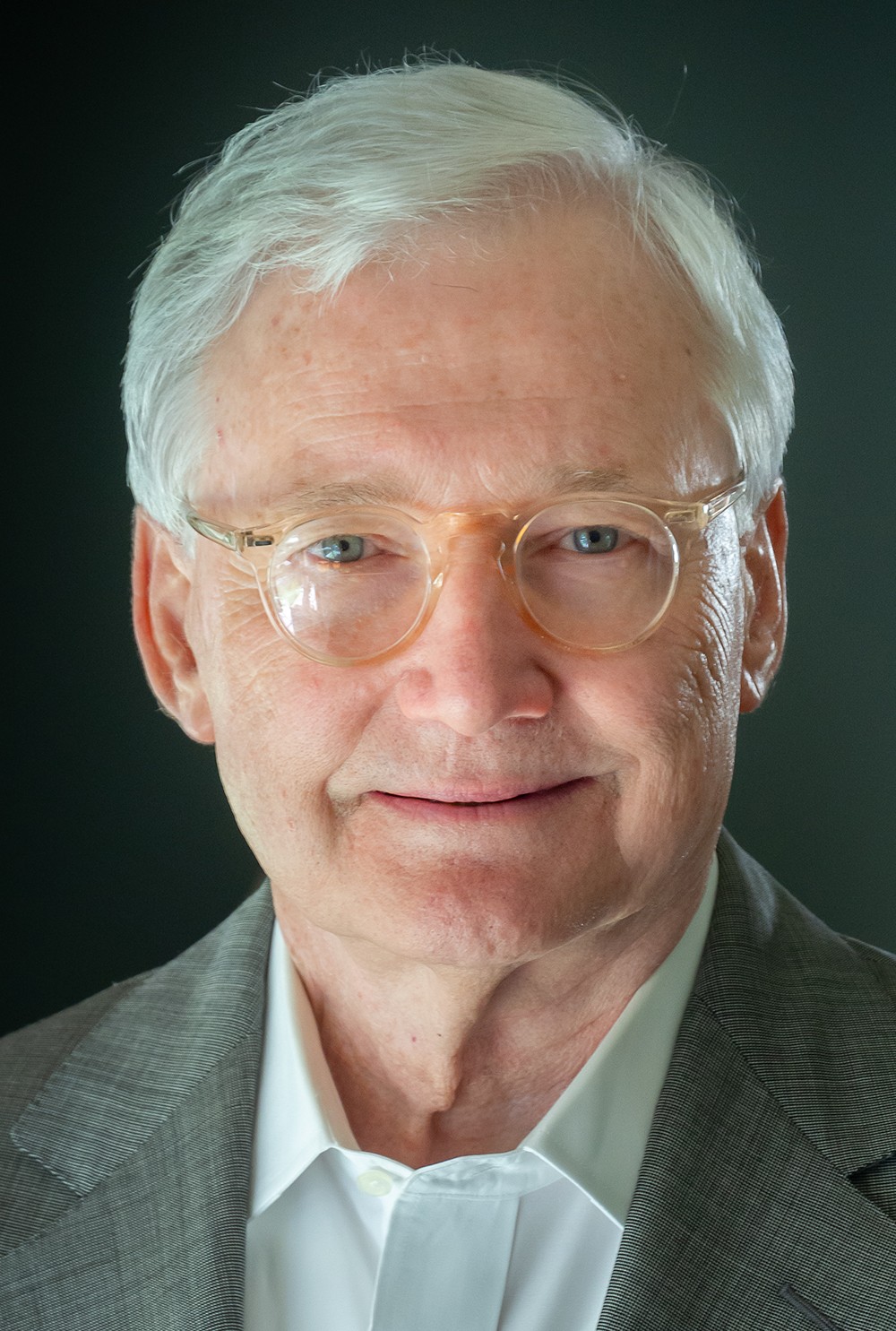
Stephen Shoemaker
I also write today because of thievery of his life and witness by the religious and political right-wing in our nation. The highjacking of his life has been led by Eric Metaxas, who wrote a flawed biography of Bonhoeffer and was part a “Stop the Steal” rally for then President Trump in December 2019. He has used Bonhoeffer to support Trump by equating the Democratic Party and President Joe Biden and “liberalism” in general with Hitler and the Third Reich. Ramping up the heat during the recent presidential election, he said this was a “Bonhoeffer moment” to save the nation.
I have a personal stake in the truth of who Bonhoeffer was.
Ironically, theologians on the more liberal side have been saying for nine years that the presidency of Trump was a “Bonhoeffer moment,” a time to begin resistance to Trump and Trumpism. Historical analogies never are exact, but how both political and theological sides could claim Bonhoeffer as their hero and guide could only happen when truth itself is in danger. So I offer this short introduction to his life and teachings, which have great relevance to the American church in these perilous times for both the church and the nation.
Bonhoeffer’s beginnings
He grew up in an aristocratic family in Germany, the youngest of six children along with his twin sister, Sabine. His father was a professor of psychiatry and his mother was the daughter of a minister, a chaplain in the court of Emperor Wilhelm II who quit his position when Wilhelm wanted to dictate what he preached and who one day referred to the proletariat as “rabble.” His beloved grandmother, Julie Bonhoeffer, was an outspoken advocate of women’s rights, and when Hitler passed a law forbidding citizens from shopping in stores owned by Jews, she at 91 marched right past the military police and shopped. Shopping as a seditious act.
When Bonhoeffer decided to go into theological studies, his father was deeply disappointed, thinking it a waste of his prodigious abilities.
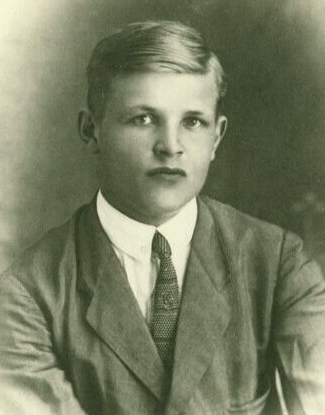
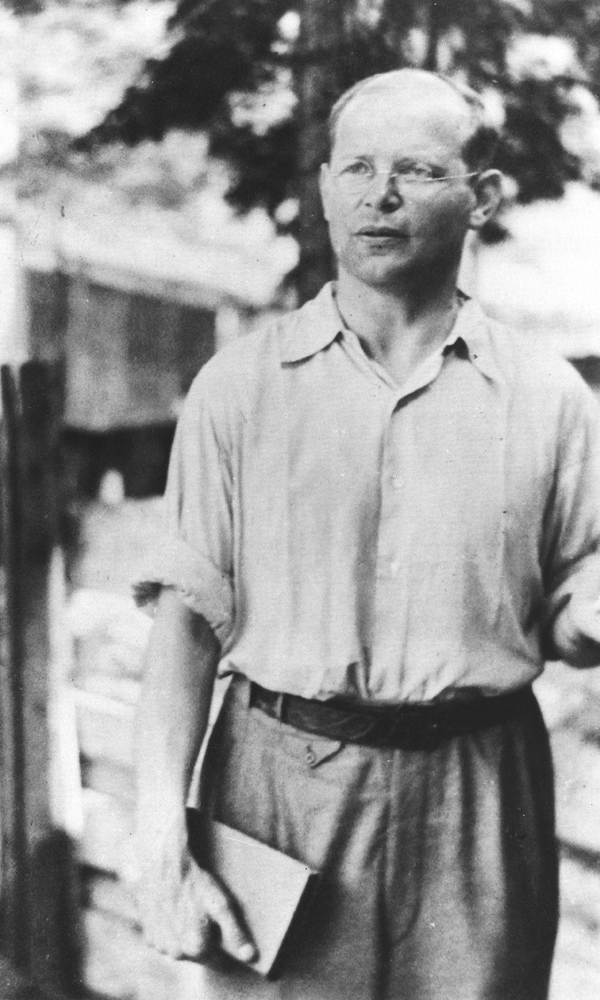
Young Dietrich Bonhoeffer
By the age of 24, young Bonhoeffer had received two doctorates and written two dissertations. Studying the nature of the church, always a key concern to him, he traveled at 19 years of age to Rome, where he discovered the worldwide ecumenical church so much broader than his German Protestant (Lutheran) Church. His dissertation was on “Christ Existing as Community Church.” As community!
The first sentence of his first sermon was, “Christianity entails decision!” He had set his path.
He traveled to the United States to study at Union Theological Seminary in 1930 and 1931. His first semester he said, “There is no theology here!” In Germany, theological studies focused on the history of doctrine and philosophy.
Metaxas and his followers like to pounce here.
But his second semester was transformative. He began attending and teaching Sunday school at the great Black church in Harlem, Abyssinian Baptist Church, not far from Union. His classes introduced him to the urgency of social justice and he traveled to the South with his Black classmate Franklin Fisher. He was scandalized by the treatment of Black people in the segregated South, and this trip gave him new eyes to see what was beginning to happen in Germany. (He did not know, nor did we, that Hitler had sent representatives to the U.S. to study how to subjugate and oppress an entire race of people.)
The Cost of Discipleship
When he returned to Germany, he wrote a now famous book, The Cost of Discipleship, its first sentence, “Cheap grace is the deadly enemy of the church.”
The book took a deep dive into Jesus’ Sermon on the Mount. He was undergoing a kind of conversion, he said, from “theologian” to “Christian.” Note that, all ye religious professionals. In a letter to a friend, he wrote: “I do believe that at last I am on the right track. … I think I am right in saying that I would only achieve true inner clarity and honesty by really taking the Sermon on the Mount seriously. Here alone lies the force that can blow all this hocus-pocus (of Nazism) sky high.”
 During that time, before Hitler came to power, he preached a sermon on national radio against what he called the “Fuhrer Principle” or political strong-man principle, that was taking over the nation. The producers of the radio program cut him off mid-sermon.
Helping Jews escape
He saw early the dangers of Nazism and the evil of antisemitism. He began to help Jews escape from Germany.
“Only the one who cries out for the Jews may sing Gregorian chants,” he said with characteristic sharpness. He had begun to see the great dividing line between the institutional church in Germany and a true following of Jesus. He helped form The Confessing Church, made up of pastors and Christians in resistance to Hitler and in repudiation of the German Christian Church, which had given its allegiance to Hitler and fallen under the sway of Nazism. The German Christian Church had become in their own words the “Reich Church.” (Today a number of American churches have started calling themselves “patriot churches.”)
Bonhoeffer raised the question and its stakes: “The question is really: Christianity or Germanism?” In 1939, he faced induction into the army. He was not yet ready to be arrested, so he traveled back to the United States and to Union Seminary. But as soon as he got there, he realized he had made a mistake. Against the pleading of his friends, he went back to Germany.
He wrote to Reinhold Niebuhr, his professor and friend at Union: “I must live through this difficult period in our national history with the Christian people of Germany. I shall have no right to participate in the reconstruction of Christian life in Germany after the war if I do not share the trials of this time with my people.”
As the clouds darkened, Bonhoeffer wrote with remarkable clarity and prescience that the church had three responsibilities toward the state:
- The first was to call the state to be the state as God ordained it to be, that is to maintain justice and stability.
- The second was its “unconditional obligation” to come to the aid of victims of state actions, all victims, every victim.
- The third was not only to bind up the wounds of victims underneath the wheel, but to seize the wheel itself. If a train is hurtling down upon a person, we must try to stop the train, in his words “put a spoke in the wheel.”
Kristallnacht
He had been moving toward this. On Nov. 9, 1938, the government’s violence against the Jews turned official and public. On the night remembered as “Kristallnacht,” the Night of Broken Glass, Jewish homes, businesses and synagogues were looted and burned. Holy objects were desecrated in the streets.
“How long, O God, shall I be a bystander?”
That night Bonhoeffer opened the Bible and read Psalm 74: “Your foes have roared in your holy place; they set up their emblems there. … They set your sanctuary on fire.” Bonhoeffer wrote in the margin of his Bible: “How long, O God, shall I be a bystander?”
These are searing words for our consciences today.
On April 15, 1943, he was arrested for being part of a plot to assassinate Hitler. Bonhoeffer had chosen his path as his path, not as a model for Christian action, but as the witness he chose tremblingly to give. He was willing to take upon himself the guilt of murder and place himself outside Christian teaching for the sake of the Jews and other innocent victims of the Nazi reign of terror.
On April 9, 1945, he was executed on orders of Hitler. During his two years in prison, his friends carried letters out which we know now as Letters and Papers from Prison. In one of them he wrote, “The church is church only when it is there for others.”
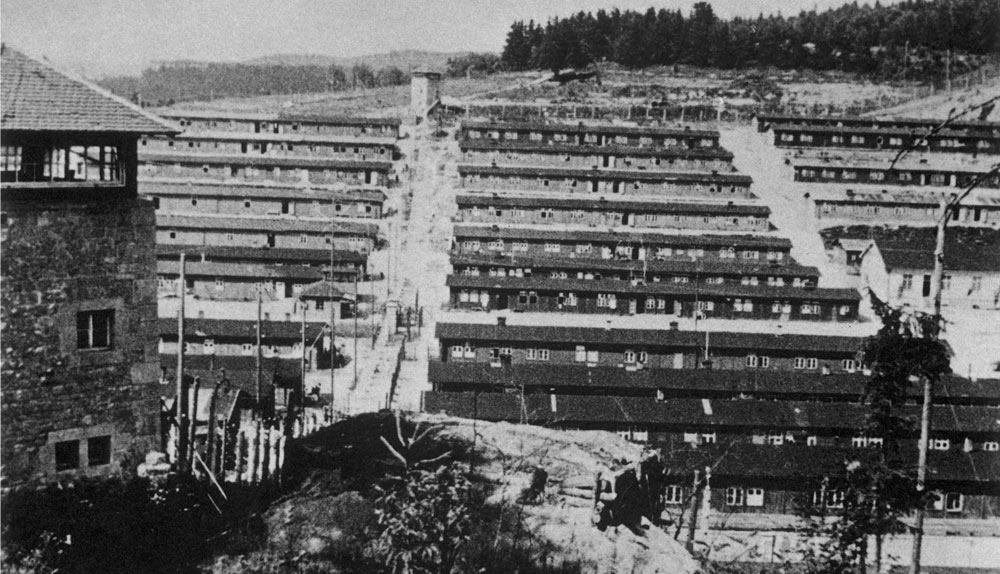
Flossenbürg concentration camp, administration and prisoner area
Who Am I?
Never parading himself in spiritual superiority, his poem from prison shows his remarkable humanity and humility:
Who am I? They often tell me
I step out from my cell
calm and peaceful and poised
like a squire from his manor.
Who am I? They often tell me
I speak with my guards
freely, friendly and clear,
as though I was the one in charge.
Who am I? They also tell me
I bear the days of my calamity
serenely, smiling and proud
like one accustomed to winning.
Am I really what others say of me?
Or am I only what I know of myself?
Restless, yearning, sick, like a caged bird,
struggling for breath, as if I were being strangled,
starving for colors, for flowers, for birdsong,
thirsting for kind words, human closeness,
shaking with rage toward power lust and pettiest insult,
tossed about, waiting for great things to happen,
helplessly fearing for friends so far away,
too tired and empty to pray, to think, to work,
weary and ready to take my leave of it all?
Who am I? This one or the other?
Am I this one today and tomorrow another?
Am I both at once? Before others a hypocrite
and in my own eyes a pitiful, whimpering weakling?
Or is what remains in me like a defeated army,
fleeing in disarray from a victory already won?
Who am I? They mock me, these lonely questions of mine.
Whoever I am, thou knowest me; O God, I am thine.
Our question today
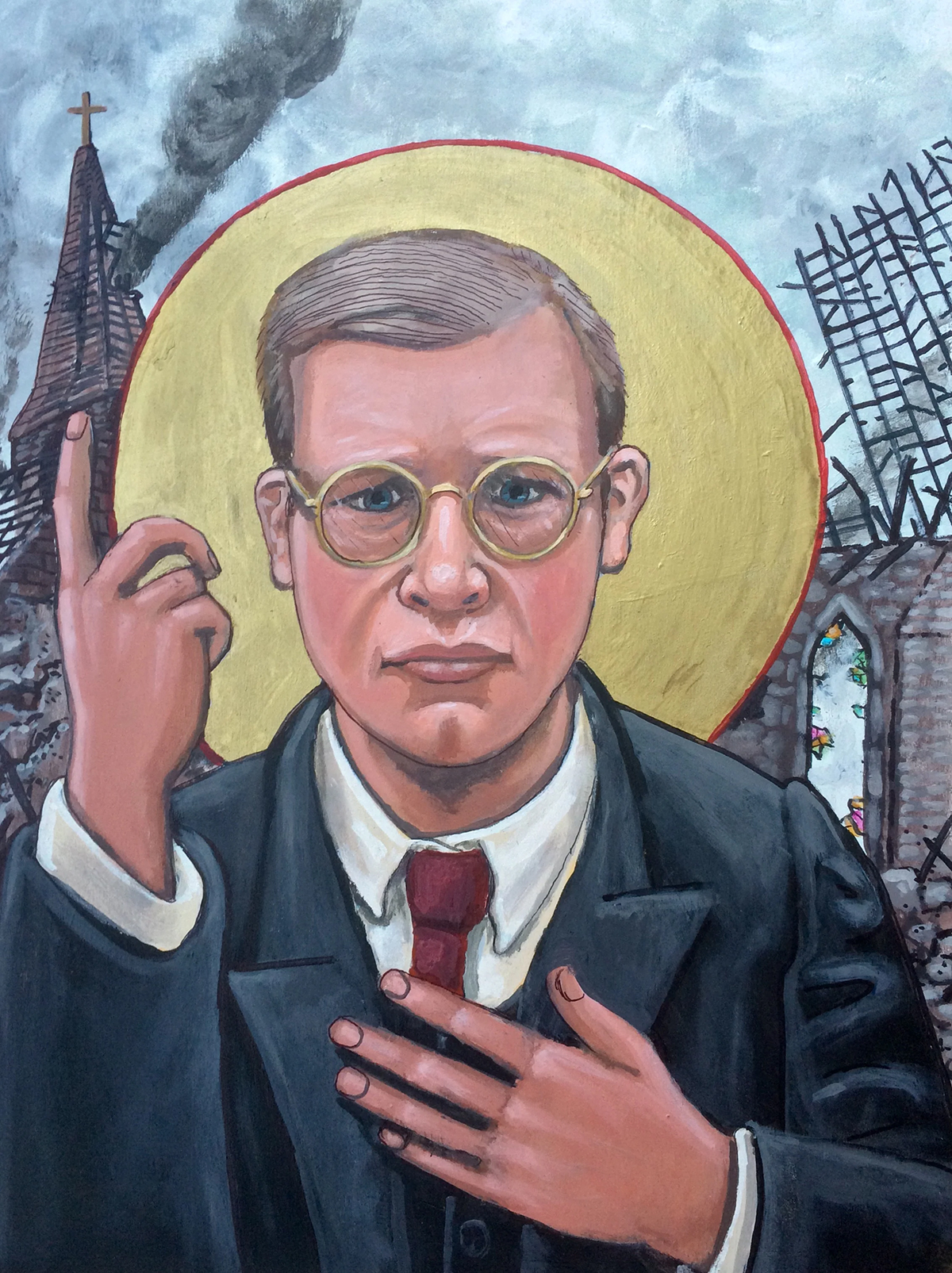
Dietrich Bonhoeffer icon by Kelly Latimore
The key question of our lives, being tested in this moment, is not “Who am I?” but “Whose am I?”
Will we take up the “unconditional obligation” to the present victims of state action? Trans people, demonized by almost $300 million of political ads during the last presidential campaign, whose rights are now being abrogated? Immigrants, legal and undocumented, now living in terror? Women of childbearing age living in restrictive states on abortion and women’s health care? We start there, but victims of state action and official cruelty are everywhere.
Will we commit, as Bonhoeffer hoped he would be able to in Germany, to the “reconstruction of Christian life” in America? A reconstruction that will be for us as it was for him, a new centrality of Jesus’ Sermon on the Mount in the life of the church.
Will we follow him as we live in a time where truth is every day and every hour now on the scaffold?
Stephen Shoemaker serves as pastor of Grace Baptist Church in Statesville, N.C. He served previously as pastor of Myers Park Baptist in Charlotte, N.C.; Broadway Baptist in Fort Worth, Texas; and Crescent Hill Baptist in Louisville, Ky.
Related articles:
The strange grace of struggling with Bonhoeffer on what it means to be a ‘good’ person | Opinion by Kristopher Norris
How conservatives misuse Bonhoeffer, King and Reagan | Analysis by Rodney Kennedy
Is this a Bonhoeffer Moment? | Opinion by Richard Hester