

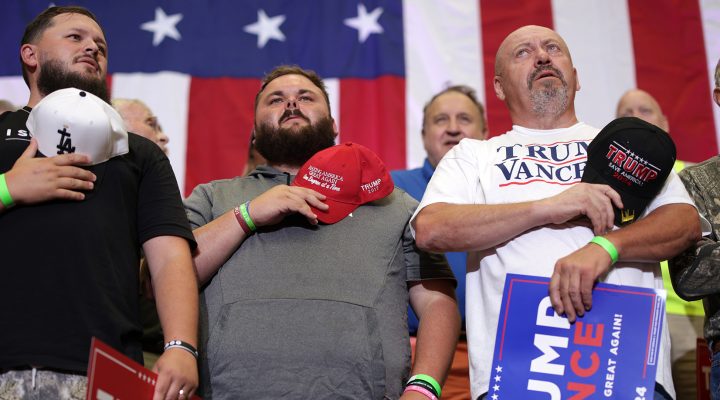
Right-wing influencers propelled Donald Trump to power by spreading misinformation that convinced the MAGA base to support political agendas detrimental to their own interests, according to Katherine Stewart, author of Money, Lies, and God: Inside the Movement to Destroy American Democracy.
Stewart discussed her research for the new book on “The State of Belief” podcast moderated by Interfaith Alliance President Paul Raushenbush. She described how billionaire powerbrokers and Christian nationalists diverted the attention of Trump’s core supporters from their own economic needs to issues they perceive as threats to their cultural and religious identities.

Katherine Stewart
“How do you get the rank and file to vote for policies that are going to make their lives harder? You get them to vote on these culture-war issues, these side issues, which I think of as these shiny baubles you dangle in front of people’s faces having to do with gender and identity and all the issues that don’t pertain to a lot of people and have nothing to do with the price of eggs or shutting down your factories.”
Among the consequences of those tactics is the ongoing and open attacks against religious freedom by the Trump administration and its conservative Christian allies, Raushenbush said.
He cited Trump’s insult-laden rebuke of Episcopal Bishop Mariann Budde’s homiletic plea for him to show mercy to marginalized communities, and a subsequent House bill to censure the pastor for her remarks. Trump sidekick Elon Musk accused the Evangelical Lutheran Church in America of misusing federal grants to help refugees, and Vice President JD Vance made the same accusation against the Roman Catholic Church.
Since the inauguration, Raushenbush said, “there has been a continuous attack on religion and religious folks and religious expression coming out of the Trump administration. I would say it’s the most blatant attack on religious communities we’ve seen in decades. In fact, I don’t remember anything like it. Anybody who expresses their religion that isn’t in lockstep with them is going to be attacked.”
“Anybody who expresses their religion that isn’t in lockstep with them is going to be attacked.”
But those attacking religious freedom are doing so with a veneer of Christianity to legitimize their actions, he added. “This is classic, this is Project 2025 with the underpinnings of Christian nationalism. They have shown they don’t care about Christianity; they care about their small version of Christianity.”
There was a time when these now-influential groups operated in the shadows, said Stewart, also author of The Power Worshippers: Inside the Dangerous Rise of Religious Nationalism.
 “When I started writing on this topic 16 years ago, I was researching a movement that appeared to be people at the fringes of American society. They were trying to force their programming into public schools, and said they just wanted to have their opinions heard, to be one voice in the noisy forum of American democracy. And they claimed to stand for values,” she explained.
Yet gradually a broader agenda emerged, namely a scheme to destroy public education, she said. “This is now the movement that has seized control of the Republican Party. The guardrails have really fallen away, and it’s the extremists who are deeply anti-democratic, more overt in their hostility to democracy than ever before, and they are the ones driving the agenda.”
But it isn’t only right-wing Christians calling the shots, she added. A number of billionaires and far-right organizations — many of them with incompatible goals — are financing attempts to take over the courts, destabilize democracy and keep Trump in the White House in order to grow their fortunes.
“Some funders are frankly atheistic and, religiously, they are all over the place. But they agree on one thing, which is the need to crush liberals in what they call the ‘administrative state.’ The funders often want economic policies that are going to justify and increase their massive concentrations of wealth. They want low taxes for the rich and minimal regulation of extractive businesses that they may be leading.”
The role of Christian nationalist pastors and social media influencers is to provide the ideological framework for the agenda to rid churches of so-called woke theologies and teachings and to help spread misinformation and conspiracy theories designed to keep the faithful in line, she said.
“This is a movement that wants to separate people from the facts because it makes them easier to control.”
The claim that Christians are persecuted in the U.S. is one of the biggest lies conservatives have told, Raushenbush said. That has inspired them to “fight back.”
The continuing spread of misinformation is a cause for alarm because it makes opposing the movement all the more difficult, Stewart responded. “This is a movement that wants to separate people from the facts because it makes them easier to control.”
Belief that the 2020 election was stolen, that spiritual battles are unfolding in the political realm and that Trump is the savior of the nation and world are among the most damaging conspiracy theories and misinformation spread on social media, in right-wing churches and by conservative news outlets.
However, the situation is not hopeless, Stewart added. “We know the administration is going to pursue a lot of performative politics, but we also know they are going to overstep, and we also know there is a certain level of incompetence. We also know they’re internally divided.”
Also, remember Trump’s forces, although well organized, remain in the minority, she said. “More Americans prefer to live in a democracy, however imperfect it may be, than in some sort of kleptocratic authoritarian system with theocratic features. That’s not what America wants. So, we are in the majority and we need to act like it.”
Related articles:
Trump vows to ‘protect’ Christians in America
This is not Christianity | Opinion by Mark Wingfield
MAGA ramps up attacks on US Christian groups | Analysis by Jeff Brumley