

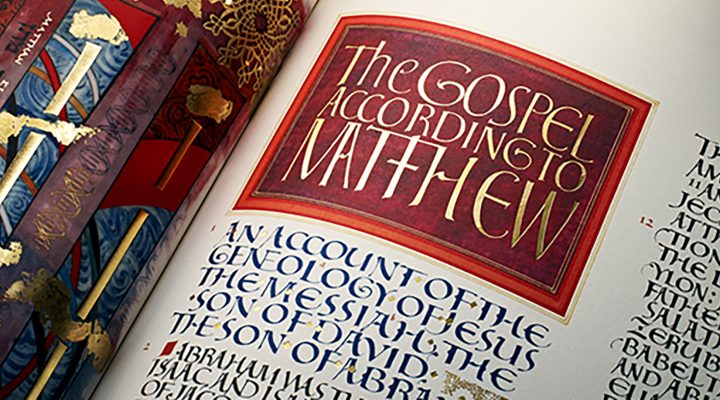
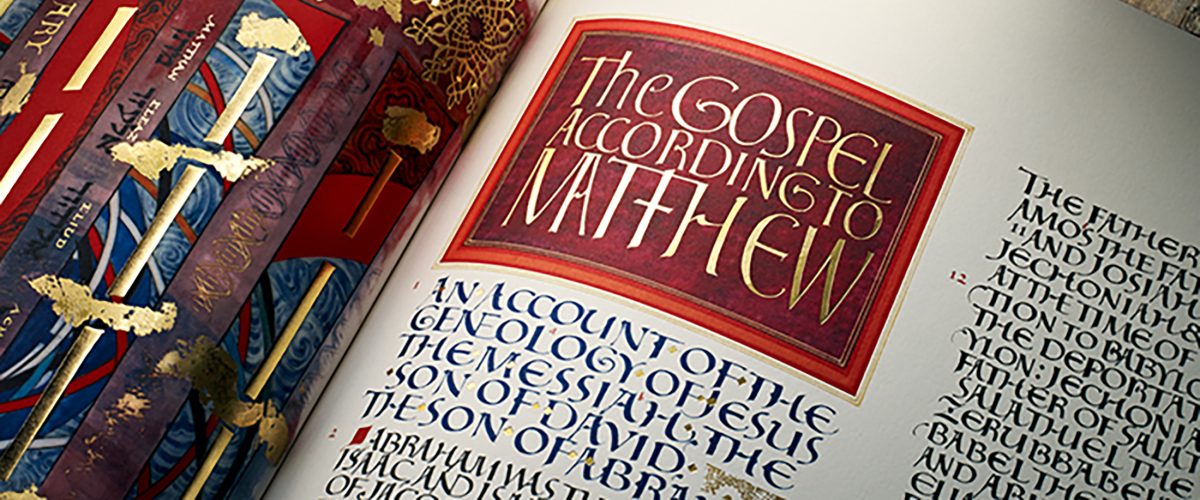
In an article about the recently completed St. John’s Bible — the first handwritten and illuminated Bible produced by the Benedictine Order in more than 500 years — Duke University professor Ellen F. Davis asks, “When is beauty a moral urgency?
Her answer is, “All the time. … Beauty is a matter of urgency when it is summoned in the service of hope.”
In her estimation, the creation of this brilliantly illustrated Bible is a “gift of hope” in our time of “awareness and urgency.” Her article has led me to think about the meaning of artistry in our common life.
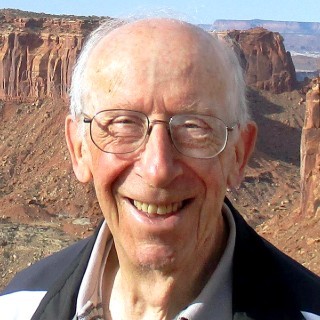
Tom Reynolds
One of the pastimes in which I engage is the making of watercolor images. Most of what I paint are scenes from my travels. I am largely self-taught, a condition that is illusory and dubious in many pursuits, but it is my estate. I find considerable pleasure and a sense of fulfillment as I choose a subject — generally a landscape or architectural image — draw a reasonable facsimile of it, and begin to render it with my watercolor paints.
The delight of seeing the picture unfold on a blank piece of paper signifies for me what must have been pure joy for the Creator who looked on the evolving universe and said, “That’s good!” And what a creation that is — more complex than our best minds can grasp and more beautiful than any of us would-be artists can emulate.
One person who tried to get his mind around the beauty and wonder of creation was psychologist Abraham Maslow, who once spoke of a moment of awakening to what he called a “peak experience” in his observation of the human kidney. Peak experiences, in Maslow’s understanding, are moments of wonder and transcendence that bring us joy and may be life changing.
“Beauty is a matter of urgency when it is summoned in the service of hope.”
In his book Toward a Psychology of Being, Maslow identified 16 qualities he found in those who have realized peak experiences: Integrated, oneness, powerful, effortlessness, self-determined, free of inhibitions, spontaneous, creative, uniqueness, present, merging of self and other, nonstriving, poetic expression, completeness, playfulness, surprise.
Maslow wrote as a scientist, but his list exemplifies the qualities that have been embraced by deeply intuitive people of all faiths. For me, the word that sums it up is “wonder.”
We can but try to express our amazement in “peak” moments that surprise us with joy. In doing that, painters, poets, composers, singers, instrumentalists, sculptors, actors, dancers — add your designations to the list — are incarnations of a divine creativity that continues to give meaning to our human existence.
In her book Walking on Water, Madeleine L’Engle wrote: “Gestation and birth-giving are basic to any form of creation. All of us who have given birth to a baby know that it is ultimately mystery, closely knit to God’s own creative activities, which did not stop at the beginning of the universe. God is constantly creating, in us, through us, with us, and to co-create with God is our human calling. It is the calling for all of us, his creatures, but it is perhaps more conscious with the artist — or should I say the Christian artist?”
When despots try to destroy the things that make human life dear and good, artists will still be creating, because artistry and creativity are knit into their very being. Their works divert our attention from the banal, trivial and profane and stir within us a yearning for beauty, grace and joy.
So, I say it as plainly as I am able: God is the Great Artist and we, created in God’s image, are artists, too. (Yes, it is true that artists can be as flawed — vain, profane and banal — as the rest of us; they are, after all, human and frequently bear the emotional burden — think Beethoven, Van Gogh and Dostoevsky — of bringing truth to light in sublime ways.) Our task, our calling, our mission is to create, not destroy; ours is to represent the beauty we observe or imagine in the medium of our choice so as to ennoble our humanity and inspire each other to live on a higher plane — to be joyful and just, hopeful and helpful, loving and lovable, free and fearless.
“In times of darkness and fear, artists point us beyond despair and desperation.”
In times of darkness and fear, artists point us beyond despair and desperation. Every day, I try to do something creative — write a piece like this, draw some lines on paper, lay a wash on a painting, bringing into existence a new creation — something that never has been done just this way before. It’s what artists do. And the great ones cause us to stand in wonder and amazement asking, “How did she do that?” The answer is by expressing the creativity at the heart of the universe, doing what they were born to do — bringing new forms of artistic expression into the world.
At the end of the movie Babette’s Feast, Babette, a servant in a small religious community — who, unknown to the locals, was formerly a master chef — spent all her financial resources to provide one fabulous meal for her humble friends. When asked why she has done that — made herself poor to please them — she replies, “An artist is never poor.”
And she continues, quoting a famous singer they all know: “Throughout the world sounds one last cry from the heart of an artist, give me the chance to do my very best.”
True artists may not be wealthy in the world’s way of valuing things, but they are rich in spirit and enrich the world.
So, look around; see the beauty in the world. Cherish it and love it. And in any way you can, embrace and emulate it. Anything else is empty, loveless and demeaning to oneself and to the creation that at its beginning was pronounced “good.”
Lines from a letter attributed to Giovanni Giocondo say it well: “Life is so full of meaning and purpose, so full of beauty — beneath its covering — that you will find earth but cloaks your heaven. Courage, then to claim it, that is all. But courage you have, and the knowledge that we are all pilgrims together, wending through unknown country home.”
In these days of “awareness and urgency” that’s what artists and lovers of art will do.
Tom Reynolds is a retired pastor who lives in the Bridgewater Retirement Community in Bridgewater, Va. He served as pastor of Harrisonburg Baptist Church for 19 years and then served several churches as an intentional interim minister over the span of 10 years. In addition to playing pool, meditating, reading, writing, watercolor painting and playing Rook, he remains active in community ministries.