

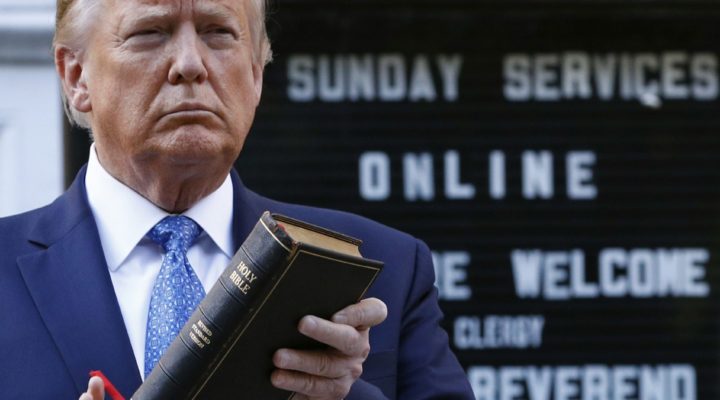
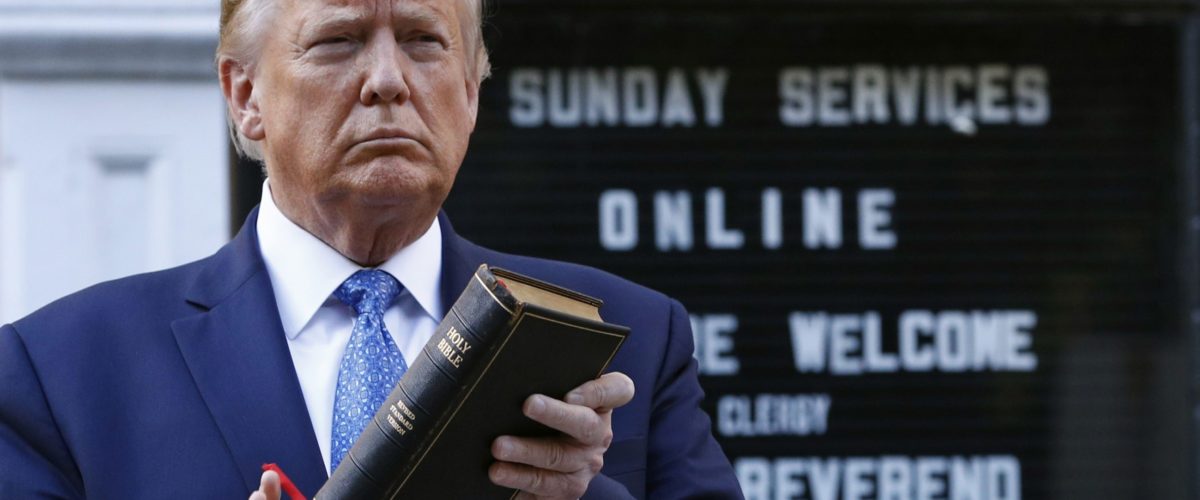
One of the most potent and frustrating images of President Donald Trump’s previous time in office was his infamous photo op at St. John’s Episcopal Church in June 2020, wherein the president cleared protesters out of the public space so a photo could be taken of him holding a Bible aloft without opening it or reading it.
Setting aside the sociopolitical implications of that moment, it spoke to Trump’s biblical illiteracy that he couldn’t draw upon the book for any sort of consolation or unity at a particularly coarse moment in the history of American politics. He could’ve pulled from any verse to make a meaningful point — from “there is neither Jew nor Gentile” to “in Christ we, though many, form one body, and each member belongs to all the others,” or even just flipped to a random page to spin whatever he happened to land upon for that moment.
Somehow, he felt waving a Bible in front of a partially burnt house — swinging leather like a fiery Baptist minister at the pulpit — would help. As the Episcopal Bishop Mariann Budde wrote at the time, “I am outraged that he felt he had the license to do that, and that he would abuse our sacred symbols and our sacred space in that way.”

Paula White (white dress) leads a group of charismatic pastors to pray over President Donald Trump in the White House.
Biblical illiteracy
Whatever one thinks of the man, Trump cannot be accused of being or trying to be a deep biblical thinker. As he famously said in a 2016 interview with radio host Bob Lonsberry, his favorite Bible verse is “an eye for an eye.”
Trump is a highly reactionary and instinctual thinker. Despite being raised in a Presbyterian household, his most abiding religious influence is Norman Vincent Peale, author of The Power of Positive Thinking. Trump’s religious views, to whatever degree he can be said to follow them, are more in line with the ideals of the prosperity gospel or spiritual manifesting than orthodox teachings.
“This relative biblical illiteracy certainly sets him apart from other prominent Christian politicians in the last century.”
This relative biblical illiteracy certainly sets him apart from other prominent Christian politicians in the last century who were far more willing to directly quote Scripture in their speeches and appeals to the American people. Whatever you think of the politics of Ronald Reagan, Jimmy Carter and George H.W. Bush, recent presidents from both parties have been deeply biblically literate and drew upon the Scriptures for their moralism, rhetorical strategies and speeches.
In the past decade, Trump’s relative religious apathy has filtered down into the Republican Party itself. While evangelicals, Catholics and Latter-Day Saints have proved remarkably willing to overlook his character flaws for the sake of political victories, the party itself has completely shifted around his cult of personality. Every Republican National Convention for the past decade has washed out the majority of old-guard conservative warriors in favor of members of the Trump family and his supporters. The committee is even run by his daughter-in-law, Lara Trump.
How can it be that the political party that once washed out Newt Gingrich for adultery is now filled to the brim with porn stars, WWE wrestlers and weirdo gadflies? Many have called this transition nakedly hypocritical, but another way to look at it is as a form of secularization. Just as the progressive left has generally become less adherent to Christianity, the right is responding in kind and shifting its moral calculus to power-seeking strategies.
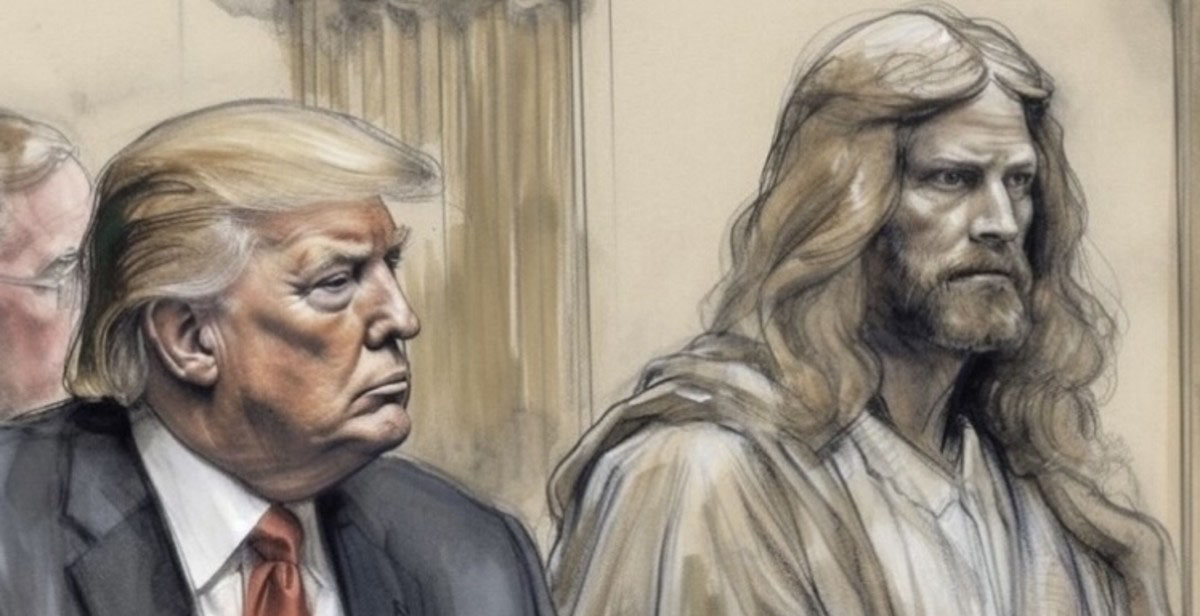
Fake courtroom sketch of Donald Trump with Jesus.
Christian nationalism
As The Sociological Forum reports in a 2021 study on Christian nationalism: “Christian nationalism is only significantly associated with Trump support among unchurched voters. These results suggest that while religious sentiments remain key correlates of political attitudes and behavior in the United States, these ties may have less to do with embeddedness in traditional religious organizations and more to do with the ways people use religious narratives in everyday life to construct and defend symbolic boundaries. At a time when fewer Americans attend religious services, religious narratives about Christian nationhood may have their strongest political effects when, and perhaps because, they are detached from religious institutions.”
“Just as the progressive left has generally become less adherent to Christianity, the right is responding in kind.”
Trump’s great gain wasn’t merely from Christians relaxing their moral standards but from non-Christians or lapsed Christians becoming more secular. Their increased nationalism and tendency to chase personality cults and authoritarian leaders have correlated with a decrease in adherence to Christianity.
This is not to suggest the Republican Party has stopped being superficially Christian or Christians are in exile from the party. The party doesn’t need to become openly hostile to Christianity for it to secularize. As social scientist Ryan Burge notes, the data suggest the opposite. Between 1988 and 2022, the percentage of Republicans saying they believe in God “without a doubt” only dropped from 66% to 63%. Democrats have secularized a great deal more in this time, dropping from 63% to 39% in answer to the same question.
There are data, though, to suggest significant degradation within American evangelicalism. A 2022 State of Theology study found 43% of respondents agreed with the statement that “Jesus was a great teacher, but he was not God,” reflecting an abandonment of trinitarian theology amongst nearly half of evangelicals. For any number of reasons, evangelicals are becoming more unmoored from traditional Christian teachings over time even as it remains culturally loyalty to its political tendencies.
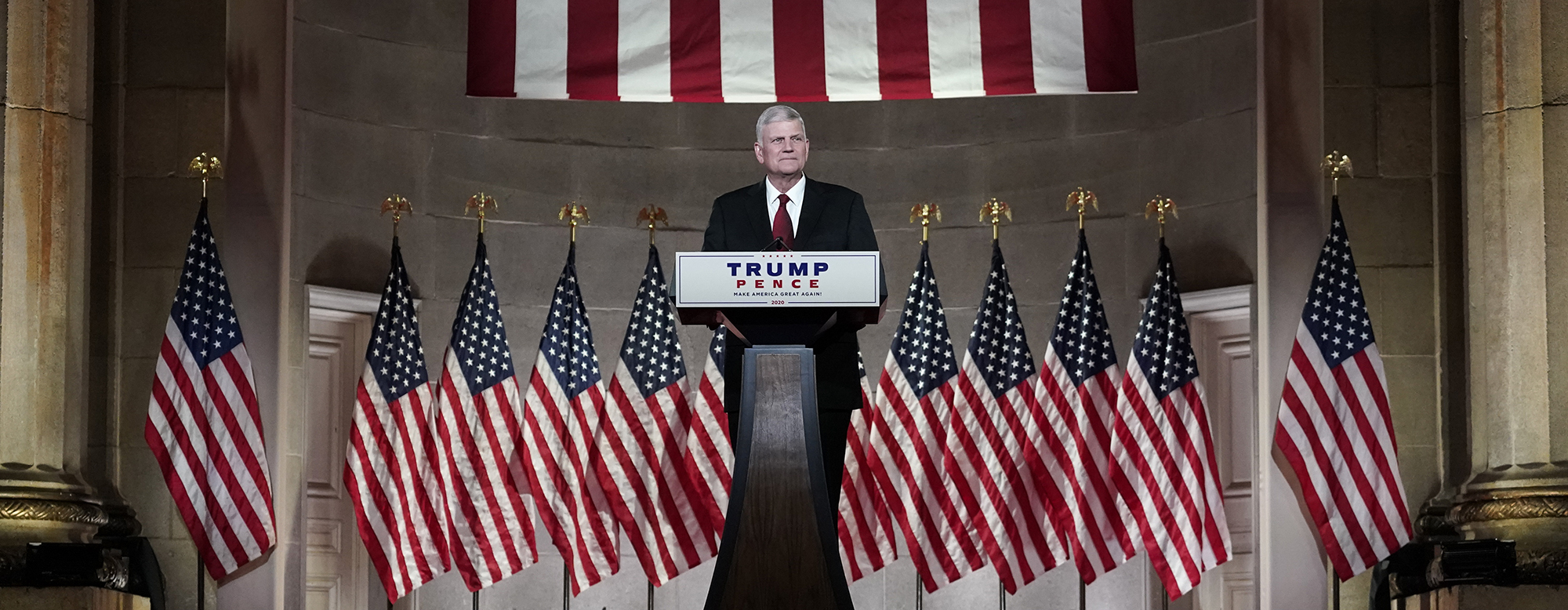
Franklin Graham pre-records his invocation to the Republican National Convention at the Mellon Auditorium on August 27, 2020, in Washington, D.C. (Photo by Drew Angerer/Getty Images)
Collapse of fundamentalism
The irony of the right’s growing secularism is that — in a way — it’s a mirror reflection of the dark side of the collapse of American fundamentalism. The religious leaders of the Religious Right ceased to be a leading functional movement in the 2000s. American evangelicalism lost too many cultural battles over prayer in schools, Darwinian evolution and stem cell research and left the movement stressed and in tatters just as the Obama administration began pushing in new cultural directions. The Religious Right was dead by 2012 and from its ashes sprung a new secular right in 2016. As a result, the ascendant MAGA movement threw crumbs their way in exchange for fealty.
In this status quo, Franklin Graham will happily hop on stage with Trump and call his election a reflection of God’s glory while putting his charitable organization, Samaritan’s Purse, on an awkward lurch less than a month later during the USAID gutting. Pro-life activists will throw their weight behind Trump only to find themselves betrayed as he starts promoting “reproductive rights” to avoid losing female voters. Trump will sign executive orders calling for the “end the anti-Christian weaponization of government” and sign pardons for jailed pro-life protesters, but will do so transactionally.
“Christians … have the power to shake the movement and make noise but they are not in control of it.”
Christians are now merely one part of a larger secular Republican caucus. They have the power to shake the movement and make noise but they are not in control of it. A pro-life activist like Lila Rose will withdraw her support from Trump on principle for violating his pro-life stances but will get savaged by MAGA supporters as a traitor. Eventually, she’ll ultimately be the one relenting and endorsing him at the last minute.
Christianity is useful because of its symbolic connection to America’s prelapsarian past, but it becomes a tool rather than an end in this paradigm. Conservative evangelicals may technically receive more direct power than Christian progressives in this arrangement, with many pro-life Christian Democrats lamenting the marginalization of their concerns, but such efforts will hardly spur the true spiritual awakening that those same Christians clammer for.
The old Religious Right is hardly fondly remembered in modern politics. Its excesses were loud and its demands against the culture were burdensome and unpopular. It brought the fundamentalism of 20th century Protestantism into the forefront of American politics and forced some very challenging questions onto a rapidly secularizing public. In doing so, it partially spurred the ascendant New Atheist movement and fractured Ronald Reagan’s political coalition after three decades of success.
But as bad as the excesses of the old Religious Right were, one is faced with the question of which is worse: a religious right or a post-religious right?
Tyler Hummel is a Wisconsin-based freelance critic and journalist, a member of the Music City Film Critics Association, a regular film and literature contributor at Geeks Under Grace, and was the 2021 College Fix Fellow at Main Street Nashville.