

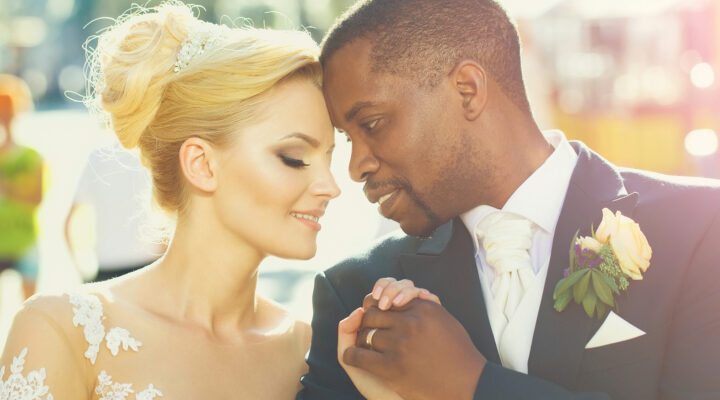

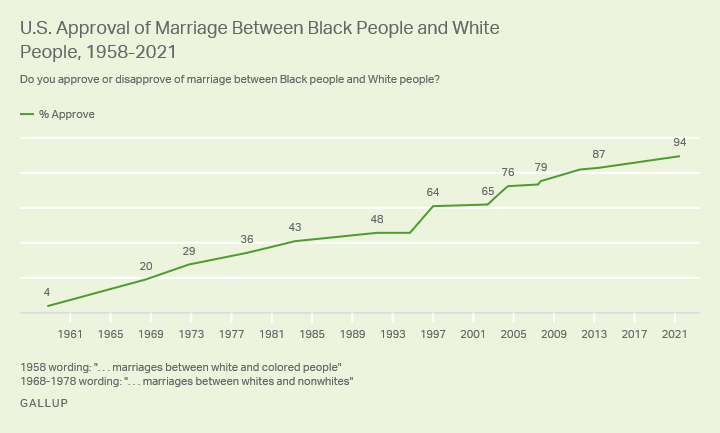
According to the latest Gallup Poll, 94% of Americans now approve of interracial marriage. The change since 1967, when Loving v. Virginia made interracial marriage legal, is nothing short of spectacular.
American support for abortion access, according to Pew Research, is 63%. Support for same-sex marriage, according to Gallup, is at 69%. Almost three-fourths (73%) of Americans report being somewhat comfortable with a close friend being transgender. American support of evolution has grown from 40% in 2009 to 54% in 2019.
Comparatively, support for interracial marriage tops all these issues.
“The road to acceptance has been blocked at every intersection by Christians of a certain sort.”
Yet the road to acceptance has been blocked at every intersection by Christians of a certain sort. This brand — Southern, white, and evangelical — has attempted to retard the advances of African Americans. This is a partial story of how this change from rejection to almost total acceptance happened.
While there are many possible iterations of interracial marriage, the illustrative focus of this article will be on marriage between African Americans and whites — the kind of interracial marriage that sparked a revolution in civil rights.
In 1958, only 4% of Americans approved of interracial marriage and 94% opposed it. Now, 94% approve and 4% disapprove. The share of people with no opinion has held relatively steady, moving from 3% in 1958 to 2% today.
Acceptance lurched forward in 1968 amid the Civil Rights Movement, but only to the 20% level. It was not until 1997 that a majority of Americans accepted such marriages. That year’s 64% acceptance rate was a huge leap from the 48% level recorded in 1991 and again in 1994.
There is reason to celebrate the improvement in race relations on personal levels.
Despite continued residential segregation and systemic racism, the post-Civil Rights era has led to more socialization between Blacks and whites and to more intermarriage. The obvious conclusion: Relationships are crucial.
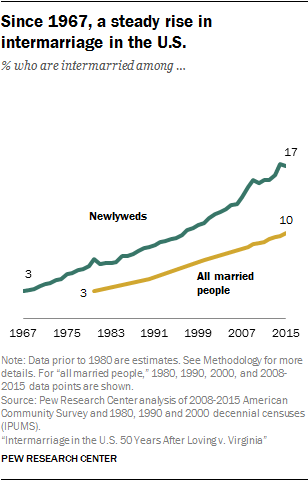
According to Pew, in 1967, when miscegenation laws were overturned in the United States, 3% of all newlyweds were married to someone of a different race or ethnicity. Since then, intermarriage rates have steadily climbed. By 1980, the share of intermarried newlyweds had about doubled to 7%. And by 2015 the number had risen to 17%.
The most common form of interracial marriage in the U.S. is between a white person and a Hispanic person. Next most common is an Asian person married to a white person, followed by Black-white couples.
A panoramic sweep of racial understanding
In the 18th century, the ruling class of white Americans etched race into law with the power of white superiority.
A bargain was made between rich whites and poor whites. In return for not being treated as if they were slaves or Blacks, poor whites were granted entry into society by virtue of not being Black. This didn’t protect them from backbreaking work or near-slave wages but at least, in their minds, they were not Blacks.
This raw deal has cursed poor whites to this day.
ThomasJefferson
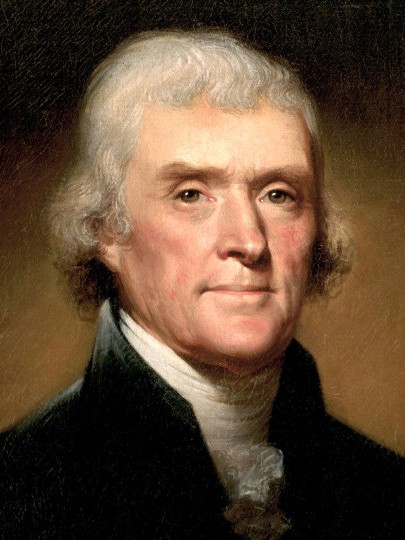
In 1776, Thomas Jefferson penned the greatest words ever uttered in the English language: “All men are created equal.” Yet he and his fellow Founding Fathers were slaveowners. In a bit of philosophical sleight of hand, they denied slaves were human. David Livingston Smith, in Less than Human, observes, “In this way they could square the moral circle.”
At the 1787 Constitutional Convention, the founders enshrined in law (Article 1, Section 2) that for the purposes of taxation and representation every slave would count as three-fifths of a person.
Later, on the eve of Confederates’ secession from the union, Jefferson Davis insisted equality between the white working class and white oligarchs could not exist at all without Black slavery: “I say that the lower race of human beings that constitute the substratum of what is termed the slave population of the South, elevates every white man in our community. … It is the presence of a lower caste, those lower by their mental and physical organization, controlled by the higher intellect of the white man, that gives this superiority to the white laborer. Menial services are not there performed by the white man. We have none of our brethren sunk to the degradation of being menials. That belongs to the lower race — the descendants of Ham.”
In 1896, ruling in Plessy v. Ferguson, U.S. Supreme Court Justice John Harlan proclaimed: “Our Constitution is color-blind. The white race deems itself to be the dominant race in this country. I doubt not, it will continue to be for all time, if it remains true to its great heritage.”
The denial of humanity, the withholding of rights, was made even more cruel by Jim Crow laws, the KKK and the lynching era. According to James Cone, in The Cross and the Lynching Tree, more than 5,000 African Americans were lynched.
“Segregation did not go quietly into its dreadful night.”
The Civil Rights Movement brought an incredible amount of violence to the nation. Segregation did not go quietly into its dreadful night. For example, the integration of Ole Miss University was preceded by a riot on the night before James Meredith would be admitted as a student.
And do not imagine the dawn of the 21st century made all things better.
In Democracy in Black, Eddie Glaude Jr. assesses: “President Obama’s election supposedly meant that we had turned a corner. We wanted to believe that we were leaving something bad behind. But we have seen and experienced so much ugliness over these past seven years. How many times have we watched Black parents in anguish as they buried their children? As they stood before the press and demanded justice, joined with other parents in a communion of grief? The deaths of Trayvon Martin, Michael Brown, Sandra Bland and so many others shattered any illusion we might have had about a post-racial America. People from all over the country took to the streets. Ferguson and Baltimore ignited our frustrations. Chants of ‘Hands up, don’t shoot’ and ‘I can’t breathe’ and ‘Black lives matter’ let the world know that race is far from being a nonissue in this country.”
A religious question
The historical evolution of race relations and acceptance of interracial marriage has to do with the secularization of the United States. Even as fewer Americans attend church, more Americans are embracing values consistent with the gospel of Jesus.
Secular humanism has produced a civic morality, a social ethic of mutuality and diversity. David Bentley Hart says it best: “The atheist who argues against a belief in God is still someone whose moral expectations have been shaped at the deepest levels by the language of Christian faith.”
The residual power of Christian faith, still alive in secular humanism, has accelerated the rate of acceptance in our culture. Even as too many who claim to be Christians harbor residual racism unrepentantly.
The gospel has been proclaimed by unexpected evangelicals as foreign to Christian faith as we can imagine. These secular humanists have exhibited a deep morality and ethic of empathy far exceeding that of traditional evangelicals. As surely as Rahab and Ruth impacted the development of Jewish and Christian faith, these “foreigners” to the faith have impacted American acceptance of others — African Americans, women, gays, immigrants, the poor.
“Secular humanism has displayed more empathy, more compassion and more acceptance than the evangelicals in America.”
Secular humanism has displayed more empathy, more compassion and more acceptance than the evangelicals in America. Evangelicals not only resist change, they actively campaign against change. They support Trump’s nativism. They are deeply involved in white supremacy as enablers of the idea of white victimization.
The philosophical concept of change
Now, consider the issue of acceptance from a philosophical perspective. Is change evolutionary or revolutionary? Studying the acceptance of interracial marriage, I side with change being evolutionary. There are so many prequels to the arrival of what may appear as a revolutionary change.
Philosopher Stephen Toulmin, in The Uses of Argument, claims change occurs by augmenting the existing perspective with new ideas of natural order that supplement existing ones. Thus, change is evolutionary.
For example, the notion that the Civil Rights Movement started with Martin Luther King Jr. overlooks a long Black prophetic tradition. “The Black prophetic tradition has been the leaven in the American democratic loaf,” Cornell West said. “What has kept American democracy from going fascist or authoritarian or autocratic has been the legacy of Frederick Douglass, Harriet Tubman, Sojourner Truth, Martin King, and Fannie Lou Hamer. There are always unheralded predecessors in the background.”
Political change
 What does all this have to do with the nation’s current political climate, where rebounding racism appears to be on the ascent even as more couples and families have firsthand experience with interracial heritages?
For one thing, the “dilution” of the white population is driving the fears of white supremacists. Whether spoken aloud or not, it is the loss of a white majority ruling class that motivates today’s Republican Party and MAGA politics. Not only are minorities outpacing whites in birth rates, more interracial marriages are producing mixed-race children.
According to recent data, about 10% to 15% of live births in the United States are considered mixed race, with the percentage steadily increasing due to a rise in interracial marriages; this means around one in 10 babies are born to parents of different races.
According to the 2020 Census, the white population remained the largest race or ethnicity group in the nation, with 204.3 million people identifying as white alone. Overall, 235.4 million people reported white alone or in combination with another group. However, the white alone population decreased by 8.6% since 2010.
At the same time, the multiracial population has changed considerably since 2010. It was measured at 9 million people in 2010 and grew to 33.8 million people in 2020, a 276% increase.
Unseen changes
From the beginning, objection to interracial marriage often focused on the likelihood of producing mixed-race children — something white Southern Christians found to be an abomination. Yet every year, America is heading toward a more and more mixed-up and integrated gene pool.
This has been an unseen and silent contributor to conservative politics.
Acceptance always encounters rough seas to find a safe harbor in American politics. Roderick Hart, in Trump and Us: What He Says and Why People Listen, says, “Many Americans felt ignored … some folks felt trapped … others felt besieged — by elites, especially by the media. So Trump offered them public therapy by becoming an alternative news source for them. Mr. Trump also sensed that many Americans were weary of the political establishment, so he used his distinct personality and a barrage of tweets to energize them.”
There’s a sense that modern politics has turned truth on its head. Reason, discussion, decorum and tradition are replaced with divisiveness, outrage, violence. Politics, void of reason and ethos, has become almost entirely about pathos (emotion). Nothing is more fraught with affect, with the raw emotions, than politics in America.
This is the perfect breeding ground for demagoguery. It is a kind of propaganda that preys on a pre-existing culture of fear and hatred, relying on pitting in-groups against out-groups, and using racial stereotypes to promote bigotry in pursuit of power. New methods of propaganda like social media now assist the dynamics of change.
Once a new idea has occurred, people are talking, reasoning, interpreting, thinking about the new habit. No one seems to notice the almost complete emotionalism of these interactions. These are the discussions within communities where people gather to talk, argue, persuade one another. Often these communities are segregated. Barack Obama referred to these places as “hush harbors” — safe places where Blacks express their anger to one another and whites do likewise.
In our increasingly diverse culture, “hush harbors” are being replaced by places where people of different races have different conversations. Perhaps this building of relationships predicated on love, trust, understanding, mutuality, etc. has fueled the almost universal acceptance of interracial marriage. And perhaps here is the model for how we can move forward in all other areas of our national life together.
Change in one area can lead to systemic change. Individual change can become corporate change.
The acceptance of interracial marriage has traversed a long, rocky, and violent road. This is where we must start. The trauma and tragedy of our racial history is open to reconciliation.
We must care for one another. Interracial marriage will not solve the problem of systemic racism, but it is a good starting point. Love between a Black man and a white woman — or a Hispanic woman and a white man — is the kind of love our nation needs to show to one another.
Rodney W. Kennedy is a pastor and writer in New York state. He is the author of 11 books, including his latest, Dancing with Metaphors in the Pulpit.
Related articles:
Support for interracial marriage has grown from 4% to 94%
23andMmmUh | Opinion by Brad Bull
Focus on the Family’s selective critique of eugenics | Analysis by Steve Rabey