



Is the church a safe place for women?
Well of course it is, right?

Andrew J. Bauman
I would have thought the church was a safe place, too, until the results came in from my research with more than 2,800 women who worked in the church. I have compiled these results in my new book, Safe Church: How to Guard Against Sexism & Abuse in Christian Communities.
The courageous women from the study have been on the front lines of Christian ministry — 26% had been in ministry between 16 and 25 years, nearly 16% had been in ministry for more than 25 years, and the rest have been working in the church between one and 15 years. These women know the church inside and out and can teach us something new if we listen to their experiences.
Here are a few of the most significant statistical takeaways from this five-year research project.
82% of respondents agreed sexism plays a role in church
I was shocked the number was so high, but I am not a woman, and I have not lived a lifetime of this behavior being my norm.
I began reading the courageous stories they shared. Stories like Hannah, who worked on her church staff as a worship leader, heard all-male church staff members joking they could increase church attendance if they required women to wear white T-shirts to get baptized. (Of course, she didn’t think it was a joke.)
“She cannot be on stage. She has a sleeveless shirt on.”
What do you think she felt in her body after hearing that? What did she think about her breasts? Her worth? Imagine how small, invisible and objectified she must have felt.
Rose also shared her belief that the church placed the responsibility on women “for having bodies rather than holding men accountable for perverse thoughts.” Numerous participants admitted they felt “shamed” for having a female body and that an “unfair responsibility” was imposed upon them by men in church leadership positions.
Similarly, Kelley said she was made to wear dresses at church: “I have a big butt, so I would always wear huge skirts to cover my butt because I didn’t want men to lust after me.”
Beth also was criticized for her choice of clothing. “Women could not wear tank tops. … I remember working at vacation Bible school, and it was like 9,000 degrees in this little country bumpkin church, and they (said), ‘She cannot be on stage. She has a sleeveless shirt on.’”
These women felt the weight of the male gaze and the responsibility of male integrity was put squarely on their shoulders; this is a form of abusive behavior and speaks to a pornified church environment that is not safe for women.
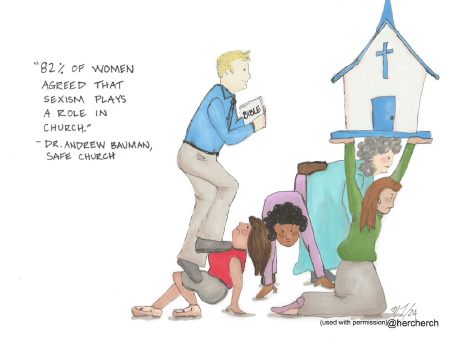
77.9% of women felt opportunities in ministry had been limited due to their gender
Gail shared in the questionnaire about her experience with her limited opportunity to be hired as the worship leader of her church: “I was kept from being hired as a worship leader, although I had been ‘filling in’ for the role for over a year, had a degree in music and more than a decade of experience. I couldn’t be hired because I was a woman, even though leadership agreed I was doing an exemplary and exceptionally qualified job. The man hired in my place was a far less capable musician, administrator and music director.”
Gail’s experience is not isolated and is a form of intuitional gaslighting and objectification. The church is “using her” for her skills and giftedness yet has no plans of compensating her. They continued to use her until they found an average male replacement, and the pain of that experience, Gail never will forget.
Heather experienced this painful statistic when she answered, “I got a master of divinity degree from Harvard, and I still could not find a church in my denomination to hire me because I was a woman, so I changed denominations to find a job.”
We have amputated half the body of Christ because many men are insecure and are more committed to patriarchy than a correct understanding of God’s word.
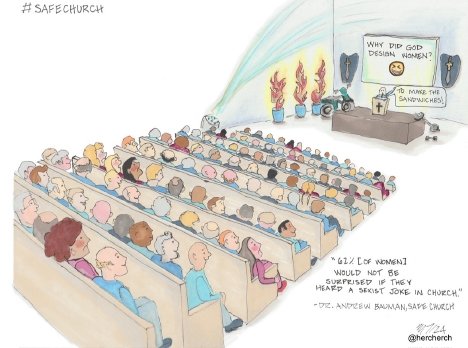
62% would not be surprised if they heard a sexist joke in church
These so-called “jokes” against women are normalized by men in power, which increases their occurrence and acceptance. One woman wrote that “sexist jokes that were very inappropriate (and sexual) were prevalent. When I asked if (the male leaders) would tell less of them, I was told that ‘men will be men,’ and if I wanted to succeed in a man’s profession, I needed to be OK with it.”
When women spoke up against the sexist jokes, they were gaslit and mansplained and told to be quiet and loosen up. Being told it’s “just a joke” is another way to silence women’s experience and continue a normative culture of objectification, all the while cursing a women-sacred intuition in favor of an insecure male-centered sexism.
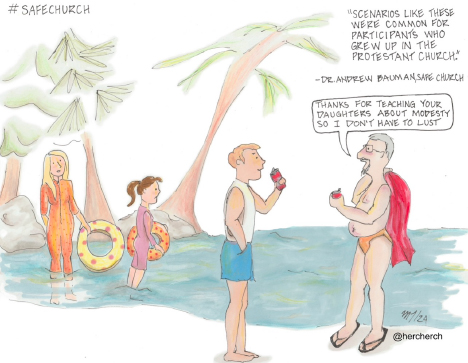
35% of women who worked in the church said they had experienced sexual misconduct/harassment or responded that it was “complicated” rather than saying no
Rebecca said her parents forced her and her sisters to wear a wetsuit-style bathing suit, called “modesty swimsuits,” when they went swimming. Rebecca covered her skin from torso to neck. She said one of her father’s friends commented that he was “thankful (he) could go swimming with (his) family because (he) did not have to worry about lusting because of how the girls dressed.”
She would be praised for her modesty and for protecting her “brother in Christ.” Rebecca was a teenager, which made her dad’s friend a potential pedophile and a danger in sexualizing children. Yet it was normalized as a conversation about “modesty” of Rebecca and her sisters rather than sexual perversion and pornified thinking of this adult man.
Jackie also shared her story. She was in her late teens, and her abuser was in his forties and previously was her science teacher at her Christian school and a spiritual leader in the community. He raped her multiple times. Jackie’s pastor said both parties were wrong and she was “a tempter.”
“Jackie’s pastor said both parties were wrong and she was ‘a tempter.’”
She said the church leadership “made me make a formal apology to (my abuser’s) wife less than 24 hours after they got me away from him and then to his daughter the next day.”
Can you believe that?! We cannot dismiss Jackie and Rebecca’s stories as just merely rare one-off experiences. About 35% of the more than 2,800 women (981 women) in the survey said yes or answered “it’s complicated” when asked if they had been sexually harassed as they worked in the church.
From my research, we also can observe that years of experience and sexual victimization are firmly related, meaning the more experience you have in the church, the more likely you are to be victimized.
What to do?
These stories are disturbing and humbling. I hope they propel us to change the system from which many of us (especially men) have benefited. But, similar to the sweet liquid of Ethylene glycol, hierarchical norms in the church are killing us and keeping us from knowing God more fully. As men, we first like power and control, which makes us feel strong. Still, we slowly realize we are not meant for the isolation of power or the perpetration of the abuse.
I genuinely believe we are all made in the image of God and by not hearing and empowering women’s voices, we are missing out on knowing our Creator more fully. Remember Luke’s words in Act 2:18, “I will even pour out my Spirit on my servants in those days, both men and women, and they will prophesy.” Or the Apostle Paul who writes in Galatians 3:28, “There is no Jew or Greek, slave or free, male and female; since you are all one in Christ Jesus.”
We are one in Christ Jesus; God’s Spirit is on us equally, and it’s time we start living out our faith and following God’s glorious desire for a safe church.
 Andrew J. Bauman is founder and director of the Christian Counseling Center: For Sexual Health and Trauma and a licensed mental health counselor. A former pastor, he now works with men and women to bring healing and wholeness to their sexual and spiritual lives. This article is adapted from his book Safe Church: How To Guard Against Sexism & Abuse in Christian Communities. Art is by Her Cherch and is used by permission.