

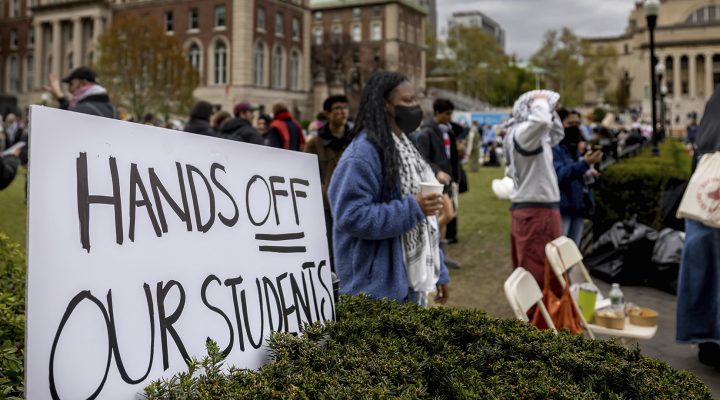

Mahmoud Khalil, who helped lead protests at Columbia University against civilian casualties in Gaza, was arrested by U.S. immigration officers and sent to a detention center in Louisiana. This activates alarms in my First Amendment-loving mind.
A series of unusual tactics have been used by the Trump administration after Khalil’s arrest. Khalil has not been charged with a crime. He has been held without being allowed a telephone conversation with family or his attorney.
This is not normal operating procedure for the treatment of legal residents.
The ACLU and Khalil’s attorney are arguing Khalil’s arrest is a violation of his First Amendment rights. Secretary of State Marco Rubio, however, accused Khalil of participating in protests he described as antisemitic and supportive of the terrorist group Hamas. Foreigners who come to the United States and do such things, he said, will have their visas or green cards revoked and be kicked out.
“This is about people that don’t have a right to be in the United States to begin with.”
“This is not about free speech,” Rubio said. “This is about people that don’t have a right to be in the United States to begin with. No one has a right to a student visa. No one has a right to a green card, by the way.”
Amid many factual errors, Rubio conveniently overlooks the fact that Khalil has a green card and is in the U.S. legally. And that green card has guaranteed rights. To make his extreme case, Rubio is relying on an obscure provision of the Immigration and Nationality Act of 1952 that grants power to the Secretary of State to expel foreigners.

Student negotiator Mahmoud Khalil on the Columbia University campus in New York at a pro-Palestinian protest encampment on April 29, 2024. (AP Photo/Ted Shaffrey)
The law, also known as the McCarran-Walter Act, came amid the anti-communist fears of the early Cold War. The law effectively limited most immigration to Europeans. It also codified rules allowing ideology to be used to deny immigration and allow deportation.
The provision says any “alien whose presence or activities in the United States the secretary of state has reasonable ground to believe would have potentially serious adverse foreign policy consequences for the United States is deportable.”
To say Khalil’s campus protests adversely affect American foreign policy is a stretch. Khalil’s immigration status will be decided by an immigration judge who will determine whether to revoke his green card. But already Rubio and Trump have deemed themselves judge and jury.
There is little precedent for deporting a legal permanent resident based on the 1952 law.
ICE Director Tom Homan also has weighed in. “When you hand out leaflets inciting violence on a college campus, that’s illegal,” he said. “Being in this country with a visa or a resident card is a privilege, and you got to follow certain rules.”
Like Rubio, Homan is wrong.
Homan also invoked the famous aphorism of Justice Oliver Wendell Holmes in the 1919 case Schenck v. the United States: “falsely shouting fire in a theater.” Holmes invoked a “clear and present danger” test to judge whether speech is protected by the First Amendment. The defendants in that case mailed leaflets to new recruits and enlisted men with leaflets that compared military conscription to involuntary servitude and urged them to assert constitutional rights. The burden of proof here is on Homan because so far there is no evidence Khalil handed out leaflets promoting violence.
At a news briefing, Trump’s press secretary also pressed the issue of leaflets. Karoline Leavitt accused Khalil of “siding with terrorists.” She asserted that “pro-Hamas propaganda fliers” with the organization’s logo were distributed at the protests Khalil led at Columbia. Her broad attack on Khalil doesn’t suggest he distributed “propaganda fliers” but that he was present when they were passed out.

White House Press Secretary Karoline Leavitt (Photo by Michael Brochstein/Sipa USA via AP Images)
Leavitt sanctimoniously declared: “Mahmoud Khalil was an individual who was given the privilege of coming to this country to study at one of our nation’s finest universities and colleges and he took advantage of that opportunity by siding with terrorists, Hamas terrorists.”
She added for good measure: “This is an individual who organized group protests that not only disrupted college campus classes and harassed Jewish American students and made them feel unsafe on their own college campus but also distributed pro-Hamas propaganda fliers.”
By the way, distributing pro-Hamas fliers is not any more illegal than distributing pro-Israel fliers.
Leavitt declined to share the purported fliers with reporters, saying doing so would corrupt the dignity of the White House briefing room. She presented no evidence Khalil had produced or distributed any fliers.
Nor have officials accused Khalil of having any contact with Hamas, taking direction from Hamas or providing material support to it.
Fortunately, in the United States, this case will not be resolved in the media or in the White House but in the courts.
Justice Louis D. Brandeis gave perhaps the greatest defense of freedom of speech ever made by a Supreme Court justice: “To courageous, self-reliant men, with confidence in the power of free and fearless reasoning applied through the processes of popular government, no danger flowing from speech can be deemed clear and present, unless the incidence of the evil apprehended is so imminent that it may befall before there is opportunity for full discussion. If there be time to expose through discussion the falsehood and fallacies, to avert the evil by the processes of education, the remedy to be applied is more speech, not enforced silence.”
“The remedy to be applied is more speech, not enforced silence.”
This case will come down to whether Khalil’s freedom of speech is protected by the First Amendment. Because lawful permanent residents are protected by the Constitution — including First Amendment free-speech rights and Fifth Amendment due-process rights — the case appears likely to set up a major test of whether that statute is constitutional.
In the theatrical world of Trump, is the arrest of Khalil a typical distraction? Is he manufacturing a case against a green card holder that can be seen as wrong on the surface? He manufactured the alleged face-off between patriotism and Black athletes protesting police brutality by kneeling for the National Anthem. What should have been a slam-dunk win for freedom of expression was used by Trump to fan the flames of his own political gain.
Is the “wall of separation” too high for the administration to scale? A foreign student with a green card — a legal immigrant — has free speech protection. Even if Khalil engaged in hate speech, there is no evidence he will be found guilty of violating U.S. law. The relationship between the First Amendment and hate speech is complicated.
While the U.S. Supreme Court has recognized several exceptions to the First Amendment (obscenity, defamation, fraud, incitement, true threats and speech integral to already criminal conduct), the court also has ruled multiple times that hate speech cannot be directly regulated due to the basic human right to free speech recognized in the Constitution.
One may only ponder the court’s willingness to make exceptions to the First Amendment in some cases related to public safety yet refuse in other cases, most specifically, hate speech.
What this amounts to is a significant case testing the limits of the First Amendment. And Khalil — whether you like his message or not — is as deserving of free speech rights as any natural born U. S. citizen.
Rodney W. Kennedy is a pastor and writer in New York state. He is the author of 11 books, including his latest, Dancing with Metaphors in the Pulpit.
Related article:
Wake up, liberal Democrats; and I guess you’ll have to abduct me, too, President Trump | Opinion by Brad Bull