


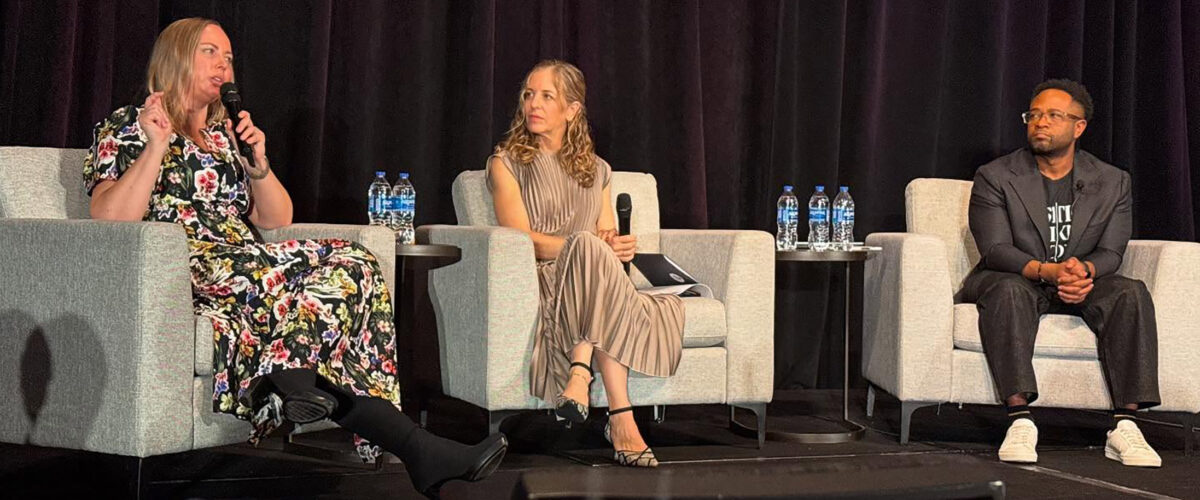
“White Christian nationalism in America is but our most recent chapter of an ancient story of what happens when Christianity is co-opted by empire,” according to Lutheran pastor and author Angela Denker.
Her brand-new book is Disciples of White Jesus: The Radicalization of American Boyhood. She joined a panel discussion with historian Jemar Tisby after his keynote address at the Summit for Religious Freedom April 6 along with Rachel Laser, president of Americans United for Separation of Church and State.
In dialogue with Tisby and Laser, Denker discussed her research into the history and incubators of white Christian nationalism.
For her, the story begins with Pontius Pilate in the biblical account of Jesus’ final week.
 “The Jews have long been blamed for the crucifixion of Jesus, but in reality, the Roman Empire crucified Jesus,” she said. “And so every time I talk about Christian nationalism, I always start with this conversation between Jesus and Pontius Pilate. Pilate is trying desperately to obfuscate the conversation, to blame the Jews, to suggest the Jewish people … paint Jesus as an alternative king. And Jesus explicitly rejects that.”
White Christian nationalism is “an ancient, ancient story. It goes back to the Crusades,” she said. “We now have a secretary of defense in this country, unfortunately from my home state of Minnesota, Pete Hegseth, who has Christian Crusader tattoos.”
White Christian nationalism is not a Republicans versus Democrats issue, the pastor said. “This is an ancient battle of what happens when religion is corrupted by empire.”
Ultimately, white Christian nationalism will damage the church, Denker predicted. “When we merge religion with power, what gets destroyed is religion. What gets destroyed is faith. … When people are forced to choose between political identity and their faith, most often they choose the political identity.”
That’s evident today in conservative megachurches where “Jesus is just going away and away and away and away, and they’re becoming very clearly vehicles for the Republican Party and for Donald Trump personally himself. That’s going to become more and more clear.”
In the meantime, boys and young men are increasingly being indoctrinated in the ideology of hierarchy that feeds white Christian nationalism, she said. She spoke of an “influence that is heavy from right-wing Christianity on YouTube, on podcasts.”
“Remember, a cultural Christianity is not a religion necessarily.”
“What happens is there becomes a vacuum of content pushing back against this cultural Christianity,” Denker explained. “Remember, a cultural Christianity is not a religion necessarily, and it is not something that’s grounded in faith, but instead it is an excuse for white male headship and power. What is really important to know is that even for families and young men and boys who don’t consider themselves really Christian, who don’t go to church, who aren’t religious, nonetheless, they’re still overwhelmingly influenced by this dominant culture in America that paints God and paints Jesus as a muscular, violent, greedy white man. That is still the dominant depiction that many people in America have of God and of Jesus. And it’s been strengthened by prominent evangelical pastors who’ve been propped up by the publishing industry.”
This image of Jesus is seen in the theology expressed by Vice President JD Vance, she added. “It is a cultural depiction that has huge reach, and I think we underestimate the reach this cultural depiction has and the influence it has on white men and boys in all parts of the country, not just in evangelical churches, not just in the Bible belt, (but) in progressive neighborhoods. … I want people to be able to see where these influences are coming from and begin doing the work to offer alternative narratives about masculinity and, if you’re a person of faith, if you’re a Christian, alternative narratives about Jesus.”
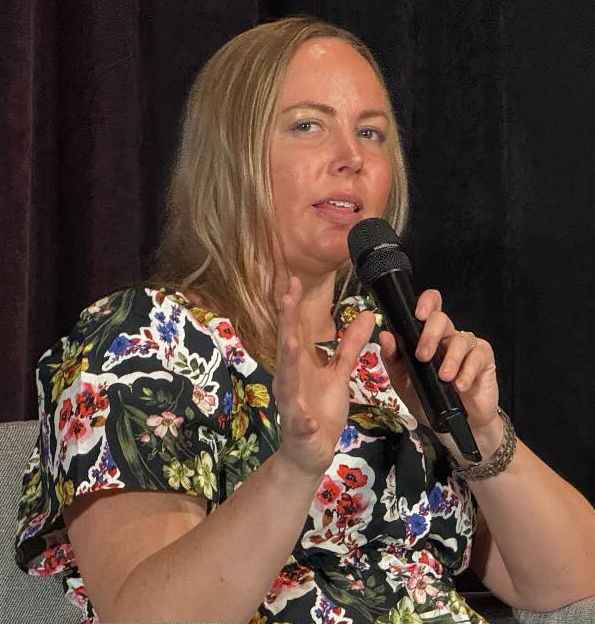
Angela Denker (Photo by Mitch Randall/Good Faith Media)
An easy assessment of one’s beliefs would be this question, she said: “Am I using my faith to exercise my power over others, to hold others down, or am I using my faith to look at how to increase liberation for other people? If we ask that question of our politicians, it’s very clear quickly what kind of faith in politics is helpful. It strengthens democracy and strengthens the separation of church and state.”
Denker was a journalist before becoming a pastor. She has applied those investigative and writing skills in Disciples of White Jesus, which examines the rise in radicalization among young white men in America.
In the book, she makes a case for right-wing Christianity’s influence through preaching “traditional gender roles” and “submission of women.”
She told the conference attendees: “What I would challenge is that each person here, and maybe particularly for the men who are here, you represent alternative narratives about what masculinity means. That it can be grounded in empathy, that it can be grounded in love, that it can be grounded in vulnerability.
“This stuff is not going to change by viral social media posts. They’re great, but that’s not going to drive the change in narratives. Instead, the challenge is for you to look at your own sphere of influence, your family, your relationships, and find young men and boys who you can offer an alternative vision of masculinity to who you can share about what it means for you to be a man. … We need to focus on offering an alternative vision of what it looks like for men and women to be in partnership together, not based on hierarchy.”
Related article:
Learn from Cory Booker and the Black Church witness, Tisby urges
Hear Angela Denker on BNG’s “Highest Power” podcast with Rick Pidcock