

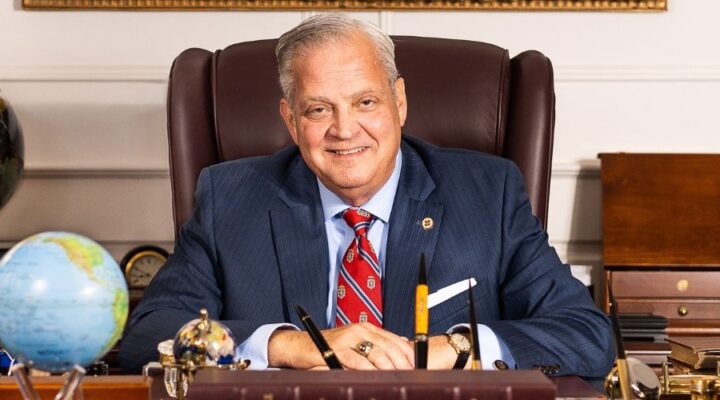

The disruptions created by President Donald Trump are necessary for “progress to be made toward correction,” Al Mohler told The New Yorker in an interview published April 1.
The president of Southern Baptist Theological Seminary in Louisville, Ky., is one of the most frequent front men for the Southern Baptist Convention. He was a never-Trumper in 2016, then got on board with Trump enthusiastically in 2020 and 2024.
In response to a question about how his thinking has continued to change from 2020 to 2024, Mohler replied: “I’m a Christian theologian; I’m a Christian minister. I am obligated to introspection and self-criticism. And I want to be honest. I’ll tell you what I think’s changed. I think what has changed is the sense that something more significantly disruptive is going to have to take place for any progress to be made toward correction anywhere. And I will tell you, time will tell. I do not know if Donald Trump and his disruption is going to bring about lasting, meaningful, fruitful change. I’m hoping it does. And I see the necessity of disruption. If it isn’t Donald Trump now, I don’t know who it is going to be when.”
Those are the closing words of the 2,500-word article headlined, “How Donald Trump Is Teaching Christians to Abandon Empathy.”
In the interview with Isaac Chotiner, Mohler argues that empathy is “used politically in ways that are very destructive and manipulative.”
Mohler represents the Calvinistic strain of modern Southern Baptists that often are the most politically and theologically conservative and the most demanding of complementarianism, the belief that God created men and women for distinct roles in the home and church. Sometimes, women are portrayed as more prone than men to empathy, which is considered weakness.
Empathy is “an artificial virtue, and I want to lean into authentic virtues.”
“What is your broader concern with empathy right now?” Mohler was asked.
“I think the broader concern is that it’s an artificial virtue, and I want to lean into authentic virtues,” he said. “And I think it is used politically in ways that are very destructive and manipulative.”
As an example, he cited immigration. “The open embrace of empathy in that platform is on the part of people who basically are using empathy as an argument against having any meaningful citizenship, nationality, national borders,” he said.
Thirty years ago, Mohler closed the Carver School of Church Social Work at Southern Seminary, declaring the tenets of social work are not congruent with Christian theology.
To The New Yorker, he asserted: “The whole impulse of empathy is feeling with people as they feel. It’s a therapeutic category rather than a moral category. I’m a Christian. I believe in moral categories. I believe in the importance of sympathy and even more in the responsibility of compassion. But that takes action and it’s based in truth. It’s not based on validating anyone’s self-perceived situation, nor identifying with their own read of the situation as valid.”
Asked if he’s concerned about the Trump administration’s cruelty toward immigrants, Mohler said he doesn’t see any cruelty.
“The people I hang around with, they would never inflict any deliberate cruelty on anyone.”
“I have not seen a lack of concern. What I do see is that there are very clear concerns reflected in public support for the president, sending gang members back to their home country and things like that. In the view of millions of Americans, it’s a lack of compassion for fellow-citizens that has led to relatively insane and irresponsible open borders. The people I hang around with, they would never inflict any deliberate cruelty on anyone.”
Presented with a specific example of Trump officials “reveling” in harsh treatment of immigrant prisoners, Mohler said he takes “a very Augustinian view of state power.”
He explained: “An Augustinian view of government says that government coercion is never pretty. It is necessary, but it’s never pretty. And, when government acts in a coercive manner, it always leads to some form of pain. That’s what government coercion is. And so I am not justifying it. I’m simply saying that if you are going to return people against their will to their country, where they are seen there as gang members and they’re going to be treated as criminals …”
At this point, the interviewer interrupts to clarify the situation and Mohler attempts to distinguish between “legitimate refugees” and “gang members” but will not accept that the Trump administration appears to be getting the two categories confused.
Elsewhere in the interview, Mohler speaks of a “great sifting” that has happened among Republicans and declares his own views remain consistent amid cultural change.
“In terms of principle, I see myself in a straight line, and I’m open to anyone correcting me about that,” he said. “I can tell you why I think I’m a straight line on these issues. I’m trying to achieve, legislatively and culturally, the greatest realization of the moral ends that I believe are right. That’s the strategy, and the tactics change election by election, because you’re presented with a different set of choices. I think, if you want to understand why so many evangelicals are basically so glad to have so many former Republicans gone, it is because in terms of the great issues of the day, they weren’t really all that different from Democrats. They were just liberals on a slower timetable.”
Related articles:
CONTROL Inc. | Opinion by Richard Conville
Most Republicans are fine with ICE arrests in churches, Pew finds
The latest far-right argument: Women are too empathetic to serve on Supreme Court