



Each day we are bombarded with multiple news reports of government dismantling, people being abducted by unmarked officers, orders by judges ignored, criminals pardoned, war plans texted on apps, job loss, Social Security at risk, tariff wars starting a Trumpcession, and the stock market plummeting. There is just too much to list. I stay in a constant state of overwhelm trying to keep up, feeling helpless to deal with what may be coming next.
Overwhelmed and helpless is not a space I would like to stay stuck in.
It has been suggested by many that the point of the barrage of executive orders and the hundred-mile-an-hour speed and wreckage style of DOGE is purposeful. If they go fast and hard, the thinking goes, no one will be able to stop them. So far, that has borne out with a few exceptions from public pressure.

Julia Goldie Day
As it stands, there are frightening signs of fascism as people are being taken without warning from the streets without due process. The only reason we are being given is “we have the right to do it.”
Oligarchy is being set up out in the open with the wealthiest man in the world, the largest campaign donor, firmly entrenched with his sticky fingers throughout the American government — all while his companies continue to operate with government contracts and grants without pesky investigations.
Meanwhile, the cabinet of the president is more racist, bigoted and corrupt than ever — scraping and bowing to outdo each other in enacting corrupt agendas. And the Republican-controlled Congress is doing very little, allowing the executive branch unequal power of the purse and emergency control without check.
So how could we not feel overwhelmed? Helpless?
We can feel those feelings, they are valid, and we can do something. Whether you voted for this or not, you can do something.
The ideal of the United States of America is “we the people” is it not?
“We have power. Words have power. Together we have even more power.”
We have power. Words have power. Together we have even more power.
One way we can use these words of power is on social media. Many people have been exiting certain platforms because they are owned by the shadow president and other wanna-be or soon-to-be oligarchs. I suggest now is not the time to abandon them if you have the bandwidth. We have the opportunity to communicate how angry we are with their infiltration of government systems. We can object, laugh at them, rage at them or just simply speak our own minds while we still have freedom of speech.
If we simply leave, we might not get to have interactions with people who are not exposed to the facts. Leaving may risk preaching to the choir.
For this very reason there is great urgency that requires boldness, and our interactions need to be as accurate as possible.
Allow me to share some basic information to help you interact effectively on social media and join the resistance of God’s people online.
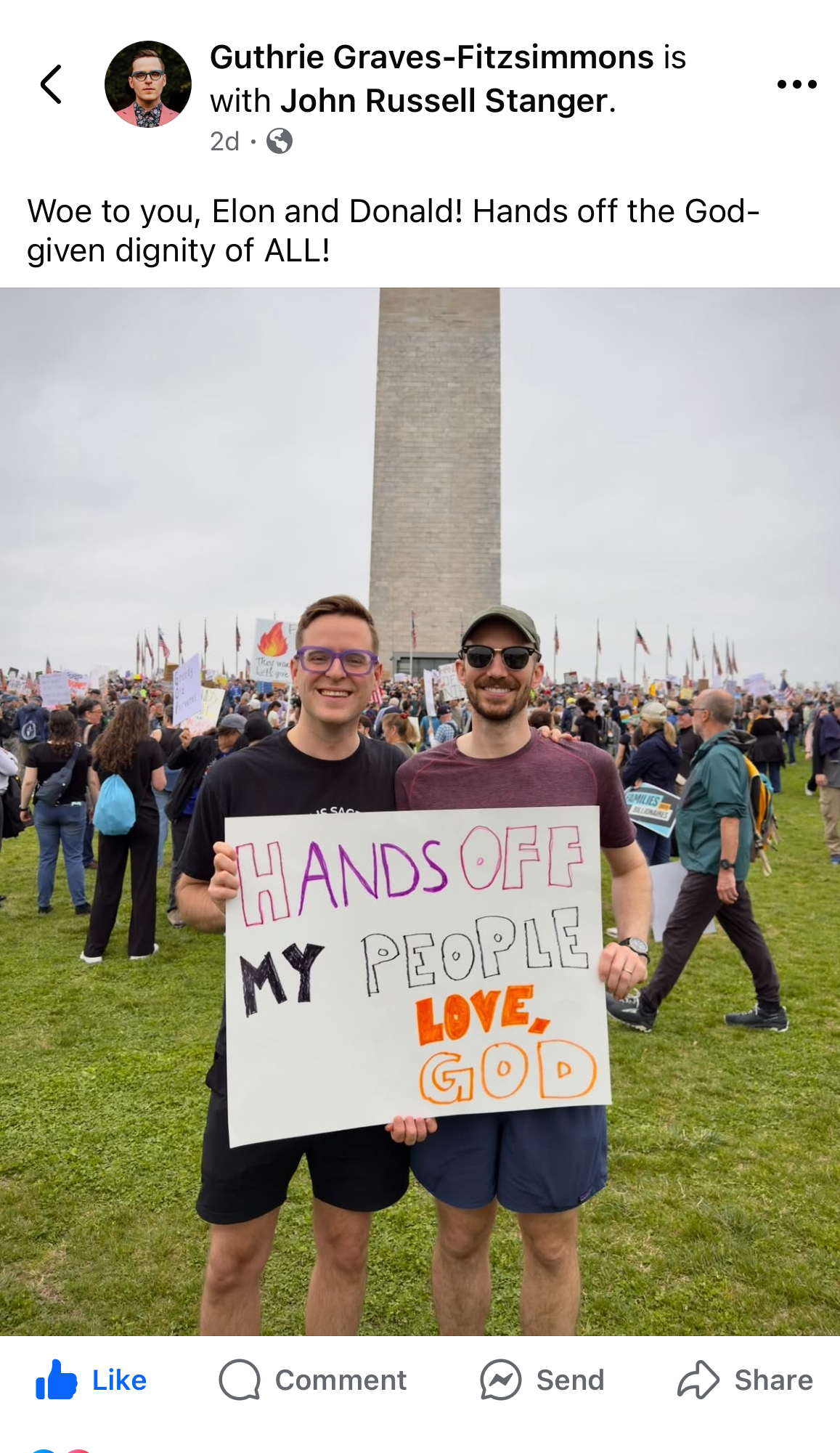
The Hands Off! rallies last weekend drew large crowds across the country. Protesters filled the streets and filled their social accounts with images of hand made signs like Interfaith Alliance Vice President Guthrie Graves-Fitzsimmons and his husband at the Hands Off! rally in D.C.
Before sharing anything, do a quick search to confirm accuracy. Are there several news outlets confirming this story? Do the numbers match up?
Here’s an example of what to watch out for: the DOGE website offers unreliable information; their data continues to be fact checked by reporters, so it changes, often to more incorrect and misleading information. Make sure you are using a reliable source and it can be confirmed with at least one other reliable source. Large news networks or newspapers are generally reliable if they confirm each other. But just because one politician said it, or you saw it on X, does not mean it is factual or true.
Upon seeing a post you find compelling, perhaps an article from Baptist News on Facebook, hit the share button and include a short blurb about why you think this is important. Make it personal if possible. Or copy a key sentence from the article in quotes to let the reader know what is in store.
Shares bump the post up in the algorithm, which means it gets seen more, prioritized. Share often, keeping in mind the post is shared to your timeline and attached to your name. I generally keep my shares to one or two a day.
React. Like, love … Same concept applies. The more reactions a post gets, the higher it gets in the algorithm.
Comment. If you react to a post and you comment, this gives it more priority. If you react, comment and share, you are giving the post optimal performance. Note that you can make a one-word comment like “Yes!” but longer comments encourage your friends. Also, never be afraid to section out your comments. It makes longer thoughts easier to read in the comment sections. The more comments you get, the better.
Not all social media platforms follow these exact generic rules, but you get the idea.
When creating your own content, find an image that will help communicate your opinion or share a photo of yourself. We need visuals to connect to each other. Videos are even more powerful and are considered the most popular tool for social media. If you can share a video of yourself, people will watch it.
Say you are going to a protest this weekend. Make sure you take photos and record some short videos so you will have visuals to share on socials. Even consider making a video ahead of time inviting others to join you.
Some tips for videos are to hold your phone up high at eye level to record (so the viewer isn’t looking up your nose), outside is great for lighting, keep it one or two minutes or less in length.
Use hashtags (#). These connect your topic to other users. You can search for trending hashtags on social media platforms and pull key words from your topic. You don’t need more than five or six or your post becomes cumbersome. Some generic suggestions are #WeThePeople, #SayNotoOligarchy, #FightFacism, #TarrifTax, #Protest.
Spread out your text. Write a few sentences and then do a hard return leaving a space. Try not to be overly long. Too much text leads to people scrolling right on by. Always proof after posting. Use the edit button in Facebook if needed. For other platforms, simply copy your text and delete and repost with corrections.
 Get creative. Use your faith and knowledge of Scripture to speak to the wrong you wish to address. This comment from Eileen Campbell-Reed stood out to me as she responded to the video released by the secretary of homeland security of human beings abducted without due process from the U.S. and caged in an El Salvador prison.
Imagine seeing your own father, brother, or son’s face behind her … Woe to people who pose in front of suffering and act as the scourge of the earth.
And (definitely past time to bring back biblical curses)
This caught my attention. I already have begun using biblical curses for a certain broligarch when commenting on Facebook.
May eternal misfortune be heaped upon his cheese-wearing head as the cries of hungry children torture his nightmares. May all his money be turned to dust or better, given to the poor, or set up as reparations for black Americans, so help me God, this I pray.
One last suggestion: As we see tech oligarchs (or broligarchs) possibly suppress or censor free speech, it may be necessary to learn one lesson from the current occupant of the White House. He uses a descriptive, often rude nickname for folks he wants to critique. You may have noticed I have avoided naming individuals outright in this piece, which was deliberate. I have strategically used “Drump” online to refer to you-know-who. Coded language may become necessary as the tech oligarchs become savvier in manipulating algorithms or receive pressure to suppress or censor our right to free speech.
“These are desperate times and asking nicely is not effective.”
Yes, this is unconventional, and my Southern upbringing does not leave me entirely comfortable with this approach. However, these are desperate times and asking nicely is not effective. Strategy is key in communicating demands. Our language must communicate how critical this moment is.
Allow me to offer you an excellent example of what resistance on social media can look like from theologian Steve Harmon. It was from Harmon’s post that Campbell-Reed made the creative comment I shared above.
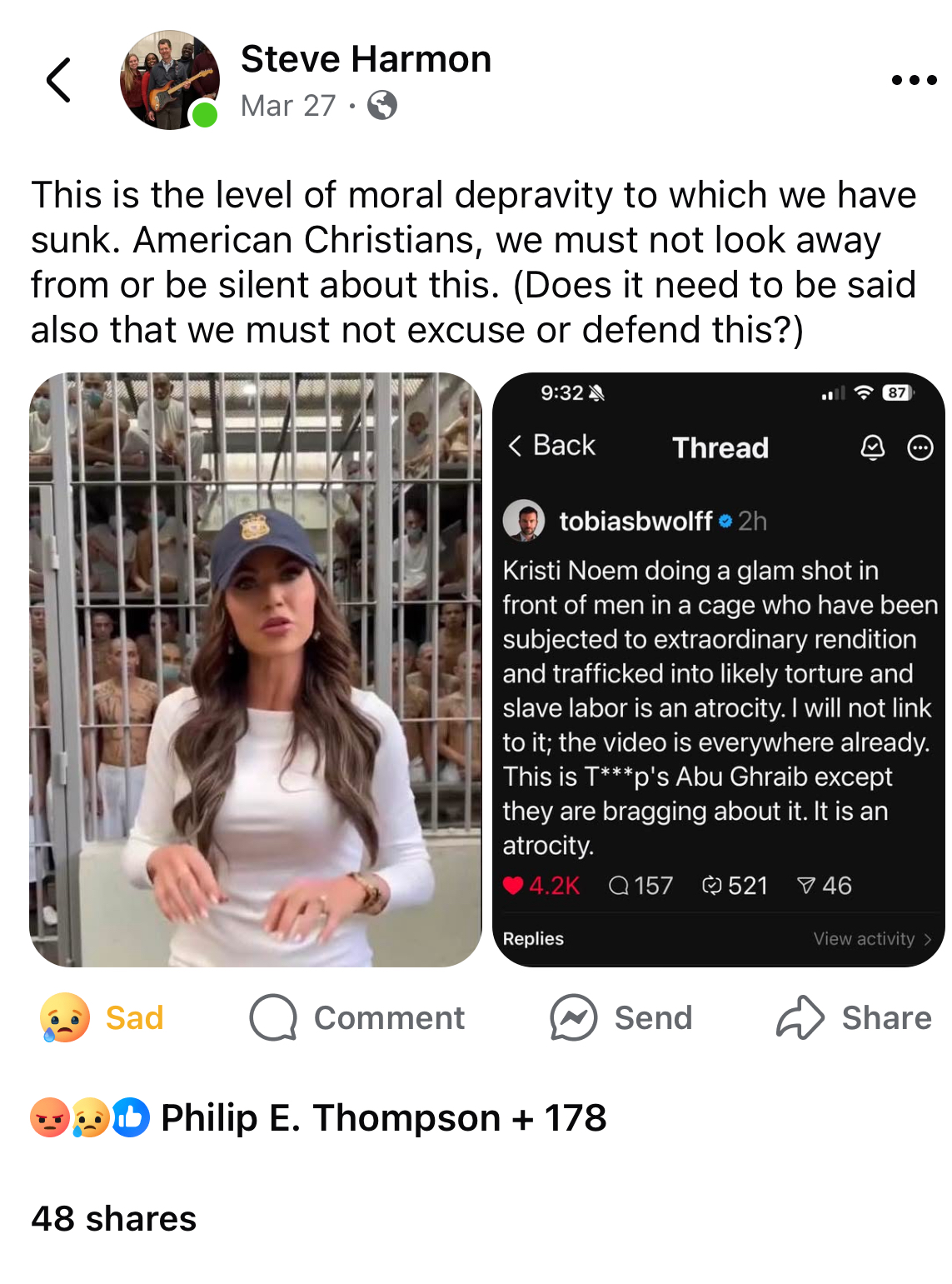 Harmon’s post and Campbell-Reed’s reaction got my attention, so much so, that I was one of the 48 people who shared the post with my own thoughts. We joined our dissent with perhaps millions of other Americans on social media. It was part of a resistance that is brewing against an administration that does not appear to be interested in listening to the morals of American people no matter what party they belong to.
It is understandable if you feel hesitant to post your political leanings on social media. It is a vulnerable space to be in during such uncertain times. When I asked Steve what compels his actions he shared with me in part:
I believe I have an obligation to serve the church by asking the church to consider whether its faith and practice is fully participating in the reign of God — the big thing God is doing in the world to move the world toward the full realization of God’s intentions for all creation, which certainly include the flourishing of all creation. In this I am taking a cue from the late Peruvian theologian Fr. Gustavo Gutiérrez, who died last October at the age of 96.
Gutiérrez defined the task of theology as critical reflection on the praxis of the church, and with so many members of the church in the United States either supporting or choosing not to confront in our context what is diametrically opposed to God’s intentions for the flourishing of all creation, there is much critical theological reflection on our practice to be done.
On any given day since January 20 there have been multiple developments related to the current American regime and the relation of American Christians to them that call for this sort of critical reflection on praxis, but I had an especially visceral reaction to seeing the secretary for the Department of Homeland Security staging a photo op in front of humiliated, dehumanized bearers of the image of God. Not even Jospeh Goebbels would stage a photo op in front of concentration camp prisoners to showcase what was being done to them to his country and the world.
The American church is at a critical moment. We must declare our opposition to policies and practices that treat people who are the image of God as anything other than that, and we must come alongside and advocate for those who are harmed by the policies and practices of the current American regime.
Julia Goldie Day is an ordained minister within the Cooperative Baptist Fellowship and lives in Memphis, Tenn. She is a painter and proud mother to Jasper, Barak and Jillian. Learn more at her website or follow her on socials @JuliaGoldieDay.