

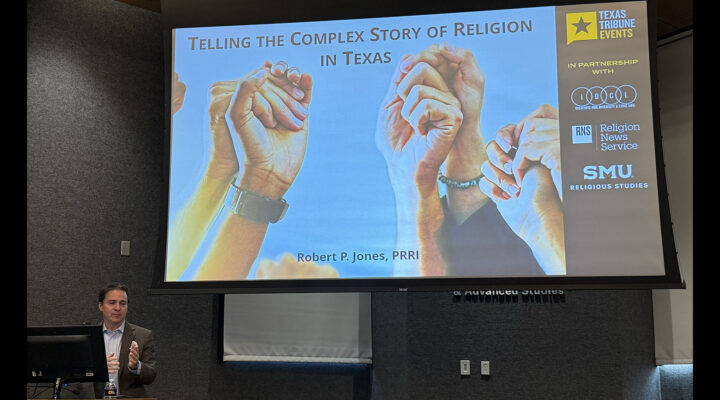
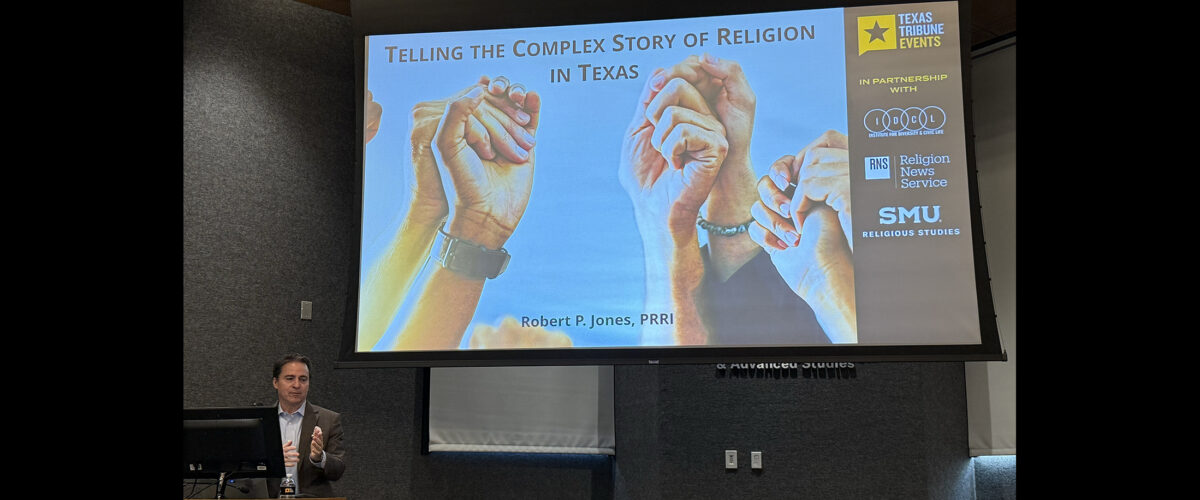
Robert P. Jones was the keynote speaker at an April 8 conference sponsored by the Texas Tribune and Religion News Service on the campus of Southern Methodist University in Dallas. The theme of the day was how journalists tell stories about religion in Texas. At the conclusion of his main remarks, Jones offered this specific commendation to the journalists in the room and watching online.
More than at any time during my lifetime, our nation needs a vibrant, independent free press. Today, carrying out that mission, one guaranteed by our Constitution but under direct assault by our current president and his administration, will require courage and inevitably entail personal risk. I want to personally say a heartfelt “thank you” to the stalwart journalists who are keeping us informed and illuminating the daily threats to democracy we are experiencing.
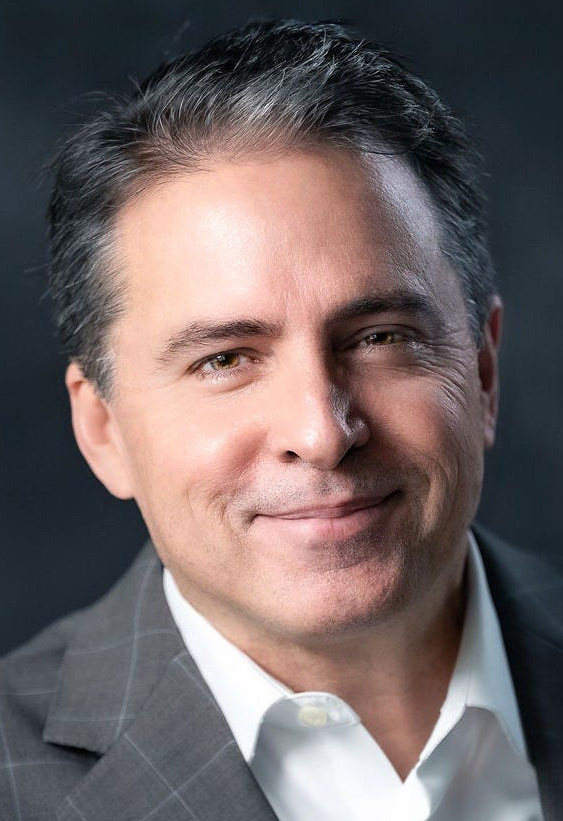
Robert P. Jones
We the public are going to need to stand behind you and honor your work as sentinels and protectors of our democracy. Together with us, you are also going to need to stand behind your colleagues. We must all be ready to speak out and act when even one of you is targeted by the authoritarian leaders and denied access, censored, jailed, deported to foreign prisons, or worse.
Such anti-American actions against the press, spurred by a leader who calls the media the “enemy of the people,” are no longer unimaginable scenarios in our country today. Some attacks have already occurred. And more unlawful actions against members of the press are surely coming.
An aggressively free press is particularly important in these days when religious identity and religious claims are being used as a cover by an authoritarian movement that is openly dismantling democratic institutions and undermining democratic norms. History teaches us that authoritarians almost always rise cloaked in religious garb, pairing their audacious claims to power with extraordinary justifications.
“An aggressively free press is particularly important.”
Authoritarians typically project a besieged ethno-religious identity for the nation and then make citizenship and legal rights dependent on alignment with that vision. They turn politics into an apocalyptic bloodsport where compromise with fellow citizens is cast as betrayal. They shift into a powerful theological register, speaking of tribulation and deliverance, violation and redemption, defilement and a purifying fire — capped always with the promise of a great new Golden Age to be ushered in by the divinely-ordained Great Leader.
When religious claims and identity are invoked by public leaders, there is a tendency among journalists — based mostly in a laudable respect for religious liberty — to be deferential, giving such language a wide berth. But in this unprecedented moment, to protect our democracy, we need journalists who are respectfully determined to take the religious claims of public actors seriously enough to interrogate them.
We need journalists to remember that whatever religions may be on a cosmic plane, the manifestation of religions here on earth are institutions and traditions maintained by fallible (and my own Baptist tradition would say, “sinful”) humans. As such, the lived social manifestations of religion, like other human constructions, are fair objects of journalistic examination. Moreover, failing to interrogate the religious claims of public leaders leaves the most powerful engine of propaganda humming along.
Take, for example, Donald Trump’s weaponization of anti-Christian bias and antisemitism. We, as American citizens who value the religious liberty of all, must abhor and resist bias, discrimination or hate directed toward anyone based on their religion. But our critical antenna should go up when we see an executive order focusing only on discrimination against the dominant religion in the land, a group experiencing only a fraction of the documented discrimination and hate crimes targeting Muslims or Jews. Our critical antenna should go up when we see broad accusations of antisemitism being leveled against a university in ways that stifle academic freedom and free speech and seem intended less to make Jewish students safe than to diminish the institution and bring it to heel for political ends.
“Rather than being treated with deference, white Christian nationalism must be identified as a dangerous movement.”
Anti-Christian bias and antisemitism certainly exist in America and are urgent, valid concerns. But in the hands of authoritarians, such valid concerns all too often function as raw materials to be distorted and used for insidious ends. With skilled sleights of hand, authoritarians manipulate them to persecute groups they declare disloyal, while permitting favoritism of others, all supposedly in the name of protecting religious liberty. Task forces and campaigns allegedly created to protect against anti-Christian bias and antisemitism will ultimately be wielded as political weapons, targeting not just people outside those explicitly named groups but, eventually and surely, the wrong kinds of Christians and the wrong kinds of Jews.
Similarly, we’ll need journalists who understand what I see as the primary ideological threat before us today: white Christian nationalism. Rather than being treated with deference, white Christian nationalism must be identified as a dangerous movement that is openly dedicated to propositions that undermine American democracy.
We are in an existential struggle to answer a question that has plagued us since Europeans first landed on the shores of this country: Are we a pluralistic society, where everyone, regardless of race or religion stands on equal footing before the law? Or are we a divinely ordained promised land for European Christians?
In these dark days, we’ll need courageous and tenacious journalists who will cast a clarifying light to help us see clearly that only one of these visions is reflective of our diverse religious population and compatible with a pluralistic democracy.
Robert P. Jones serves as president and founder of PRRI and is the author of The Hidden Roots of White Supremacy and the Path to a Shared American Future and White Too Long: The Legacy of White Supremacy in American Christianity, which won a 2021 American Book Award.