



Let me give pastors some advice: Run away as fast as possible from anyone trying to convince you that burning out or upholding unhealthy expectations (your own or from others) is a rite of passage. It is not.
I agree that pastors can be lazy, so we can get that out of the way from the start. Being redeemed by Jesus’ shed blood and called to serve him, and then uniquely care for his people as an undershepherd is cool. Still, as with everybody else, sin remains a thick sludge within those who preach and teach until we return to the ground, “earth to earth, ashes to ashes, dust to dust.”

James Ellis III
Some ministers fudge their hours or play video games when they should be visiting the sick and preparing sermons. Some are more excited about displaying academic degrees on the wall, brewing homemade beer in their basement, or thirstily chasing influencer status than they are about corralling, correcting and caring for God’s sheep and leading people to Christ. I get it.
But a bigger issue is the ability to correctly identify pastoral workaholism as an idol, so we can be better equipped to contend against it for the sake of Christ, with the Spirit’s help.
A winter lesson
In January, my small town on the edge of Lake Michigan was hit by a brutal winter storm. One morning, it dropped to -4°F, which with the wind chill made it feel like -25°F. In our 1946 bungalow, the city’s main water supply pipes were so offended by the cold that they froze solid. That meant a hasty retreat to a hotel for three days, waiting for the temperature to creep up into the teens and twenties.
Meanwhile, I kept a space heater running nonstop, aimed directly at the plumbing, hoping to thaw it out. After hours of clearing snow from our sidewalks and driveway and tossing ice melt everywhere like a crazy person one afternoon, I headed back to the hotel only to pass a truck that was stuck. The Ohio driver, who was here innocently checking on his vacation home, seemed to have underestimated the depth of the snow and ice and overestimated the power of his Dodge Ram 1500 Big Horn.
I pulled over, assessed the situation with him, and together we hatched a plan. He tied some boating ropes to my SUV to help pull him out, and it worked beautifully. We chatted afterward, both feeling like we had accomplished something worthwhile, and he offered to pay me for my time and effort, which I declined. We then went our separate ways.
“While I love helping others and do so regularly, it is much harder to lean into it when you are constantly preparing for funerals, sermons, meetings, managing staff and responding to e-mails.”
The story’s significance is this: I was on leave from my church at the time. Due to denominational polity, since I am not ordained in their tradition, my employment must be negotiated on a yearly contract. As my old contract was ending and a new one had been agreed to in principle, I had seven weeks of combined study and vacation leave to use — otherwise, I would need to forfeit it. And since there is nothing in my body or soul that believes in forfeiting compensation, this extended leave became necessary.
While I love helping others and do so regularly, it is much harder to lean into it when you are constantly preparing for funerals, sermons, meetings, managing staff and responding to emails. It is easy to slip into autopilot, disregarding important moments because they feel trivial compared to ministry’s relentless demands. It is debilitating. If pastors are so caught up in internal and external chaos that they neglect the time needed to occasionally lend a stranger a helping hand, be thoughtful, laugh without pretense, sit in silence or passionately tend to their own well-being in other ways, then we have a real problem. And, unfortunately, we do have a problem.
Not taking time off
I know pastors who, after eight, 27 or even 41 years of service — many who have been at the same church all that time — never have taken the Sundays or weeks off associated with Easter, Christmas or Mother’s Day. Privately they speak of feeling like hamsters in a wheel, trapped in a cycle of fealty, to quote the John Wick film franchise: “I have served. I will be of service.”
“I would love to take that time off some years, but my church would freak out,” they say.
Respectfully, we can be a bunch of cowards or hypocrites. Many of us decry personality-driven ministries that elevate the pastor to godlike status, yet we lead and live as if God’s mission and power go ghost when we are not in the pulpit.
“We lead and live as if God’s mission and power go ghost when we are not in the pulpit.”
I know pastors who rarely take vacations, and when they do, they still end up doing church work. Believe me, their loved ones and bodies keep score and are not fans of the neglect.
But much of the time, pastors think this is the way it must be. The trouble starts when you finally begin to see like the man at Bethsaida in Mark 8:22-26 or Bartimaeus later in Mark 10:46-52 — because now you need to do something with your corrected vision. What we need are pastors whose hearts are being renovated, who understand themselves, the Lord and their calling in a fundamentally improved, more biblically accurate way.
Workaholism
The concept of “workaholism” was first introduced by the pioneering pastor-scholar Wayne Oates in his 1971 book Confessions of a Workaholic: The Facts about Work Addiction. However, the issue has existed for as long as pastoral ministry itself, with unrealistic expectations about such work becoming normalized among pastors, parishioners and the larger society.
You can see this dynamic reflected in Marianne Bernhard’s May 1981 Washington Post article, “Clergy Burnout: When Stress and Overwork Overwhelm the Spirit.” The theme is also explored in the 1996 film The Preacher’s Wife, starring Denzel Washington and Whitney Houston, as well as its 1947 predecessor, The Bishop’s Wife. Novels like And the Shofar Blew by Francine Rivers (2003) and the writings of church fathers, monastics, reformers and other Christian leaders throughout history further illustrate the point.
Like a stubborn, insidious weed, overworking traps clergy in servitude to an obsession that feels larger than life and whose allure is deceptively compelling. After nearly two decades of navigating the pastoral vocation — serving as both a pastor and a college/university chaplain — I can tell you: It makes for an odd, often intense life. The struggle is real.
“Overworking traps clergy in servitude to an obsession that feels larger than life and whose allure is deceptively compelling.”
Honestly, many people are unconcerned with how isolating your work can be or how under-compensated you are — as if you took a vow of poverty, which at least in my case I did not. You are simply a tool of the institution that their paychecks fund, although if they tithe or give at all in the first place is another story. You are expected to be at their kid’s Barbie-themed birthday party or soccer game and troubleshoot any adult challenges they face. And you are supposed to do all of this in the name of Jesus all day long like some cute, cuddly Energizer Bunny that recites the doxology upon request.
Concierge pastors
The “concierge” approach to ministry, however, that treats pastors like spiritual Amazon delivery drivers is not from God. I decided long ago that ministry would not be my primary calling, and for that and some other choices, I have faced criticism. I just refuse to let the work define me. It is not worth it.
My wife deserves a fully present husband who prioritizes her and our life together, not someone who can only talk about church life at a dinner party, who needs to be needed by the church, or who must be nagged to death to ever take time off.
Let me be clear: I love what I do, but I do not need everyone to like me and definitely do not want anyone to worship me.
“I love what I do, but I do not need everyone to like me and definitely do not want anyone to worship me.”
As an African American, I have served in multiracial, predominantly Anglo and predominantly African American ecclesial settings. I was born in Japan due to my father’s Air Force career, while my wife was raised in an Army family that moved frequently. Together, we have lived in 10 states and three countries. Only God knows where we might be sent next.
It does not make for an easy, predictable or cushy life. But sacrificing myself on the altar of ministry is foolish and unfaithful. Pastors need to know that no superheroes are coming to save them or remedy their disordered ways. God already has done that, and continues to do so, often sending loved ones or even strangers to help us along the way.
 In life and ministry, balance, prioritization and mature identities are elusive. No one here is advocating for the kind of unrealistic, utopian thinking that implies everything can float along in perfect equilibrium every moment of every day. I am not complaining about the sacrifices that come with serving people in Jesus’ name as a pastor — although voices like Peter Scazzero’s, for example, offer both ancient and modern rhythms that can help us work more sensibly and sustainably. I am not suggesting pastors should “quietly quit” or standardize mediocrity or unprofessionalism.
Ministry is a grind, and some of that is just the static reality of the matter. Nevertheless, being a pastor is not the “holy grail.” It represents meaningful, incarnational work, but so does what is provided by military personnel, HVAC technicians, educators and health care and social workers, and the T-Mobile staff who kindly make my cell phone cooperate when it gives me the blues.
In one of the courses I teach at Winebrenner Theological Seminary, a student, Henry Volk, once reflected: “Fast-food churches preach a QR code Jesus.” As prophetic and accurate as his statement is, too many pastors are also living QR code lives — failing to lead by example.
Yes, the struggle is real, but we can do better.
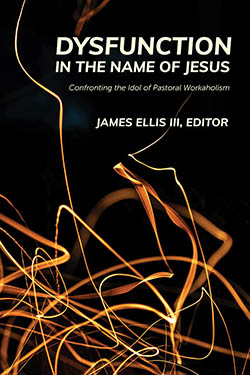
James Ellis III is an ordained Baptist pastor and assistant professor of practical theology at Winebrenner Theological Seminary. His latest book is the edited volume Dysfunction in the Name of Jesus: Confronting the Idol of Pastoral Workaholism. He holds a doctorate from Western Theological Seminary, master’s degrees from Pittsburgh Theological Seminary and Baylor University’s George W. Truett Theological Seminary and a bachelor’s degree in African American studies from the University of Maryland. Learn more at his website.
This article is excerpted from Dysfunction in the Name of Jesus by James Ellis ©2025 and is used by permission of Smyth & Helwys Press.