

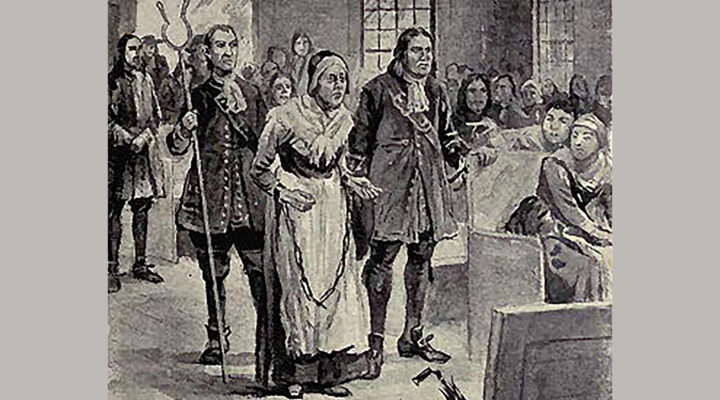
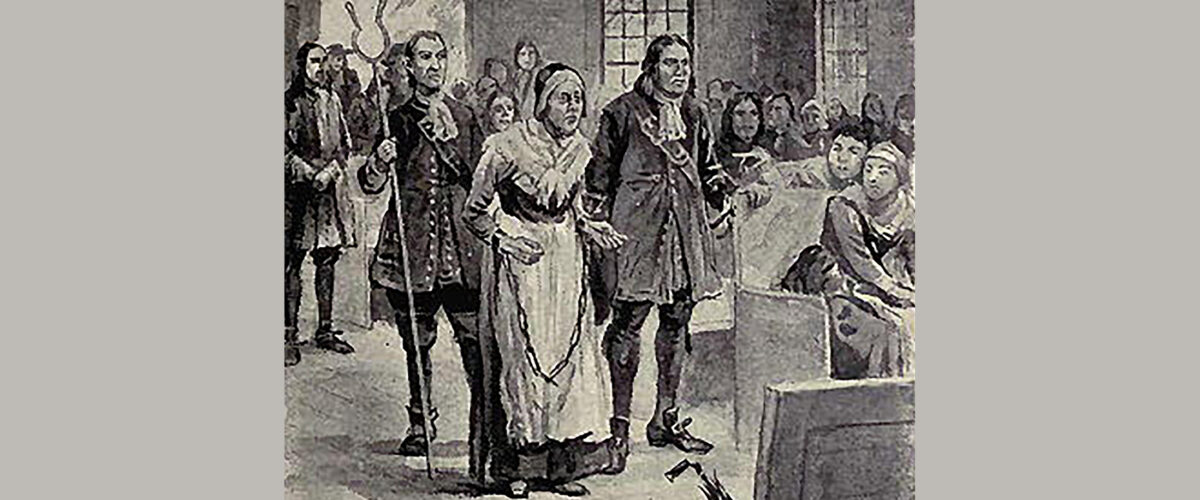
The noose sways, awaits its fresh kill. The neck destined for its grip is soon to hang from it, but an aura of calmness, even dignity, surrounds its owner, as she prepares to meet her fate.
It is July 19, 1692, Salem Village of Massachusetts Bay Colony.
Witch trials, at fever pitch. But why this one? The accused is a well-regarded pillar of the community, referred to as a “model of Christian behavior.” Various theories are proposed, including revenge for a long-standing land dispute.

Lynne Weiler
This execution almost didn’t happen. The jury initially returned a not guilty verdict. But the accusers were out for blood. Screaming and fainting in court, their antics along with “spectral evidence” swayed the jury’s final decision to a finding of guilty. The accused was also partially deaf, and as such, missed an opportunity to fully acquit herself when questioned.
So we are told of a frail 71-year-old mother of eight who will live on in the infamy of a benighted era: Rebecca Nurse. A convicted witch.
The silver lining, if there could be any, was that her execution was thought to mark the beginning of the end of Salem’s reign of terror, as those who knew her came to second guess their wisdom in executing this saintly old woman. A realization too late for Rebecca and the other murdered innocents.
False witness had wreaked its havoc. How her words haunt: “I can say before my Eternal Father I am innocent. … The Lord knows I have not hurt them.”
History rhymes
For me, the story hits especially poignantly. If amateur investigation into my lineage is to be believed, Rebecca Nurse is my ninth great-grandmother. (She might be yours, too; there are a lot of descendants). Notwithstanding the distance in time and space, this horror feels personal and close at hand, especially after what I’ve witnessed in recent months. For the witch hunt spirit, dear reader, is alive and well, and very much on the move.
“The witch hunt spirit, dear reader, is alive and well, and very much on the move.”
As it happens, history rhymes.
Some people go to the beach for a holiday. I went to Evangelical X (formerly Twitter). What I experienced there felt something like that sinking sensation when you’ve lost something important. It was as if I were watching a wrecking ball crush the bridges many have worked a lifetime to build. You might even call the feeling a kind of grief. While online incivility is nothing new, many are noticing an uptick on our current timeline.
Much of the fury we see now has been percolating since COVID. This rage was further ignited with the recent publication of a few inflammatory, popular books marketed to the Christian Right and the online ecosystem that has sprung up in their defense.
Without detracting from the valid concerns raised in these spaces (traditional print and social media), let’s be frank. Something is very wrong. This crusade is ostensibly a defense of the Evangelical church from mounting threats. A noble cause, to be sure. Yet its gleefully condemnatory vibe conjures up 17th century Salem in a way that hardly seems to bear the marks of Christian grace and love — and in many cases, with insufficient support of its claims of truth.
In addition to warning you about the precarious state of the American church in their books, these same influencers also use their social media to make sure you know other things, important things.
The immigrants are eating pets in Ohio.
The Good Samaritan parable is really about God’s love toward us, not primarily a paradigm of how we should treat others.
Don’t you know, empathy has the potential to poison the soul?
Michelle Obama is secretly a man.
I have to wonder what exactly has captured their imaginations, such that they reliably choose the least charitable path, appearing to take delight in making others smaller. These sorts of posts teach us nothing, if not the winning formula: A heaping portion of misanthropy with a side of conspiracy. Or as our parents would have simply called it, good old-fashioned gossip.
Gallons of ink have been spilled in support and critique of this movement. I leave the specifics to the many others who have skillfully evaluated its strengths and failures, and to the more than enough publicity supplied in book reviews and X threads. My concern is its widespread toxic influence, extending far beyond the reach of a few dyspeptic commentators. For students of history, it’s all too familiar.
It is the resurrected spirit of the witch hunt.
Nursing grievances
Consider the arc of events. Just a few years ago, the factions were debating how to love your neighbor best in a variety of situations: by submitting to presumably “greater good” interventions, or by encouraging personal freedom. Now, the question is reframed to be, “Well, just who are my neighbors?” (And by extension, why should I love them?)
“Where a scalpel might be best employed, a cudgel is used instead.”
Yesterday’s grievances are nourished and enshrined, serving as organizing principles of today’s arguments. Where a scalpel might be best employed, a cudgel is used instead. Accusations fly, and motives are assigned — the worst kind.
Naturally, not everyone is happy with this state of play. Many people attacked within these books and related X discussions felt maligned, said to have meant things they didn’t say or didn’t mean (denials easily validated by any fair reading of their own writings).
One favorite target is deceased, and thus quite unable to defend himself. Trouble is, they don’t get to set the rules. Those who do speak up are disparaged, mocked for making their cases. They are not afforded the respect the accusers demand for themselves.
As a result, this corner of social media is a dark corner of largely baseless character assassinations and demonstrable mischaracterizations of people in ministry who, although imperfect, have left a trail of changed lives through their gospel witness.
Again, the point here isn’t to minimize concerns about menaces to the church. We can and should make a case against problematic statements made from the pulpit or troubling cultural trends that push against fidelity to God’s truth, where relevant. But the fatal flaw with many of this past year’s debates litigated on X is that the accusers conflate fealty to a very specific brand of American politics with fealty to Jesus and his word.
So often, the arguments are lacking in good will and good scholarship, attacking godly orthodox leaders with as much venom as if they were full-blown heretics. Scripture invites us to humbly engage in the process of God restoring God’s image to our broken human race, as we live out the ideal “in essentials, unity; in non-essentials, liberty; in all things, charity.”
We are called to be fishers of men, not harpooners. And I’m pretty sure a Mendelian cross between deadly nightshade and prickly pear doesn’t pass as genuine fruit of the spirit.
“We are called to be fishers of men, not harpooners.”
Every time someone at pen or keyboard blithely tears down others, without giving the accused a fair hearing to clarify, the spirit of 17th-century Salem stirs. As I read the social media salvos and book quotes, it is not too unlike reading the transcript of Great-Grandma Nurse’s trial.
Interestingly, both movements were promoted in their respective times by the prospect of “naming names.” Proverbs 16:28 — the passage that refers to troublemaking as a perversion — would like a word here.
A better way
Mercifully, God has provided other examples, better angels to lead the way. None other than the master of apologetics, C.S. Lewis, is instructive here, as described in an essay by academic Michael Ward. In it, we read that Lewis’ “passions were people and arguments, but he did not often make the mistake of confusing them. … While he laid into the arguments of a colleague with great forcefulness, he never named the man but covered his opponent in a thoughtfully woven cloak of pseudonymity.”
And in a striking admission of the need for others’ input and correction, Lewis said, “My own eyes are not enough for me.”
Notwithstanding the photographic negative of this ideal run amok within witch hunt Christian X, I’m very glad to report there is hope. You’ll find it in grace-filled Christian social media. Believers (or their ministries) such as Chuck Swindoll, David Jeremiah, Joni Eareckson Tada, Derwin Gray, Hugh Ross, Karen Swallow Prior, to name a few, frequently post encouraging insights, leaving me edified, intellectually and spiritually.
And then there was the very lovely personal encounter I had not long ago.
At around the same time I became aware of the florid online nastiness, a notable bestselling Christian author made a rather unique and refreshing gesture, even in the throes of her own serious health battle. She invited her readers to send in prayer needs. She would then make herself available to pray for whatever was asked within a given timeframe. If she saw your reply, she would acknowledge it, indicating she was lifting you up.
In the few moments after I submitted a note about my family, the little red heart showed up. My eyes brimmed with tears.
This author is Nancy French. I never have met Nancy. But she prayed for me.
She doesn’t know anything about me or my political affiliation. Yet based on my request, she knows I’m a sister in the Lord and as such, worth building up, not tearing down. I realize I’ve been homesick for this sort of loving expression within social media, eminently more mature, looking so much more like our Savior, than the cutesy snark that passes for “Christian influencing” these days.
“I’ve been homesick for this sort of loving expression within social media.”
First it whispers. Then it shouts.
The frenzy of the 17th-century witch hunts — starting with rumor and innuendo and leading straight to the gallows — may have faded from that time and place, but its animating force never really has gone away.
While early Salem was pre-X, they did have their own version of social media: the printing press. And as a result, the infamous Malleus Maleficarum (The Hammer of Witches), “a guide to the identification and prosecution of witches,” was widely disseminated, shaping public opinion into a conspiratorial mold and setting the stage for the subsequent execution of thousands worldwide.
It is doubtful the people at the time had any inkling where this was headed when the frenzy began. And when it was all over, I wonder if they grasped the strange irony of the witch hunts, that the false witness they bore conjured up the very spirit they claimed to be fighting, the spirit of antichrist.
What happened in 17th-century Salem will not stay firmly in the 17th century, unless we actively resist it. You’ll know it when you see it. It will look like an empty moralism, devoid of grace. A disembodied religiosity, pure muscle of judgment and no heart of compassion. Detachment from a sense of shared humanity and, ultimately, from the love and truth of the Creator. And it will sound a lot like a clanging cymbal.
Lest one still thinks this analogy is a stretch, around the time of this writing, I saw a tweet: Two of the more prominent Christian conservative supporters called for the state to execute a former presidential adviser. By hanging.
In the end, I would love to say this to dear Rebecca Nurse: I’m so sorry. Deeply sorry that you met this unjust end. It’s grievous to see the same sort of hateful condemnation rising again, in my time. I hope we can do better going forward and honor your memory, by resisting the witch hunt zeitgeist wherever we find it.
Galatians 5:14 — “For all the law is fulfilled in one word, even in this: ‘You shall love your neighbor as yourself.’ But if you bite and devour one another, beware lest you be consumed by one another.”
Lynne Weiler holds a bachelor’s degree in English literature and master’s degrees in public health and nursing. After starting her career in corporate consulting, she shifted gears to pursue health care, most recently working as a nurse practitioner. Her various academic and professional experiences grappling with the human condition have stoked a passion to articulate the role of faith in the marketplace of ideas. She loves the natural beauty and changing seasons of Rochester, N.Y., where she makes her home with her husband, daughter and dog.
Related articles:
The return of the witch hunters | Opinion by Susan Shaw
At Salem, a reminder the Puritans were Christian nationalists too | Opinion by Joe Westbury
Let’s do the Satanic Panic once again | Opinion by Erin Wyma