

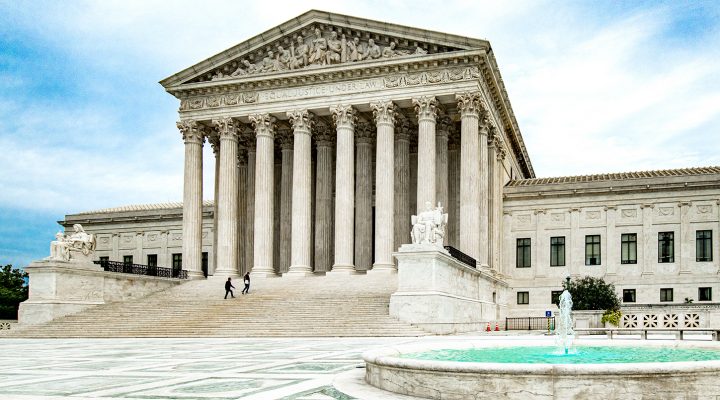
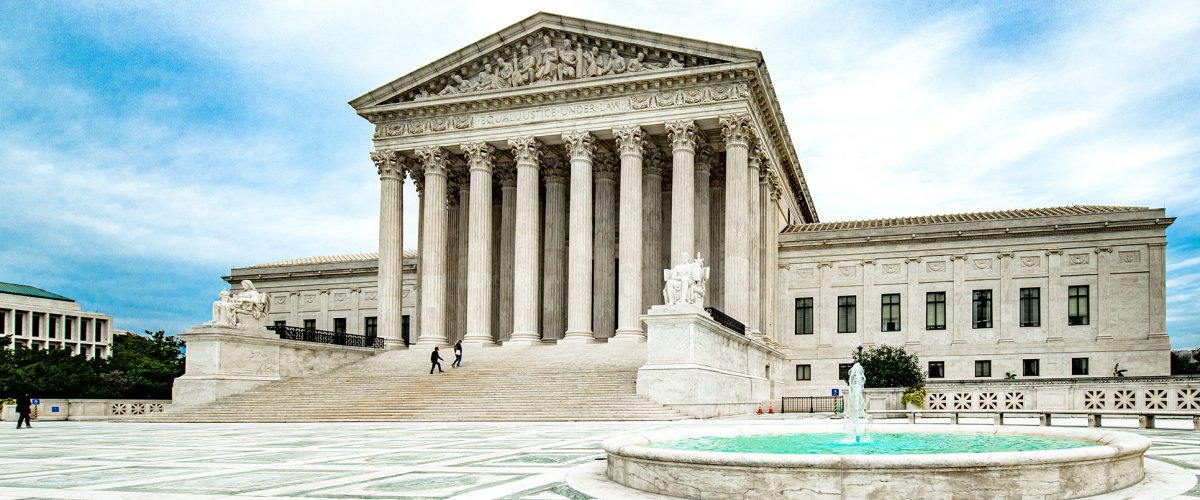
For the time being, the Trump administration has been blocked by the U.S. Supreme Court from using a centuries-old law to deport a group of Venezuelans accused of being gang members.
“The government is directed not to remove any member of the putative class of detainees from the United States until further order of this court,” according to the unsigned order issued April 19. Justices Samuel Alito and Clarence Thomas were the lone dissenters among the court’s nine justices.
At issue is President Donald Trump’s March 15 proclamation invoking the Enemy Aliens Act of 1798 to counter what it claimed is an “invasion” of the U.S. by Tren de Aragua, an international crime organization based in Venezuela. The law grants a president power to detain noncitizens during times of war and previously was used only during the War of 1812, World War I and World II.
The American Civil Liberties Union and Democracy Forward promptly sued the administration.
The American Civil Liberties Union and Democracy Forward promptly sued the administration in the U.S. District Court in Washington, D.C., on behalf of immigrants currently in federal custody.
The district court’s temporary restraining order barring the deportation of the accused Venezuelans or any other immigrants under the act was upheld by a federal appellate court upon government appeal.
The White House then appealed to the Supreme Court, which lifted the restraining order April 7 on condition detainees be given notice of deportation in addition to the right to challenge their removal from the U.S.
But the ACLU filed an emergency brief with the high court April 18 after learning a number of Venezuelan detainees were being prepared for deportation from the Bluebonnet Detention Center in Texas.
“Emergency relief is necessary not only to preserve the status quo and prevent permanent and irreversible harm to applicants, but also to preserve the courts’ jurisdiction, in light of the government’s position that it need not return individuals, even those mistakenly removed,” the ACLU brief states.
The ACLU’s request said plaintiffs are not challenging the government’s responsibility for prosecuting immigrants who have committed crimes or to prohibit the removal of individuals in violation of existing immigration laws. “It asks only that this court preserve the status quo so that proposed class members will not be sent to a notorious prison in El Salvador before the American judicial system can afford them due process.”

Kilmar Abrego Garcia
The reference to “those mistakenly removed” points to the case of Kilmar Abrego Garcia, a legal immigrant mistakenly deported to El Salvador’s notorious CECOT prison in March.
While the administration referred to his detention as an “administrative error,” it has yet to comply with an April 10 Supreme Court order for his return to the U.S. and has since launched a concerted campaign to label him as a dangerous criminal and gang member.
Rights groups issued calls for justice and decried the government’s actions as detrimental not only to Garcia but also to the American legal system.
“This is a straightforward matter — the administration made a mistake by deporting Kilmar Abrego Garcia to a Salvadoran prison and the highest court in the land agreed unanimously that it needs to rectify this grave error by bringing him home to his American family,” said UnidosUS President Janet Murguía.
“This is the worst example of the Trump administration’s overreach, its harmful approach to immigration and its cruel methods to separate families, including those of U.S. citizen-born children,” she said.

Baher Azmy
“The Trump administration’s power grab is a direct threat to the separation of powers and the core principles of constitutional government,” said Baher Azmy, legal director for the Center for Constitutional Rights, during an online gathering of human rights leaders.
“Even after losing in court, the administration is testing our tolerance of disobeying a lawful court order and thus testing whether the rule of law actually matters in this country,” Azmy added. “The normalization of this behavior is fueling the administration’s ongoing assault on democracy.”
El Salvador also has no intention of returning Garcia, Salvadoran President Nayib Bukele said during an April 14 visit with Trump and media at the White House, according to a CBS News report.
“I don’t have the power to return him to the United States,” the president said. “How could I smuggle a terrorist into the United States?”

Scott Bessent
In another controversial move, U.S. Department of Homeland Security Secretary Kristi Noem and Treasury Secretary Scott Bessent recently signed an agreement to expedite deportations by allowing the International Revenue Service to share immigrants’ tax data with the Immigration Customs and Enforcement, CNN reported.
“The IRS has gone back on its duty to protect taxpayer information from improper disclosure,” the watchdog group Public Citizen said in the CNN report. “If allowed to stand, this agreement will provide a roadmap for federal law enforcement to gain access to confidential taxpayer information without obtaining court order as required by law.”
In an effort to further clamp down on illegal immigration, the president signed a new executive order directing the U.S. military to increase its presence at the Southern border including by seizing control of the Roosevelt Reservation, a stretch of land between Mexico and Arizona, California and New Mexico.
The order directs the Department of Defense to assume jurisdiction over the area for the purpose of placing detection equipment and to enable border-wall construction.
The American Civil Liberties Union responded with concern the administration may be moving toward implementation of the Insurrection Act, which would give Trump power to place National Guard forces under his control and deploy them in the U.S.
“Make no mistake: If Trump invokes the Insurrection Act to activate federalized troops for mass deportation — whether at the border or somewhere else in the country — it would be unprecedented, unnecessary and wrong,” said an ACLU statement.
“It’s worth repeating that there is no invasion of America, and if President Trump doubts that, he could consult himself. Last month he declared on Truth Social that the (fictional) ‘Invasion of our Country is OVER.’ Yet under his new directive, the Defense Department is claiming new and potentially expansive powers over large swaths of federal land — including where U.S. citizens and other border residents live.”
Related articles:
An Easter message from Jennifer, wife of Kilmar Abrego Garcia | Opinion by Robert P. Jones
It’s time to name and prosecute Trump’s minions | Opinion by Mark Wingfield
Immigration updates: Trump defies court orders and betrays Afghans