


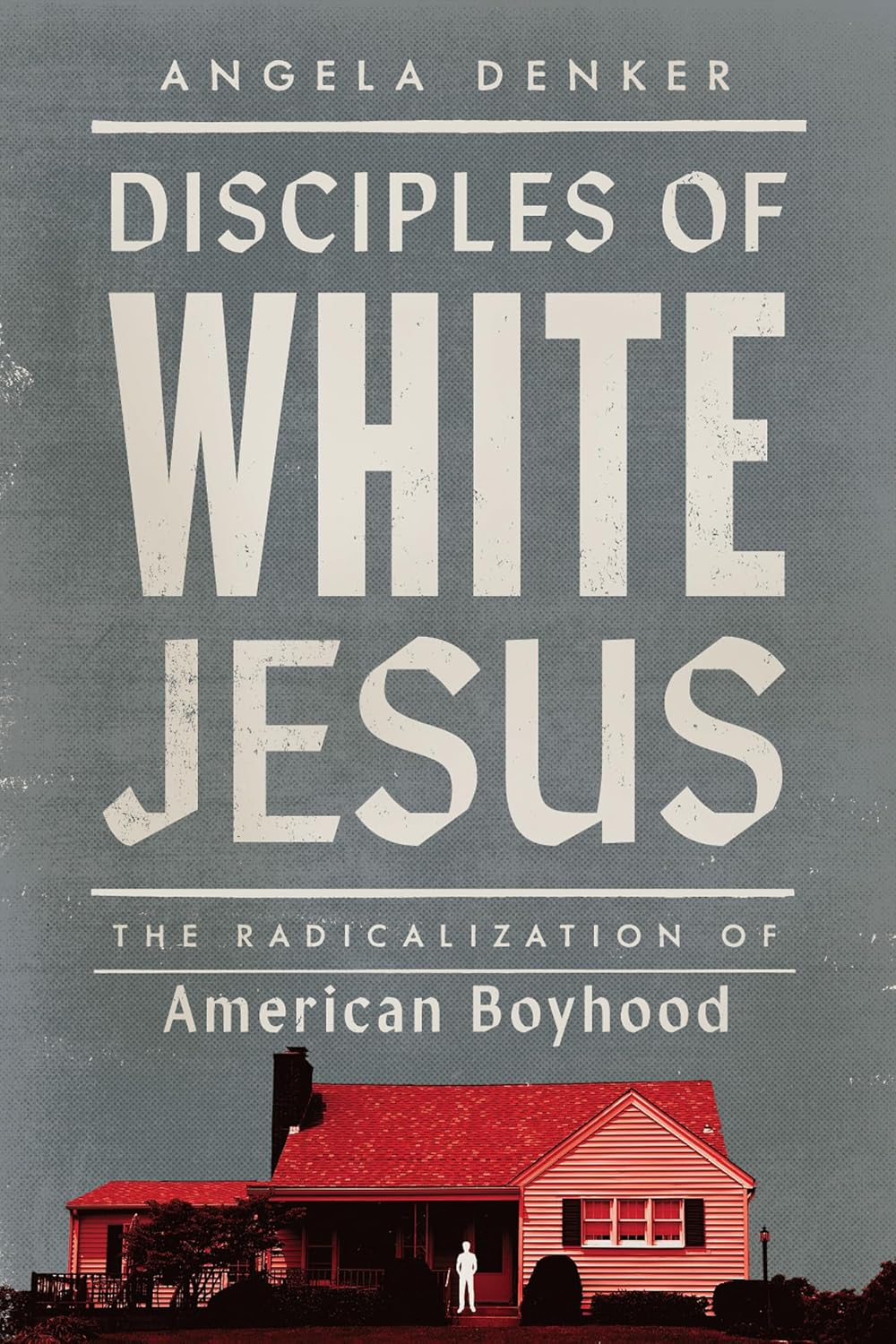
One of the tragedies of race- and gender-based discrimination and violence is that white people can’t — or won’t — see how such issues have anything to do with them, said Angela Denker, author of Disciples of a White Jesus: The Radicalization of American Boyhood.
Nor do they typically perceive how Christianity has been co-opted and used by some to dismiss, justify and perpetuate social ills such as racism, misogyny, the oppression of LGBTQ people and mass shootings, said Denker, a Minnesota-based pastor in the Evangelical Lutheran Church in America.
“Oftentimes, white Christians have a tendency to do this distancing thing when bad things happen — ‘I can’t be racist, I can’t be complicit in religion-based violence. That has nothing to do with me,’” she said.

Angela Denker
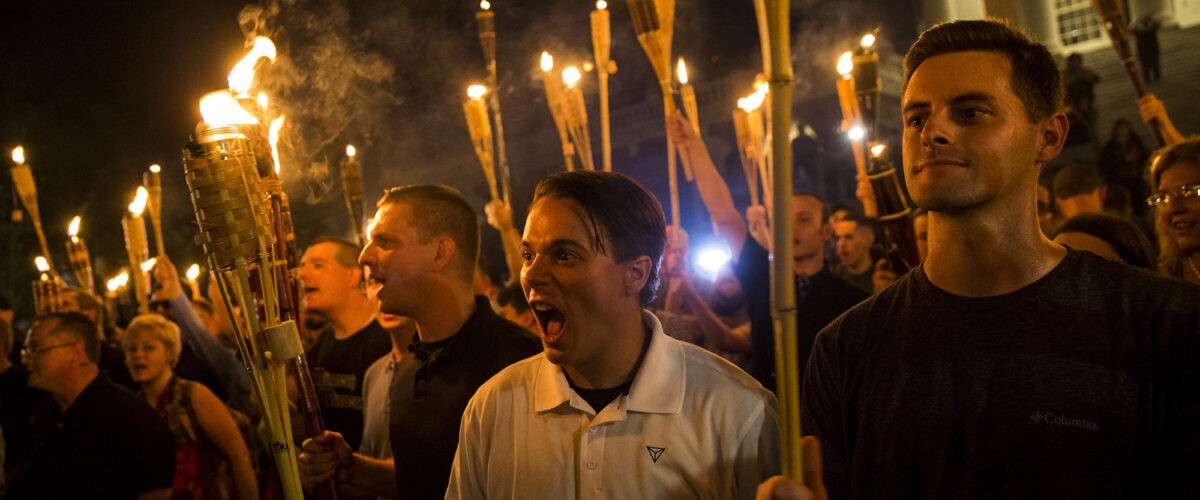
In her new book, Denker untangles and exposes those threads by focusing on the radicalization of white boys and young men, showing how right-wing Christianity and online influencers stoke hatred, violence and a culture of hypermasculinity.
Disciples of a White Jesus also presents the desperate struggle many white boys and young men endure after embracing extremist ideologies and religion, she said. “This is grounded in two truths: that white men and boys are most likely to be mass shooters and are uniquely dangerous and violent, and that they are the most likely to die by suicides. So, they are uniquely vulnerable.”
It is important that parents, youth ministers, pastors, chaplains and others talk about these issues to counter extremist messaging and avoid the temptation to judge and condemn young white males, said Denker, also author of the 2019 book Red State Christians: A Journey into White Christian Nationalism and the Wreckage It Leaves Behind.
“I live in a house with a white man and white boys, so I know we must not dehumanize these boys and men who are searching for identity and masculinity,” she said.
Denker said the research and writing for her latest book propelled her on a journey through her own racial and religious connection to the trends she was documenting. One of the more painful instances was taking a hard look at the Lutheran faith she shares with Dylann Roof, the then 22-year-old white supremacist who fatally shot nine people at Mother Emanuel African Methodist Episcopal Church in Charleston, S.C., in 2017.
“I know we must not dehumanize these boys and men who are searching for identity and masculinity.”
She traveled to the city in 2023 to pay respects at the church and to Columbia, S.C., to meet the pastor of the ELCA congregation Roof attended as a child and young adult.
Roof’s story, Denker explains in Disciples of a White Jesus, “violently intersects with Mother Emanuel’s story and also collides, unavoidably, with my own. I realize how scared I am to even write about Roof, to acknowledge how his story and his violent actions are bound up unavoidably with the lives and future of the young, white Christian men and boys in your life and mine.”
Her story collides with Roof’s “because we were both baptized into the same church body, the Evangelical Lutheran Church in America, where I have been ordained as a minister for more than 10 years.”
 Despite being a progressive Mainline Protestant tradition, the ELCA is one of America’s “whitest denominations,” she said.
Writing about Roof, then, “I would have to look in the eye of the racist hatred and violence that drove him, to see where it intersected with the stories of young, white Christian boys and men in America — to try and understand what had happened, and how we could tell the truth about it. Because I knew that part of what ails young, white Christian men and boys is the stifling silence of shame, fear, and unwillingness to tell the truth.”
What happened to Roof and what often happens to other white boys and young men follows a roughly predictable path from isolation and loneliness to the adoption of radical ideologies and religious beliefs fostered, at least initially, in chatrooms and other online spaces, Denker said in an interview about her book.
The early steps typically involve a sporadic consumption of radicalizing content. “It usually starts off as a joke to be on these sites, but their devices don’t know they are doing it as a joke.”
The hook begins to set in as algorithms increasingly directing white boys and young men to platforms rife with racist, misogynist and hypermasculine messaging.
“In those moments of loneliness or identity questioning, what they have with them is their phones.”
“Then there ends up being something that happens in a young man or boy’s life — a breakup, being cut from a team, bullying by teens — that creates an identity crisis. And in those moments of loneliness or identity questioning, what they have with them is their phones.”
Suddenly, those right-wing sites seem to offer solutions to life’s challenges, she said. “It goes from being a joke to now you are really listening to content about what it means to be a man and how to attract women.”
Radical platforms also give shape and voice to the resentments young white boys and men have toward their peers, females and society, Denker said. “It’s wrapped up in this idea of grievance, of blaming other people — ‘if everybody would just go along with my ideas everything would be great.’”
The Christianity animating many of these platforms is a form of fundamentalism similar to right-wing movements in other faiths, she said.
“It has more in common with Hindu and Islamic fundamentalism than with the gospel of Jesus. It provides a common cause of power and a means of violence. It’s highly focused on controlling women’s clothes and is against reproductive health care, gay marriage and LGBTQ rights.”
In the U.S., its adherents are enamored with the Crusades as a form of righteous Christian violence and with the idea of America as a Christian holy land.
“It’s a partner of autocratic rulers and often they work together, as the Russian Orthodox Church works with (Vladimir) Putin and Iranian fundamentalists work with authoritarian leaders in that country.”
Donald Trump gave permission for the ideologies and theologies of violence to come into the open, and right-wing Christians have done a good job of creating narratives to support their beliefs, she explained. Now it’s time for progressives and others opposed to masculine and violent Christianity to generate stories about healthy alternatives, Denker concludes in the book.
“It’s the stories that make us see ourselves in one another, that help us see God where we’d least expect God and show us an unlikely path away from the madness and pain and death that is all violent masculinity has to offer,” she writes. “Only stories can make us reach for a common humanity far beyond the insecure, desperate, greedy, grasping hands of a fake white Jesus.”
Related articles:
White Christian nationalism is an ancient story, Denker says
Jesus and John Wayne exposes militant masculinity in the age of Trump | Analysis by Alan Bean
Christian groups praise Trump’s ‘healthy masculinity’ and ‘manifest destiny reborn’