

Donald Trump’s de facto campaign slogan throughout the 2024 presidential season was, “I am your retribution.”
In countless ways during his first 100 days in office as the 47th president, Trump has seemed hell-bent on proving he meant it. Sometimes his acts of retribution have been broad and consequential, such as in the mass pardons and commutations on Day 1 of some 1,500 individuals convicted or charged with crimes in the January 6 insurrection he fomented at the U.S. Capitol.
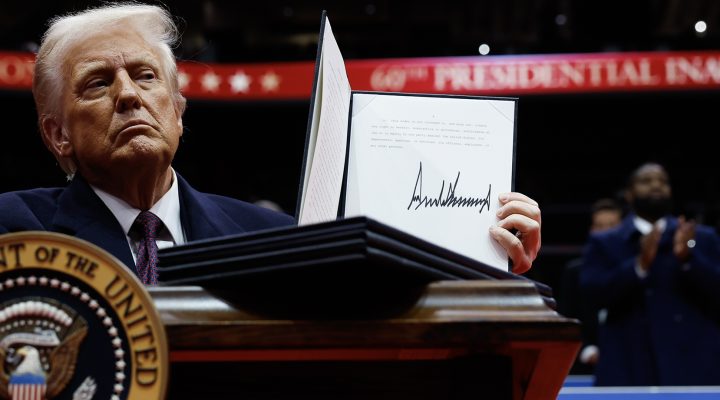
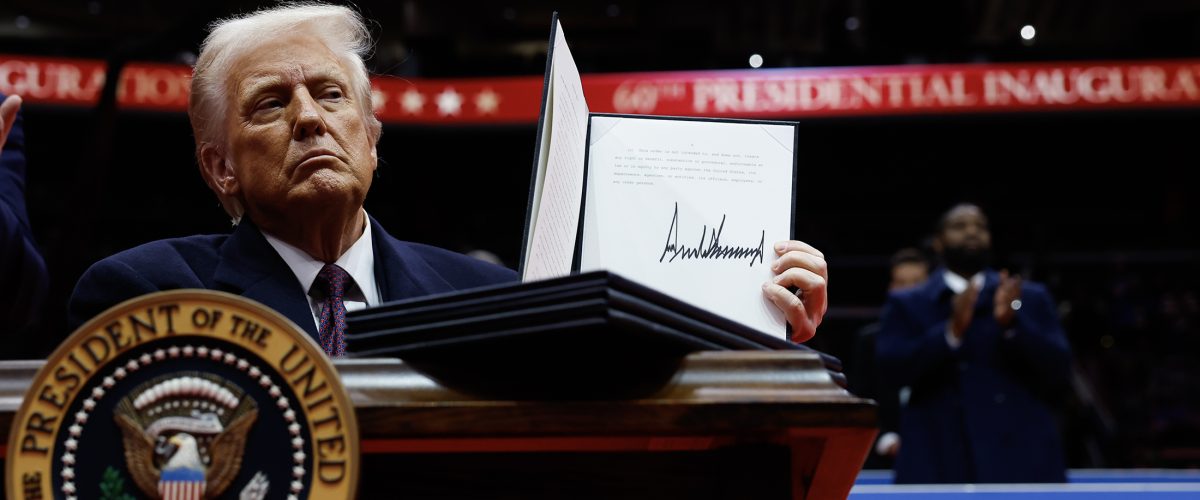
Others of Trump’s retributive actions have bordered on the petty, as demonstrated by the very first presidential proclamation he signed shortly after being sworn in on Jan. 20 of this year. (Yes, it’s turning into a very long year.)

Stan Hastey
Annoyed that U.S. flags were flying at half-staff for his inauguration, he signed a proclamation hours after his swearing-in mandating that all flags be raised to full staff immediately. Hereafter, the proclamation declared, flags flown will be at full staff for every presidential inauguration. House Speaker Mike Johnson, in defiance of the U.S. Flag Code, already had ordered flags flying at the Capitol to be raised for Trump’s inaugural festivities. Trump’s proclamation did allow flags to be returned to half-staff at midnight on Jan. 20 in continued commemoration of President Jimmy Carter, who had died at age 100 last Dec. 29.
The nonpartisan Flag Code stipulates the U.S. flag will be flown at half-staff for a 30-day period to honor the memory of a deceased current or former president over all federal buildings and their grounds, as well as at U.S. embassies and other facilities abroad, including military installations and vessels at sea. In Carter’s case, flags were not to be lowered until nearly 10 days past Trump’s inauguration, presumably including that day.
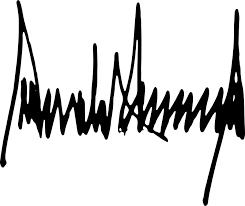
Trump’s initial proclamation on the flag matter, as well as on more than 130 executive orders he has signed during the first 100 days of his second term, bear his distinctive and inimitable signature, made in long, thick strokes with Newell Brands Sharpies that often are virtually illegible. A question I’ve been wanting to ask since Trump’s first term is, what gives with the pen and that autograph?
Analyzing Trump’s signature, while perhaps not a purely scientific venture, nonetheless has proved irresistible to handwriting analysts. Although the Dewey Decimal System at the Library of Congress earlier classified graphology as among the “occult sciences,” in 1980 that moniker was dropped and graphology was moved to three different fields in the classification system — forensics, human resource personnel selection and diagnostic psychologies — as noted by Valerie Weil, a handwriting analyst based in Pittsburgh.
As quoted in HuffPost, Weil said of Trump’s autograph: “The main thing that I see in his signature is the impatience. It’s fast. It’s moving. He does not like to look back. He does not like to have to double-check himself. He’s very insistent, almost to the point of arrogance.”
“Trump’s trademark signature screams narcissism, omniscience and omnipotence.”
More pointed was Tracey Trussell of the British Institute of Graphologists, who was quoted in London’s The Standard as saying: “Trump’s trademark signature screams narcissism, omniscience and omnipotence. The tall vertical representation shows obstinacy, inflexibility and a strong desire to have agency. This is enhanced and intensified by the rigidity and angularity of his pen strokes. It’s his way or no way.”
Although I’m neither a graphologist nor a psychologist, let alone a psychiatrist, perhaps we do well to consider some definitions, specifically those of “megalomania” and “narcissistic personality disorder.”
 The latter, according to the American Psychiatric Association, is characteristic of those who have a grandiose sense of self-importance, such as exaggerating their achievements and talents; are preoccupied with fantasies of unlimited success, power, brilliance, beauty or ideal love; believe they are “special” and can only be understood by other special or high-status people; require excessive admiration; have a sense of entitlement; take advantage of others to achieve their own ends; lack empathy, or are unwilling to recognize or identify with the feelings and needs of others; are often envious of others or believe others are envious of them; and show arrogant, haughty behaviors or attitudes.
As for megalomania, the American Psychological Association defines it as “a highly inflated conception of one’s importance, power or capabilities, as can be observed in many individuals with mania and paranoid schizophrenia. In the latter, megalomania is often accompanied or preceded by delusions of persecution.”
All of which brings me to the cover of the June issue of The Atlantic, the oldest continuous journal in publication in the country. In the latest issue’s cover story, based on an interview with President Trump in the White House earlier this month and written by staff writers Ashley Parker and Michael Scherer, some quotes virtually jump off the page.
Asked how his second term has differed thus far from his first, Trump replied: “The first time, I had two things to do — run the country and survive; I had all these crooked guys. And the second time, I run the country and the world. I’m having a lot of fun, considering what I do. … You know, what I do is such serious stuff.”
Trump likes to say he is our retribution. One fears we are becoming his.
Stan Hastey served as Baptist Press Washington bureau chief during the presidencies of Jimmy Carter and Ronald Reagan and covered the three inaugurations of the 39th and 40th presidents.
Related articles:
Will the Real Donald Trump please stand up? | Opinion by Stan Hastey
Heritage Foundation leader sees Trump’s first 100 days as ‘glorious’