


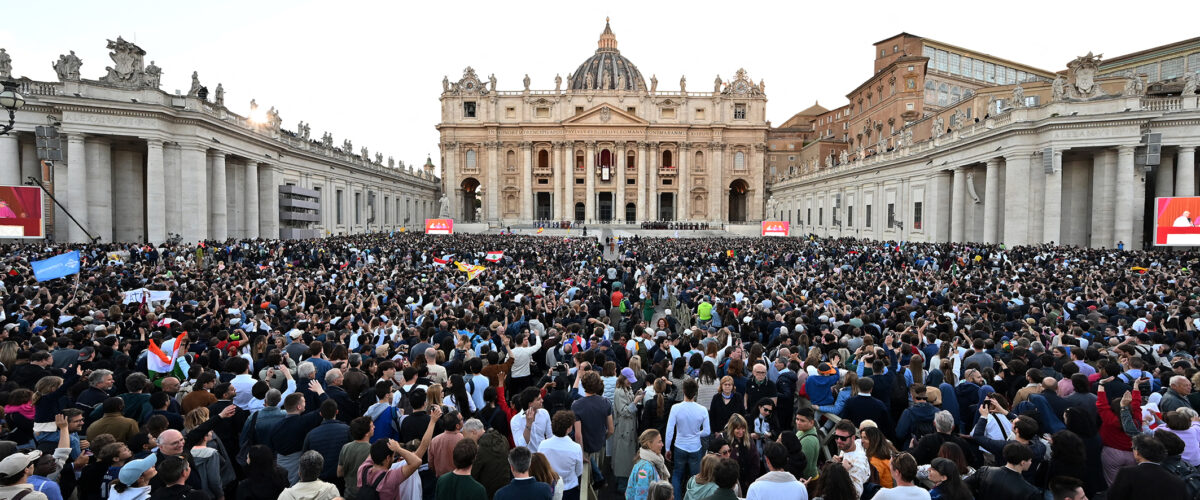
In what seems to be an act of surprising confidence and agreement, the College of Cardinals came to quick agreement on the second day of this week’s papal Conclave to launch white smoke from the Sistine chapel. Thousands gathered outside St. Peter’s Basilica on Wednesday, with sirens blaring, flags waving and helicopters hovering overhead, as billions waited to hear the news of the newly elected Roman bishop — whose leadership will usher in the next decade of the Catholic Church.
On May 8, at 12:13 p.m. U.S. Central Time, Pope Leo XIV, also known as 69-year-old Chicago-native Cardinal Robert Francis Prevost, was introduced to the world as the first American pope.
His chosen name points to a connection to Pope Leo XIII (1878-1903), whose leadership sparked many of the Roman church’s most valuable commentaries on Catholic social teachings and could signal a focus on morality and justice.
Betting on the outcome of a Papal Conclave is always risky business. After one pope dies, Catholic cardinals have a habit of choosing a new leader of differing temperament or politics to shake things up. But in the aftermath of decades of financial and sex scandals, in addition to declining church attendance and political strife, this new pope speaks to what the Vatican wants to fix and prioritize.
“Betting on the outcome of a Papal Conclave is always risky business.”
In the 16 days since Pope Francis died, there has been much contention about who can lead the church under these conditions. However, the quickness of the conclave suggests confidence in Pope Leo’s ability to lead the Roman church.
The New York Times describes him as temperamentally “reserved and discreet,” with a strong record within the Vatican. He’s seen by many as a “dignified’ choice who is committed “to the poor and migrants and to meeting people where they are,” and whose experience serving in Peru has given him a strong global vision of the church.
Pope Leo XIV’s selection won’t be without controversy. The Survivors Network of Those Abused By Priests sent a letter to the Vatican in March arguing his record of handling priests alleged of sexual abuse under his leadership has been weak, and alleging he showed “inaction” against two accused priests. His defenders have alleged actions were taken within the relevant dioceses or were not acted upon due to lack of evidence or expired statutes of limitations.
Overall, Pope Leo’s selection has sparked excitement, with much of the coverage focusing on his American background and moderate views, which could signal a desire for a quieter papacy. He’s a continuity candidate, a Vatican insider, a moderator.
This could be what the Roman Church needs after decades of controversy, or it may be viewed as insufficient.
Robert Barron, Catholic bishop of Rochester, Minn., and host of the popular “Word On Fire Ministries,” said before Conclave a pope’s mission is to be above politics, to be the figure of final authority and unity for 1.4 billion Roman Catholics, which means he needs to be an impartial referee for controversies to keep the life of the church in motion.
“What’s bugging me a bit as I read all these accounts leading up to the Conclave is this politicization of it: Left or right? Are they for climate change or against it? Are they for migration or against it? Look, the gospel has moral considerations and those have to be expressed sometimes in political terms on which we debate. But to be focusing on this particular political matters, what ultimately matters is whether you’re in love with Jesus Christ. … What (am I) looking for in a pope? Somebody who loves the Lord Jesus Christ and who can proclaim in a convincing way to our contemporary culture the resurrection of Jesus from the dead.”
Even if he meets that bill, Pope Leo ultimately will have a global influence on issues of climate change, social justice, migration and institutional trust within the church. That’s the nature of the job.
Tyler Hummel is a Wisconsin-based freelance critic and journalist, a member of the Music City Film Critics Association, a regular film and literature contributor at Geeks Under Grace, and was the 2021 College Fix Fellow at Main Street Nashville.
Related articles:
Pope Leo XIV is likely to continue the Francis agenda
The ancient and modern politics behind choosing a pope | Analysis by Kristen Thomason
Dividing lines at Catholic Conclave may be different than you expect
Remembering the ‘People’s Pope’ | Analysis by Steven Harmon