



Years attending and later working at Christian summer camps left Cara Meredith feeling somewhat ambivalent about letting her own children experience what is essentially an evangelical rite of passage.
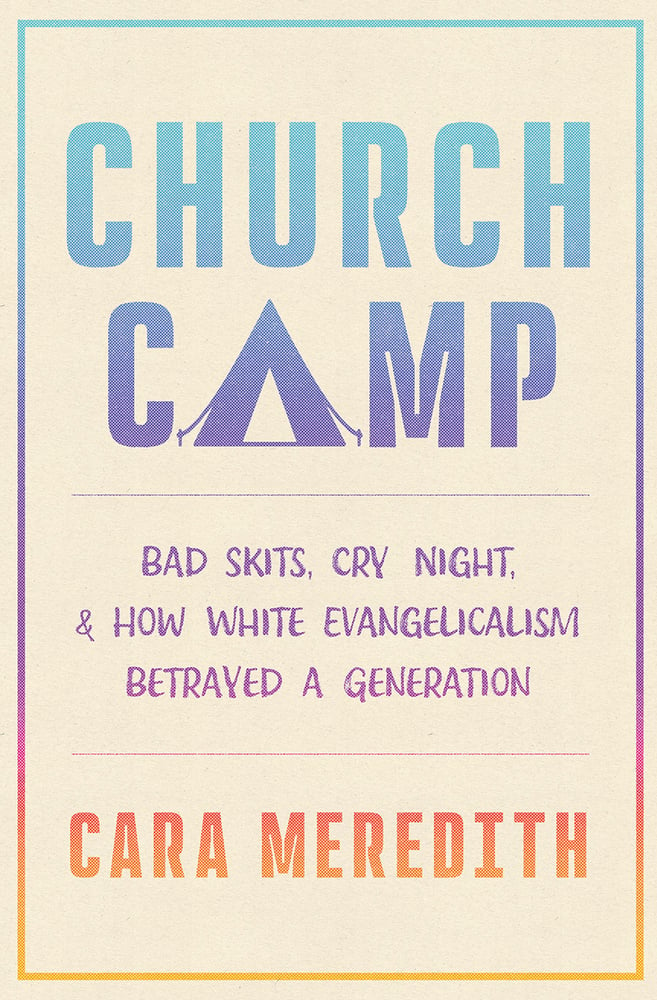
So perplexing was the question that it helped inspire her new book, Church Camp: Bad Skits, Cry Night & How White Evangelicalism Betrayed a Generation.

Cara Meredith
Meredith, a writer and speaker, attended Camp Arrah Wanna, an American Baptist Churches in the USA facility outside Portland, Ore., in the late 1980s before serving four years as a ropes course instructor, lifeguard and program director for an Evangelical Covenant Church camp in California. She went on to serve as a speaker for a number of different nondenominational and denominational camps, including Young Life in California, Oregon and Washington beginning in the 2000s.
While cherishing the experiences, Meredith said she acknowledges the camps were a fit for her in part because she was white, heterosexual and adhered to the emotional and performative attributes expected at evangelical summer camps.
At the launch party for the book, she was asked, “Will you send your own kids to camps like these?”
Her answer: “I think they would have an incredible time, but they are biracial and they identify as biracial, Black or mixed race, so I’m not convinced many of these camps would be as welcoming to them as they were for me.”
Still Church Camp is not a hit piece designed to tear down Christian camps. “I write about the things I loved about camp because I love camp. And I criticize camp because I love camp,” she said.
The good
Part of the project explores the genuine fellowship and belonging Meredith found during her years attending and leading camp.
“Camp was the place I felt most at home, the place where the most authentic version of me came out to play. It was the place I became my silliest and, perhaps, most real self,” she writes.
It’s also where she most deeply felt the presence of God, and where the natural surroundings imparted peace and an experience of the holy. “In more ways than one, camp was who I’d always been. Camp defined me. Camp gave me life, for camp was ultimate life to me. Until it wasn’t anymore.”
The bad
But some negative camp encounters here and there, followed by time and motherhood, ushered in a season of spiritual reflection and questioning that brought doubts about the transactional and performative faith reinforced in those periods away from home, Meredith explains.
“And nowhere have I also mourned the damage done to others and the damage done to me, too often in the name of Jesus — for the things we thought stood for Jesus — as we sheltered under the umbrella of white evangelicalism. Church camp has been the source of some of my deepest hurts, just as it has been the foundation of some of the sincerest kindnesses and generosities I have ever known.”
 Meredith said she interviewed nearly 50 other former campers and counselors, in part because one of her intended audiences includes people who can identify with the stories shared in the book.
“But my first audience is a post-evangelical audience, those who once identified as evangelical or now identify as exvangelicals. It doesn’t mean they had to have been a camper or worked at a camp to connect with the ideas I present in the book,” she explained.
She defines it even further in a Substack published ahead of the April release of Church Camp.
“It’s for those of us who swallowed lies about purity culture and about a version of God we believed wholly male (and wholly white). It’s for those of us who thought we killed Jesus, because twisted and warped versions of the gospel manipulated us into carrying such a weight on our shoulders.”
Cry Night
Meredith’s chapter titles reveal much about what was right and what was wrong about camp, including “God the Mostly Father,” “Superhero Jesus,” “Dirty Rotten Little Sinners” and “Now Go and Live the (White) Way of Jesus.”
The chapter “Cry Night” delves into the ritual of making emotional decisions to follow Jesus.
“We all knew what was coming: conversations with God, alone, out on the wide, expansive field or perhaps with our counselors and our cabinmates,” she writes. “Decisions to follow Jesus and recommitments to follow Jesus and vowed promises to remain true to Jesus in the year ahead (or at least until the next year at church camp, when the spiritual calendar started all over again). And tears, lots and lots of tears.”
“This particular evening tends to go down in the history books … as inauthentic and performative, a manipulative deluge of grace.”
As a speaker, Meredith’s job on those nights was to ensure campers understood “why their villainous scalawag selves needed God to kill his Son: Because God loved them!”
Looking back, she adds, “This particular evening tends to go down in the history books of Baptist and Presbyterian, Assemblies of God and Methodist church camps not as one of holy intimacy with darkness and light but as inauthentic and performative, a manipulative deluge of grace.”
The camps also hammered home purity culture teachings, sometimes so intensely that one of Meredith’s interview subjects compared camp to a seminar on 10 reasons not to have sex before marriage.
“Whether campers or staff members, the onus for young girls and women to protect their ‘brothers in Christ’ lay entirely on them — because in this movement, it was the woman’s body that caused the man’s mind to stray. And for a number of the women I interviewed, shame accompanied the perceived responsibility to uphold the values of purity culture,” Meredith writes.
She concludes with a discussion of how the invitation into conformity at church camps comes at the expense of racial identity: “The history of camping is one of exclusion rather than inclusion, most notably toward communities of color.”
“No matter how true and real and pure the gospel, camp itself remains a place of hate and trauma — and the longer camp remains unsafe for children of color, the longer it remains a haven for a majority white population.”