

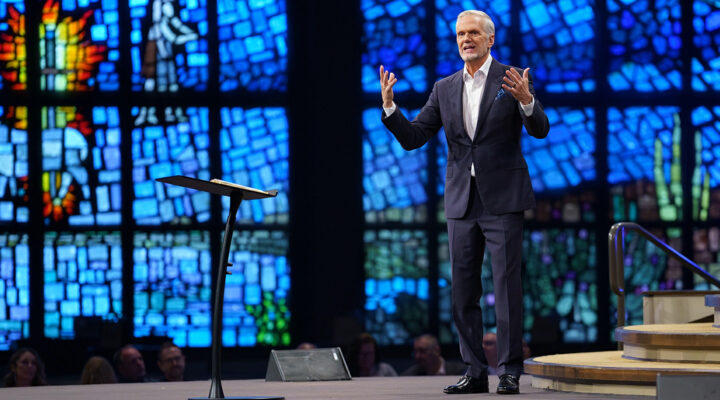

With his father and brother in the news for taking control of a Houston megachurch, Ed Young of Fellowship Church in Dallas is now hawking a downloadable Church Bylaws Kit for other pastors who desire to become Controlling Executive Officers.
Ed Young of Dallas is a son of H. Edwin Young, longtime pastor of Second Baptist Church in Houston. A group of members recently formed a corporation to sue their church’s leaders for what they consider an illegal change in bylaws that gave the elder Young the power to name another of his sons, Ben Young, his successor without a search committee or congregational vote.
Some of the ideas embodied in the controversial new bylaws at Second Baptist Houston are found also in the 37-page Church Bylaws Kit.
Ed Young of Fellowship Church in Grapevine, Texas
For any pastor interested in an authoritarian model of church governance, Young’s kit will serve as a godsend. Here is a full U-turn away from good-faith participation in the congregational autonomy model of Baptist polity.
Critics say this is the surest way to steal a Baptist church. The steps are easy:
- Have a secret meeting of the senior pastor and a few of his friends to draft the new bylaws.
- Give as little time as possible and as little input as possible before asking the church to approve the new bylaws.
- Appoint the senior pastor as the leader.
- Appoint three of the pastor’s most loyal friends to the new board of directors, which may take various names.
- Place all authority in the hands of the senior pastor and the board of directors.
- Dismiss all authority for church deacons.
- Cease congregational business meetings and no longer allow members to vote on any business.
There’s nothing original here. Calvinist Baptists in the Southern Baptist Convention and the American Baptist Churches USA should sue Young for plagiarism. In the early 2000s an executive minister of ABC USA offered a training seminar for how a church could become an elder-led congregation. As moderator of the Dayton Area Baptist Association, I attended the one-day workshop.
The process seemed relatively easy. All a church had to do was surrender every Baptist principle of the last 400 years — congregationalism, priesthood of the believer, the power of the laity, democratic polity — and become basically a four-piece band. The senior pastor serves as the lead singer and the three other members of the quartet are the backup singers.

Edwin H. Young preaching at Second Baptist Houston Feb. 25, 2024.
Comparing to Calvinist elders
As I read Young’s document, I couldn’t tell the difference between Fellowship Church bylaws and the bylaws of any neo-Calvinist Baptist Church in the SBC. I compared Young’s document with the bylaws of Grace Baptist Church Coral Gables, Fla. The senior pastor of Grace is Tom Ascol. The church bylaws are available at www.truegraceofgod.org.
Young’s proposed bylaws are even more restrictive and less congregationally democratic than Ascol’s.
Young’s proposed bylaws vest “plenary power” to manage and govern the church in the board of directors. When a Baptist church polity sounds more like a corporation than a local church, I have Baptist questions. The key to understanding “plenary power” is this: The congregation does not vote. The board of directors will consist of three to nine people, who are not required to be residents of the same state.
“The senior pastor becomes CEO and chairman of the board.”
The senior pastor becomes CEO and chairman of the board.
From Young’s template: “All corporate powers are to be exercised by or under the authority of the Ministry Leadership Team. The senior pastor is a designated member of the Ministry Leadership Team and is thus a designated director of the board. The Ministry Leadership Team is assigned the rights, powers and responsibilities of a board of directors pursuant to the appropriate laws of the state in which the church is incorporated, which in the case of the bylaws set forth in the appendixes, are found in the Texas Business Organizations Code.”
The senior pastor chooses the other members of the board and officers. There is even an attempt to connect this power to Scripture, citing Acts 14:23 and Titus 1:5.
Acts 14:23 reads: “And after they had appointed elders for them in each church, with prayer and fasting they entrusted them to the Lord in whom they had come to believe.” Titus 1:5 says: “I left you behind in Crete for this reason, so that you should put in order what remained to be done and should appoint elders in every town, as I directed you.”
The attempt to equate first-century church hierarchy with a local congregation seems a bit like twisted exegesis. The New Testament has various offices: bishop, presbyter, elder, deacon. Christian denominations have engaged in a picking and choosing the offices that best serve their needs. Any attempt at a definitive biblical stamp of approval on one form of church polity is an exercise in futility.
Senior pastor power
Young’s proposed bylaws make frequent reference to the controlling power of the senior pastor: “The senior pastor shall serve as the chairman of the Ministry Leadership Team and shall be present and preside at all Ministry Leadership Team meetings.” Further, the senior pastor shall nominate people he deems qualified to serve on the Ministry Leadership Team.
Thus, the senior pastor becomes the Nominating Committee, the Personnel Committee and the Pastor-Parish Relationship Committee. The senior pastor hires and fires all staff with or without cause.
“This is an unmitigated quest for power by a preacher willing to violate Baptist autonomy.”
Young’s model attempt to give this exercise of power the validation of the New Testament. For example, “The senior pastor of the church is responsible for leading the church in accordance with biblical principles as set forth in the New Testament. … As such, the senior pastor shall be the leader of the church congregation, the church staff, all church organizations, all church ministries, the Ministry Leadership Team, and all church advisory teams, to accomplish the New Testament purposes of the church. The senior pastor is expressly authorized to do all things necessary and proper to fulfill the above-described leadership position and to fulfill all duties incident to the office of president.”
Young’s bylaws make clear the full authority of the senior pastor and the Ministry Leadership Team. They “shall have final authority for affairs pertaining to property and other temporal matters as required by civil law for nonprofit corporations. In particular, the Ministry Leadership Team shall be responsible for the acquisition and disposition of church property, which includes the management of its financial resources. The Ministry Leadership Team shall have the power to buy, sell, mortgage, pledge or encumber any church property and incur related indebtedness.”
The bylaws specify regular and special meetings of the Ministry Leadership Team but there is no mention of congregational meetings. The congregation, for example, will not have a meeting to discuss the sale of purchase of property, the approval of the annual budget, or the appointment of a new senior pastor.
The bylaws specify the selection of the senior pastor as a responsibility of the board of directors: ‘The Ministry Leadership Team shall act as the Senior Pastor Selection Team. The Senior Pastor Selection Team may, in the course of its search for a new senior pastor, consult with officers, pastors and/or employees of the church.”
Young can dress his bylaws in angelic costumes; give them wings and flaming swords. He can quote Scripture verses alleging pastoral authority. He can piously intone he’s only doing what God commands him to do. But this is an unmitigated quest for power by a preacher willing to violate Baptist autonomy and push Baptist churches into an authoritarian hierarchy that makes the Catholic Church look like a democracy.
This is spiritual demagoguery.
Life is more interesting when your congregation can, at any monthly business meeting, have a deacon make a motion to fire the pastor. Long live the power of the laity. May God’s people never be tamed by a bunch of authoritarian power grabbers.
Rodney W. Kennedy is a pastor and writer in New York state. He is the author of 11 books, including his latest, Dancing with Metaphors in the Pulpit.
Related articles:
Houston lawsuit is a tale of pastoral succession, megachurch wealth and family dynasty
87-year-old Ed Young steps down at Second Baptist Houston, to be succeeded by his son
Why is there a growing trend toward elder governance in Southern Baptist churches? | Analysis by Rodney Kennedy