

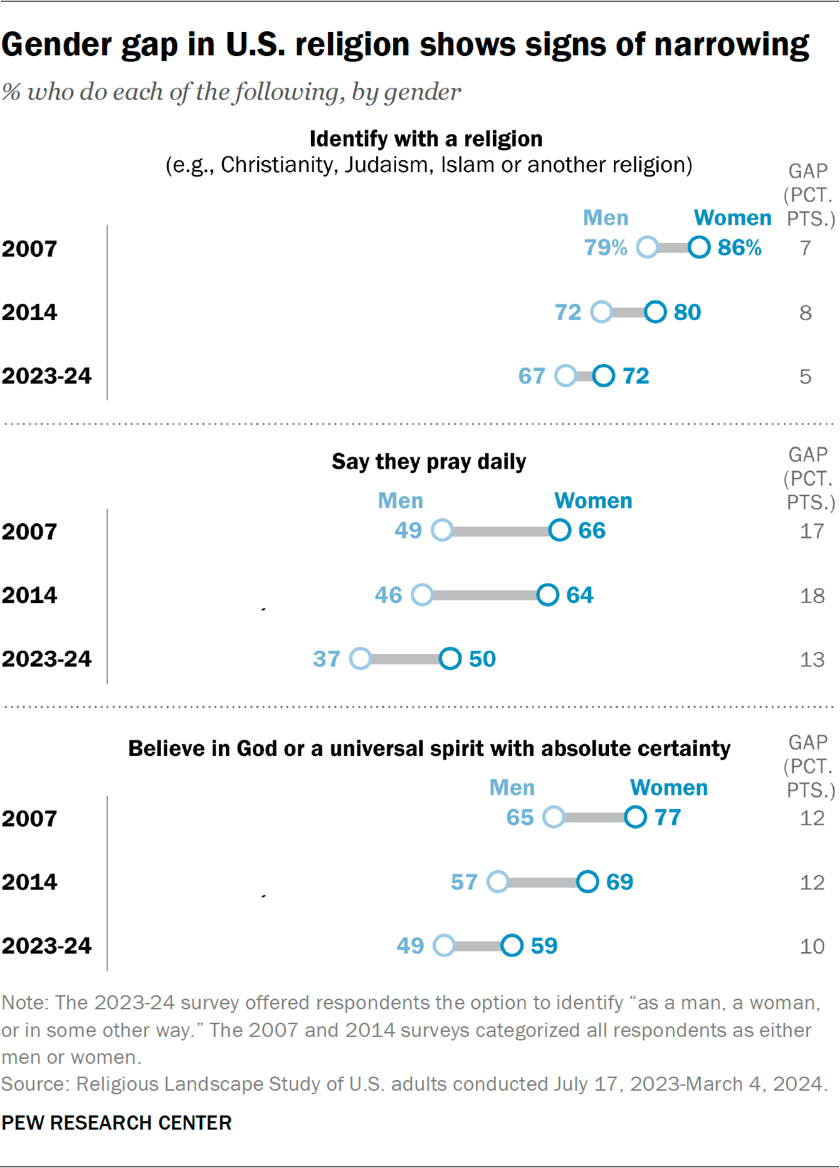
American women remain more likely to be religious than men, according to Pew Research Center’s Religious Landscape Study.
The study aligns with other research on gender and religion: Women have consistently been found more likely to be religious than men, in America and many other countries.
One contrary trend, as widely reported this year, is that young Gen Z men are now more religious than their female peers. They attend services more often and are more likely to identify as religious. More Gen Z Christian men are staying in church, while more Gen Z women are leaving.
That trend is found among those who identify as Christian to begin with.
Yet among all adults nationwide, women remain more likely than men to embrace religion.
 According to the 2023-24 Religious Landscape Survey, 66% of women identify as Christian while only 59% of men do. Men are slightly more likely to identify with other religions, with 8% of men and 6% of women having a non-Christian religious identity. However, women are still more likely overall to be religious.
Women also are much more likely than men to pray daily. The data show half of all women report praying at least once per day, compared to 37% of men.
Aligning with their greater disposition toward religious identity and spiritual practices, women say they feel a sense of spiritual well-being more often than men. Among survey participants, 45% of women and 35% of men reported having a sense of spiritual well-being once a week or more.
 Likewise, 29% of men say they seldom or never feel a sense of spiritual peace and well-being. Only 20% of women reported this.
The Pew study does not attempt to explain why women are more religious than men, but sociologists disagree on the issue. Some theorists say male testosterone causes men to feel more comfortable taking risks without needing spiritual guidance. Others say gender roles make women more comfortable submitting to an authority figure than men.
Whatever the reason, the trend of higher spirituality among women has remained consistent over time, the survey found, even as tendencies for Americans to identify as religious continue to decrease.
While the Pew study examined gender, it did not isolate attitudes and practices among those who are transgender, nonbinary, intersex or gender nonconforming. The most recent survey did ask participants to identify as either heterosexual, lesbian/gay (paired together) or bisexual.
 In previous studies, Pew found lesbian and bisexual women tend to be slightly more religious than men. But among the gay and lesbian community, about half (34%) as many identify as Christians than among the heterosexual community (66%). Christian identity is even lower among those who identify as bisexual (27%).
Likewise, only 33% of lesbian and gay Americans say they are “religious,” compared to 60% of heterosexual Americans.
However, when the question was asked differently, the gap between gay, lesbian and bisexual Americans versus heterosexual Americans narrowed significantly. Asked if they consider themselves “spiritual,” 68% of gays and lesbians said they are very spiritual or somewhat spiritual. That’s only a few points behind heterosexual Americans who said they are “spiritual.”
Related articles:
6 in 10 US adults say they’re Christians
Landmark study documents religious faith of LGBTQ Americans