

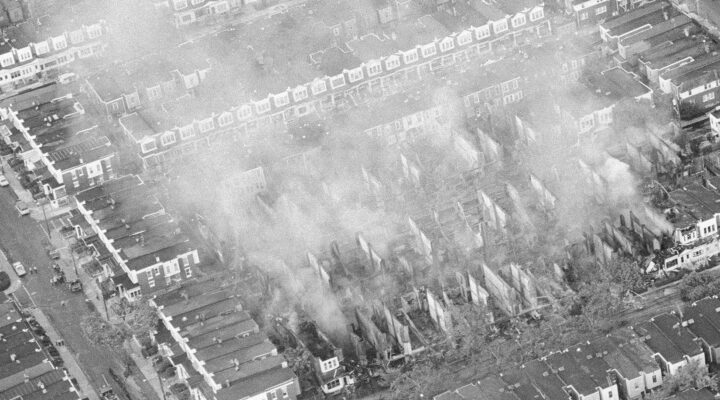
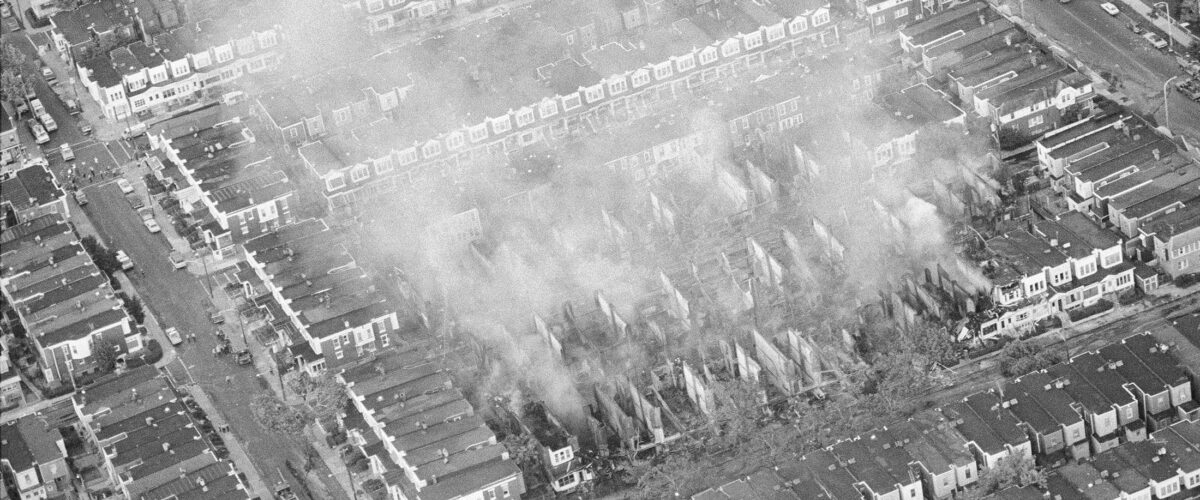
Forty years ago, on May 13, 1985, a tragedy unfolded in the Cobbs Creek section of West Philadelphia that would forever scar the conscience of a city and shock the world.
On that day, the Philadelphia Police Department — under the approval of city officials, including Philadelphia’s first Black mayor, Wilson Goode — dropped a military-grade bomb on a residential row house occupied by members of MOVE, a radical Black liberation and environmentalist group.

Edmond W. Davis
The fire from that bomb raged unchecked for hours. It was not only permitted to burn, it was weaponized. Eleven people, including five children, perished in the flames. Sixty-one homes were destroyed, reducing an entire Black neighborhood to smoldering rubble. And yet, not a single police officer or government official ever was held criminally responsible.
I was 9 years old. I remember it like yesterday. Our address at the time was 5822 Chestnut Street. I remember the vibrations of the helicopters, the thunder of sirens, the thick, choking air as smoke floated over the blocks. I remember the name Ramona Africa — the lone adult survivor — and how she became a familiar face throughout West Philly in the following years. I saw her at events, sometimes just walking down the street, always carrying the weight of a history the city tried to forget.
But some of us never could forget.
A government that bombed its own
The MOVE bombing is not just a moment in Philadelphia history; it is a national symbol of state-sponsored violence against Black people, post-slavery but after American police dropped bombs on other American citizens in Tulsa’s Black Wall Street District in 1921. It symbolizes the failure of leadership even under the cloak of progress and how systemic racism can endure in Black faces, Black offices and Black titles.
Mayor Wilson Goode, either authorized or not, allowed a war tactic to be used on a community of civilians, in the city of brotherly love. His leadership — timid, bureaucratic, detached — offered no moral resistance to the police department’s militarized madness. The Philadelphia Fire Department, in collusion with the police, allowed the fire to burn unchecked. They didn’t just fail to save lives, they helped destroy them.
“The Philadelphia Fire Department, in collusion with the police, allowed the fire to burn unchecked.”
This was on Wilson’s clock, but the dereliction of duty by police and fire departments reminded many of the days of Frank Rizzo, a racist police commissioner, then mayor.
This was more than a tactical error. It was a moral collapse. It was the state declaring war on a family and a neighborhood, and in doing so, it told every Black child in West Philly their lives, their homes and their futures were expendable.
What was MOVE?
MOVE wasn’t perfect. The group — founded by John Africa — was radical, uncompromising and confrontational.
Their neighbors often complained about trash, loudspeaker rants and an ideology that rejected modern institutions. But MOVE’s beliefs in natural living, environmental justice, anti-police brutality and systemic Black liberation were rooted in a long history of Black resistance.
They were surveilled, harassed and, in 1978, involved in a standoff where an officer died. After that time, the city sought to eradicate MOVE by any means necessary. In 1985, it did. And it used a bomb — on American soil, against American citizens, on a residential street.
A city’s darkest day
There’s no way to frame May 13, 1985, as anything but a domestic war crime. The images of children burned alive. The testimonies of neighbors screaming for help. The intentional refusal to extinguish the flames. It wasn’t just a physical fire; it was the fire of indifference.
No apology can undo that. No reparations (which came late and insufficiently) can rebuild what was erased. This was not just a policy failure. It was an expression of American racial hierarchy in its rawest, most violent form. And it happened with a Black mayor in office. Let that sink in.
A former homeless kid reflects
In 1986, a year after the bombing, I became homeless. I slept at 30th Street Station, in basements on Haverford Avenue, and eventually in Coatesville. I was that kid who could still smell the smoke of Osage Avenue on my walk to school. I was that kid who learned the system would rather destroy you than deal with you.
Now, I’m a global speaker, an Amazon No. 1 author, and a retired history professor. But I carry that day in my bones. I speak today not from the lens of comfort in Arkansas, but of memory from that day in Philly.
There is a fantasy that’s becoming a reality in our American fabric. That illusion is that this MOVE is only a footnote of history as it makes the provocateurs look bad, but it’s the truth and it must be told.
What did we learn?
Sadly, too little. The MOVE bombing has been sanitized, ignored or taught with caveats. Even with documentaries, commissions and apologies, there is no systemic curriculum in schools — especially in Philadelphia — that unpacks the significance of this tragedy.
What could we have learned?
- The dangers of police militarization: Law enforcement with military weapons will treat communities like war zones.
- The risk of government overreach: When the state decides a group is undesirable, it will bend or break its own laws.
- The importance of community belonging: MOVE wasn’t just a fringe group; it was a symptom of a larger struggle by Black people to be seen, heard and left to live freely.
- The myth of representation as salvation: A Black mayor did not stop a Black neighborhood from being bombed. Representation without radical accountability is not justice.
A new curriculum for the people
It is not too late. The School District of Philadelphia — and school districts across the U.S. — need to create a dedicated curriculum that teaches students about the MOVE bombing in its full, raw truth.
This should not be buried in a footnote. It should be a semester-long case study in:
- Police-state behavior in urban Black communities
- What government overreach looks like in real time
- The failure of leadership and complicity of silence
- The humanity of people deemed “radical”
- The importance of civic resistance and historical memory
And let’s make this clear: This isn’t about diversity, equity or inclusion slogans that politicians love to defund. This is about survival, truth and healing. It’s about belonging — something we’re told we have but are shown we don’t.
May 13, 1985, was Philadelphia’s darkest day. But it doesn’t have to be its last lesson. As a former West Philly kid who rose from homelessness, jail and failing at fourth grade to speak globally, I’m calling on Philly’s leaders, educators and citizens: Don’t let the fire of MOVE die in vain. Lets learn in-class lessons from past pain.
Make it a torch for truth.
Edmond W. Davis is a nationally known social historian, retired college professor, international journalist and global speaker. He was born and raised in West Philadelphia.