



As someone who has fond memories of watching the original Star Wars in the theater, I will confess I am drawn to the meme of Star Wars stormtroopers in their off hours — hanging in the break room, eating lunch, talking about the weekend. It’s a take on these foot soldiers of the Empire that emphasizes their humanity and reminds us we are connected to them in more ways than we might like.
Cosmic evil requires assistance to carry out its ends. In story after popular story — The Lord of the Rings, The Hunger Games, Harry Potter and many others — mortal forces enable the big bads, your Dark Lords, President Snows, White Witches.

Greg Garrett
When we watch Star Wars, when we read Harry Potter, those distinctions seem crystal-clear. I’ve taught Harry Potter at Baylor for some years now, and none of my students has ever idolized Lord Voldemort. None of my students has ever argued that Katniss Everdeen in The Hunger Games tales is anything other than courageous and admirable, or that Cato, Brutus and Enobaria in those stories are anything but reprehensible tools of the state and President Coriolanus Snow.
The human villains in our stories are the ones serving Empire or ultimate power, the ones standing by while human rights and human hopes are crushed (or actually crushing them!), leaning into violence against those who just want to live and love and build a future.
“Our awareness of right and wrong is pretty close to absolute when we see it on the screen or on the page.”
Our awareness of right and wrong is pretty close to absolute when we see it on the screen or on the page. Nobody in the pews on Sunday morning thinks, “I am digging these Pharisees!” One of the reasons great films, novels and shared stories are valuable is because they let us step away from our own moral starting lines and observe the ethical choices of their characters without having to identify with them.
As C.S. Lewis observed, stirring stories let us steal past the waking dragons of reason, and that’s why they are among our most powerful tools for moral transformation.
But there is something deeply disturbing about the fact that so many in the West — MAGA trolls, Brexit supporters in the UK, adherents of the former National Front (now Rassemblement RN) in France — are able to easily identify and loudly root against the cinematic evil represented by stormtroopers, Hunger Games sadists and Death Eaters, but seem unable to recognize that they have become the allies of tangible racism, sadism and exploitation by cleaving to their political leaders and movements.
How does this happen? In both my James Baldwin and Harry Potter classes this semester, we concluded what we were seeing was an existential choice between love and fear.
Love calls us to sacrifice, to embrace courage and hope. It’s no accident that the Christian testament is full of admonitions not to be afraid.

Young Harry Potter sees Lord Voldemort’s face in the first of the “Harry Potter” films. (Image via IMDB)
Fear, on the other hand, pushes us into a dark space where it becomes harder to make good moral choices. Yoda tells the young Anakin Skywalker (eventually Darth Vader): “Fear is the path to the dark side. Fear leads to anger. Anger leads to hate. Hate leads to suffering. I sense much fear in you.”
Many of our fellow Americans (and I suspect those who’ve embraced fascistic or limiting regimes of policies elsewhere in the world) have done so out of fear. Even those who identify as Christian have forgotten how Jesus promised, “My peace I leave with you.” They look around the world, they see difference, they feel indifference, and the moral ground shifts beneath their feet.
“They would wince if they watched a Bond villain and his minions doing onscreen some of the things we see happening daily in our country.”
They would wince if they watched a Bond villain and his minions doing onscreen some of the things we see happening daily in our country. But they feel, somehow, safer for the violence, safer for the deprivation of some scapegoat’s rights, safer bowing to some strongman or dark lord whose power, they imagine, extends over them like an umbrella. Since the violence is directed at others, they can believe they will be safe, and their fears can be soothed.
The choice between love and fear explains much, but so, too, does the moral compromise that comes when one’s day-to-day existence depends on evil being minimalized or compartmentalized.
The Jewish philosopher Hannah Arendt spoke of the “banality of evil” in her New Yorker articles and book on the Nazi war criminal Adolph Eichmann. As in the 2024 film Zone of Interest, set within the zone of evil, if you will, of Auschwitz, we always wonder how and why “ordinary people” acquiesce to the very clear immorality of the regimes that govern them. And yet, in every era, they manage.
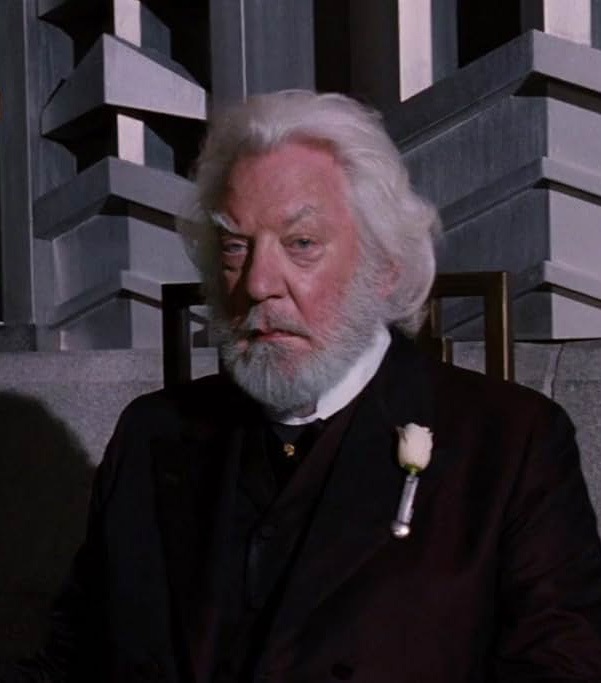
President Snow in “The Hunger Games.” (Image via IMDB)
Sauron, President Snow, He Who Must Not Be Named, the White Witch, the Sith Lords, the Ringwraiths, the Children of Thanos — all of these are notably and theatrically evil characters. There is nothing banal about their murderous, power-hungry natures, which is why it so easy for us to identify on the screen. They’re stylized, vicious, they kill and destroy without thought or hesitation. The movie soundtracks call out their dark natures in dissonance and minor chords.
But we all see actual leaders today who are not supernatural figures of evil but who daily commit or call for evil acts.
I’m a believing Christian, but believing Jews, Muslims, Buddhists, Sikhs and moral atheists can likewise distinguish actions that represent the best of our humanity and those that demean it. When anyone is victimized, when violence becomes a tool of a regime, when people disappear without their human rights being considered, when children are left to starve or die for lack of medical intervention, we all know we are witnessing evil.
Or we should.
So what accounts for people saying yes to evil pogroms and unknowingly becoming stormtroopers? Normalization of the demeaning and the immoral, normalization of hate and hate speech, the willingness to accept this new normal rather than offer moral resistance.
Critic Patrick Ryan said Zone of Interest is about the darkness inside all of us, about how “ambient genocide” can become the water in which we swim. Southerners of a certain age speak of ambient racism as being unquestioned in their youth, and some are only now, more than half a century after Jim Crow, understanding they were complicit in the evil deeds of a Strom Thurmond or George Wallace or of the White Citizen’s Councils.
Many are realizing whether they actively screamed at Black children outside elementary schools, or simply failed to stand against sinful government actions, rules and social mores, they had put on the white helmet, accepted the Death Eater’s tattoo, agreed to send others to destruction and death so they could enjoy a peaceful lunch in the break room.
“They are realizing they were Pharisees, not disciples.”
They are realizing they were Pharisees, not disciples.
But we serve a God of love and grace, and it’s never too late to embrace the right. I’m drawn to the character of Finn, who appeared in three canonical Star Wars films. He served as a stormtrooper for the First Order (a fascist survivor to the Galactic Empire) but couldn’t countenance the Order’s cruelty, switched sides, walked into the light.
I think also of the Christian saga, where a Roman soldier came to Jesus for healing, where a Roman centurion testified at Golgotha, “Surely this man was the Son of God.”
At heart, stormtroopers are just like you and me. They’ve made a choice that maddens or hurts us, but many of them still, deep down, believe in a loving God, a risen Son of God.
So what can we do? We can live personally with a self-awareness that informs integrity. We can call out evil where and when we find it. We can preach and teach the good news of the risen Jesus instead of the so-called good news of the Empire. And when we encounter friends or family members who have become stormtroopers, we can express our concern in love and ask them why.
Maybe after popcorn and a movie.
Greg Garrett is an award-winning professor at Baylor University, where he is the Carole McDaniel Hanks Professor of Literature and Culture. One of America’s leading voices on religion and culture, he is the author of 30 books, most recently the novel Bastille Day and The Gospel According to James Baldwin: What America’s Great Prophet Can Teach Us about Life, Love, and Identity. He is currently administering a major research grant on racism from the Eula Mae and John Baugh Foundation and finishing a book on racist mythologies for Oxford University Press. Greg is a seminary-trained lay preacher in the Episcopal Church and Honorary Canon Theologian at the American Cathedral of the Holy Trinity in Paris. He lives in Austin with his wife, Jeanie, and their two daughters.